‘The portals (of his nostrils)’ fixes a bodily sense that the bare words leave open. Legge argues for it overleaf from the Yi’s appendix, where the first term means the mouth; that is a fair warrant. With the nostrils supplied, par. 3 becomes advice on keeping the breath, and Legge takes it so; without them, it could equally counsel guarding the senses and speech.
The Tâo Teh King — Sacred Books of China Part I, SBE Vol. 39 (trans. James Legge, 1891)
Open to all
page 95
No image is selected for this page; its own page image is shown.
page 95
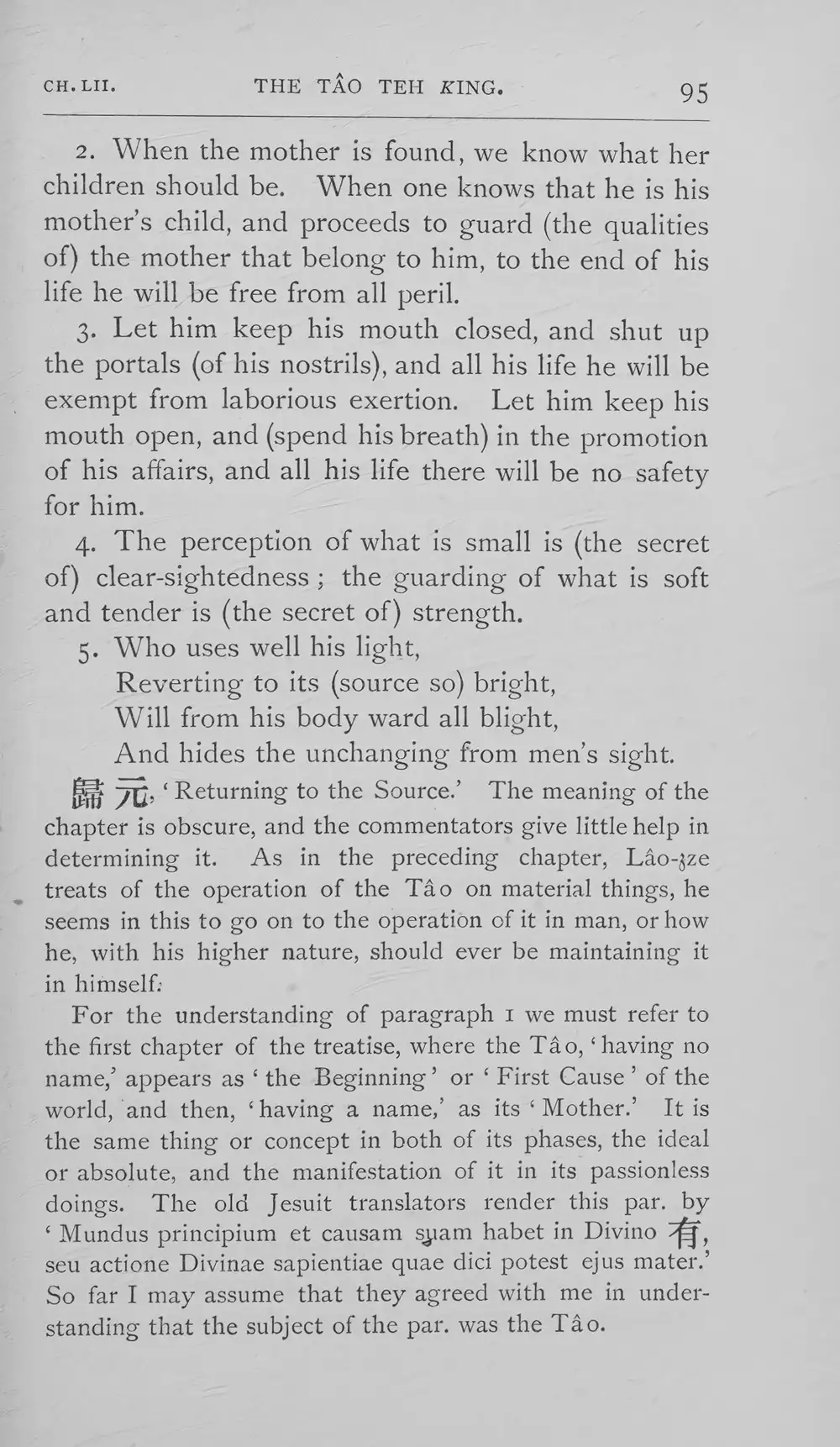
2. When the mother is found, we know what her children should be. When one knows that he is his mother's child, and goes on to guard (the qualities of) the mother that belong to him, he will be free from all peril to the end of his life.
3. Let him keep his mouth closed, and shut up the portals (of his nostrils), and all his life he will be exempt from laborious exertion. Let him keep his mouth open, and (spend his breath) on the promotion of his affairs, and all his life there will be no safety for him.
4. The perception of what is small is (the secret of) clear-sightedness; the guarding of what is soft and tender is (the secret of) strength.
5. Whoever uses his light well,
Returning to its (source so) bright,
Will ward all blight from his body,
And hide the unchanging from men’s sight.
歸元, ‘Returning to the Source.’ The meaning of the chapter is obscure, and the commentators give little help in determining it. As in the preceding chapter Lâo-ȝze treats of the operation of the Tâo on material things, in this one he seems to go on to its operation in man, or how man, with his higher nature, should always be maintaining it in himself.
To understand paragraph 1 we must refer to the first chapter of the treatise, where the Tâo, ‘having no name,’ appears as ‘the Beginning’ or ‘First Cause’ of the world, and then, ‘having a name,’ as its ‘Mother.’ It is the same thing or concept in both its phases, the ideal or absolute, and its manifestation in its passionless doings. The old Jesuit translators render this paragraph as ‘The world has its beginning and its cause in the Divine 有 [Press: being; existence], that is, in the action of the Divine wisdom, which may be called its mother.’ So far I may assume that they agreed with me in understanding that the subject of the paragraph was the Tâo.
Legge counts the old Jesuit translators as agreeing with him that the subject is the Tao, but their Latin places the world’s principle ‘in Divino’, in the action of a divine wisdom that may be called its mother. That is a Christian theology of the passage, of the kind Legge rejects in Rémusat (p. 57). The agreement is narrower than he claims: on the subject, not on what the subject is.