Legge calls Wang Pi’s 亭之毒之 a ‘strange reading’, then reports that the Nestorian Monument of Hsi-an quotes it of Heaven in the eighth century. That makes it more than a slip: the reading was current and authoritative enough to be cut in stone in a Christian inscription within a few centuries of Wang Pi. The monument is evidence for the variant’s standing, whatever its sense.
The Tâo Teh King — Sacred Books of China Part I, SBE Vol. 39 (trans. James Legge, 1891)
Open to all
page 94
No image is selected for this page; its own page image is shown.
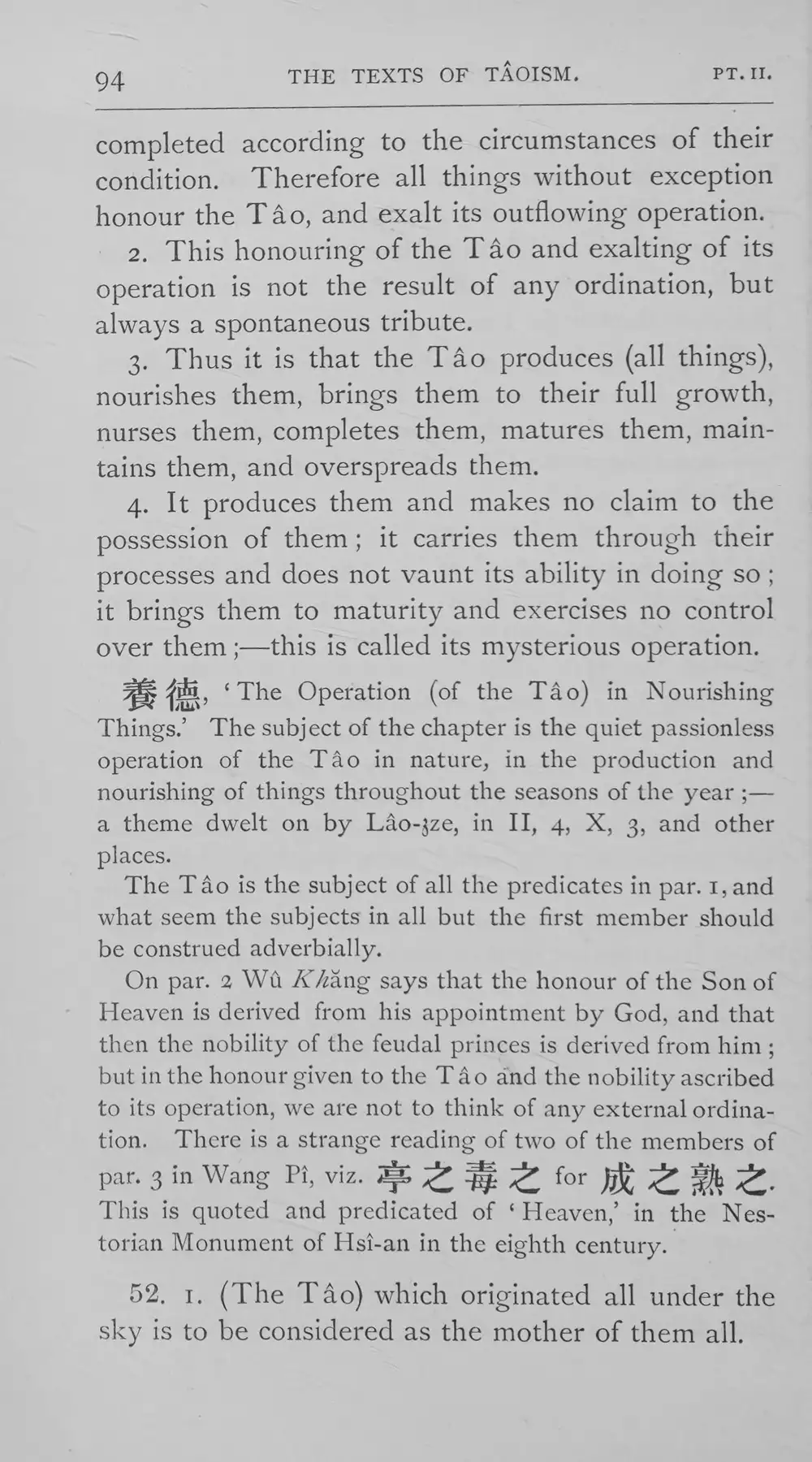
page 94
2. This honouring of the Tâo and exalting of its operation is not the result of any appointment, but is always a spontaneous tribute.
3. So it is that the Tâo produces (all things), nourishes them, brings them to their full growth, nurses them, completes them, matures them, maintains them, and overspreads them.
4. It produces them and makes no claim to possess them; it carries them through their processes and does not boast of its ability in doing so; it brings them to maturity and exercises no control over them;—this is called its mysterious operation.
養德, ‘The Operation (of the Tâo) in Nourishing Things.’ The subject of the chapter is the quiet, passionless operation of the Tâo in nature, in the production and nourishing of things throughout the seasons of the year;—a theme Lâo-ȝze dwells on in II, 4, X, 3, and other places.
The Tâo is the subject of all the predicates in par. 1, and what seem to be the subjects in all but the first member should be construed adverbially.
On par. 2 Wû Khăng says that the honour of the Son of Heaven is derived from his appointment by God, and that the nobility of the feudal princes is then derived from him; but in the honour given to the Tâo and the nobility ascribed to its operation, we are not to think of any external appointment. There is a strange reading of two of the members of par. 3 in Wang Pî, namely 亭之毒之 [Press: settles them and matures them] for 成之熟之 [Press: completes them and ripens them]. This is quoted, and predicated of ‘Heaven,’ in the Nestorian Monument of Hsi-an of the eighth century.
52. 1. (The Tâo) which originated all under the sky is to be considered the mother of them all.