Legge compares the rhymes of chapter 44 with ‘the old rhymes of the Book of Poetry’, whose religious portions he translates in SBE vol. 3. The comparison is more than ornament: short rhyming lines of this kind mark the chapter as verse in the old manner, and suggest the King draws on the same stock of proverb and song as the odes. His English keeps the short lines, which lets the reader hear it.
The Tâo Teh King — Sacred Books of China Part I, SBE Vol. 39 (trans. James Legge, 1891)
Open to all
page 88
No image is selected for this page; its own page image is shown.
page 88
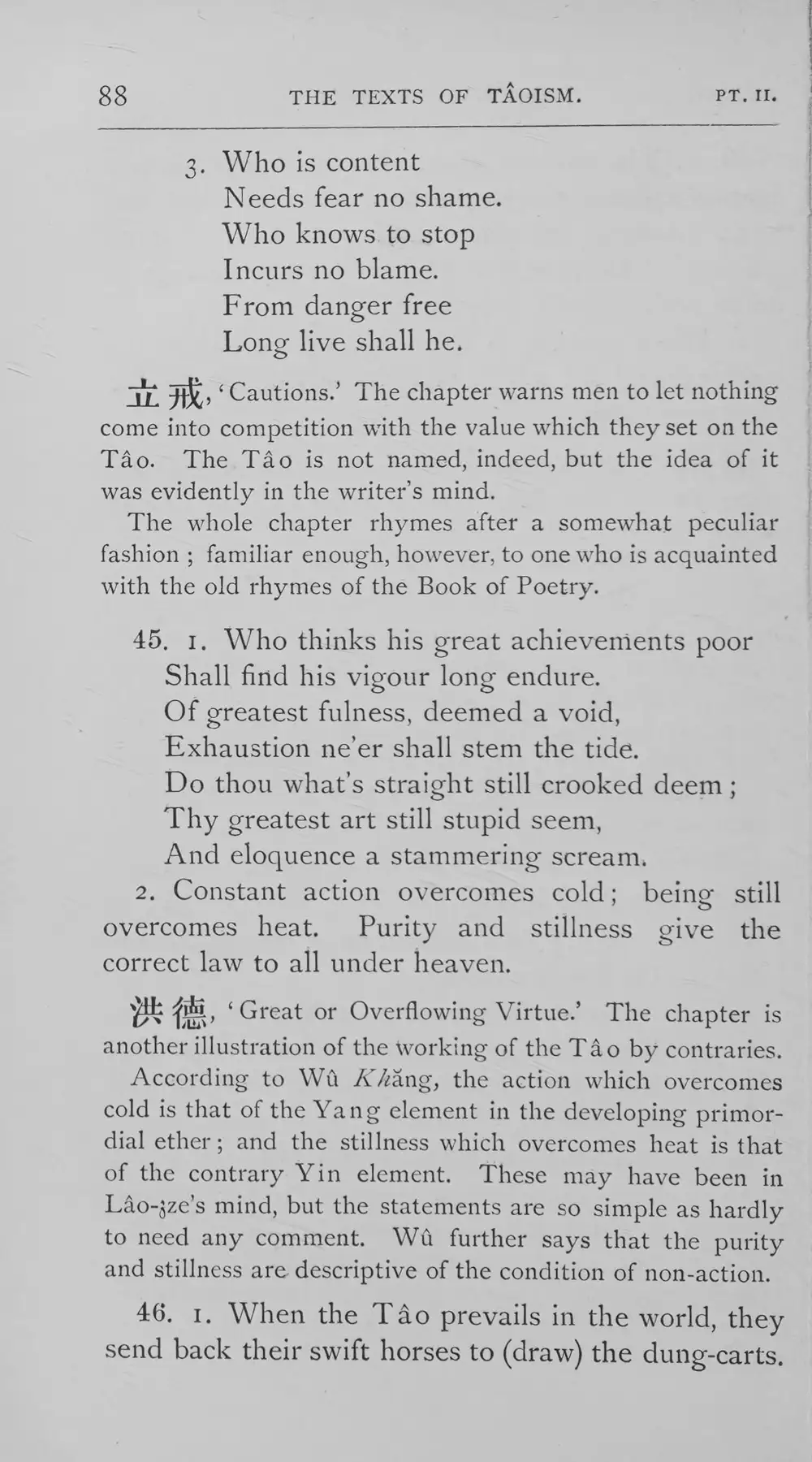
3. Whoever is content
Need fear no shame.
Whoever knows when to stop
Incurs no blame.
Free from danger,
He shall live long.
The whole chapter rhymes in a somewhat peculiar fashion; familiar enough, however, to anyone acquainted with the old rhymes of the Book of Poetry.
45. 1. Whoever thinks his great achievements poor Shall find his vigour long endure. Of greatest fullness, deemed a void, Exhaustion shall never stem the tide. Deem what is straight still crooked; Let your greatest art still seem stupid, And your eloquence a stammering scream.
2. Constant action overcomes cold; being still overcomes heat. Purity and stillness give the correct law to all under heaven.
洪德, ‘Great or Overflowing Virtue.’ The chapter is another illustration of the working of the Tâo by contraries. According to Wû Khăng, the action which overcomes cold is that of the Yang element in the developing primordial ether, and the stillness which overcomes heat is that of the contrary Yin element. These may have been in Lâo-ȝze’s mind, but the statements are so simple as hardly to need any comment. Wû further says that the purity and stillness describe the condition of non-action.
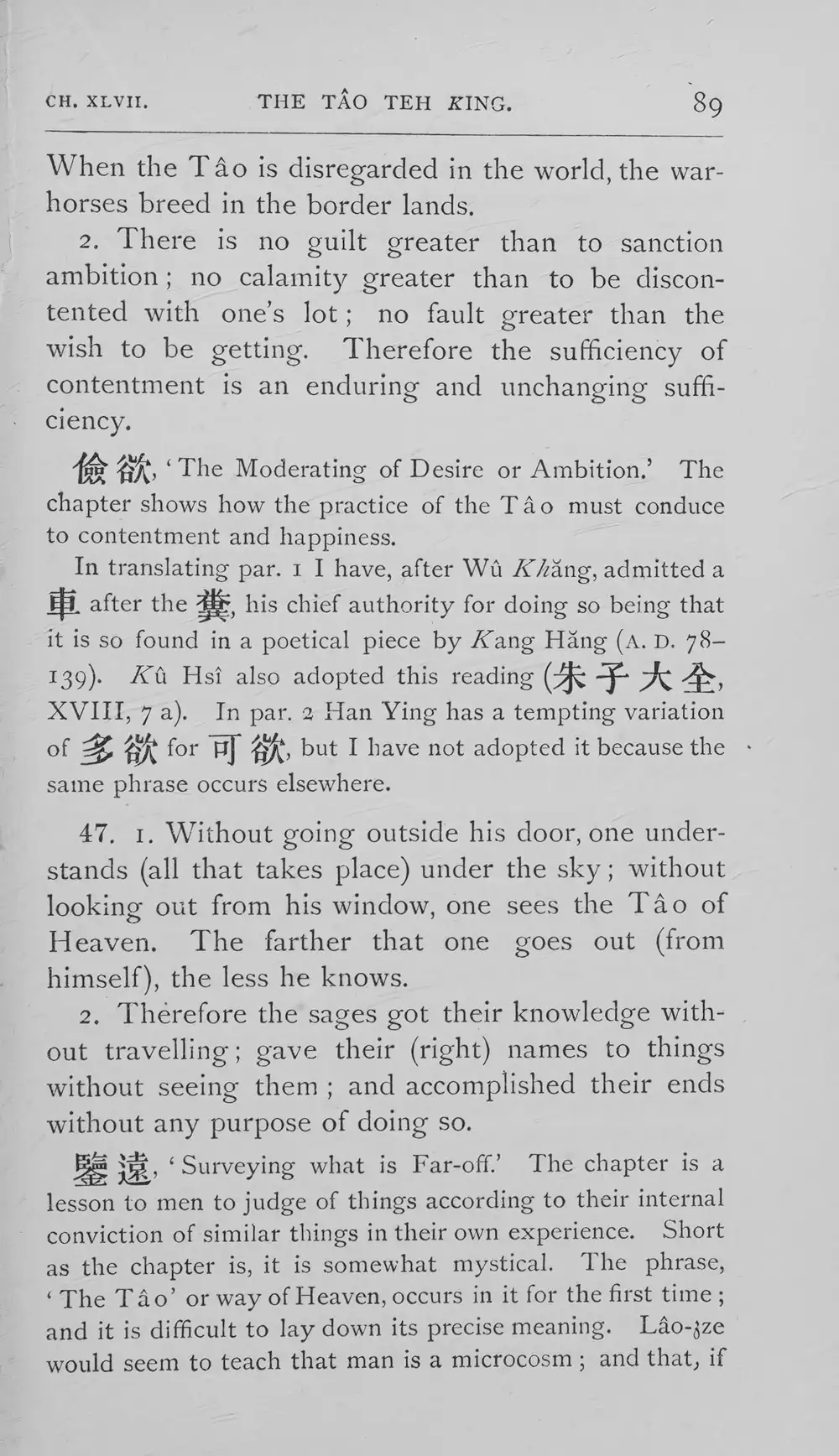
46. 1. When the Tâo prevails in the world, they send back their swift horses to (draw) the dung-carts. When the Tâo is disregarded in the world, the war-horses breed in the border lands.