Legge adds a character, a cart after the word for manure, on the strength of a poem by Kang Hang (A.D. 78–139) and the precedent of Wû and Kû Hsî. The received text makes sense without it: when the Tao prevails, swift horses go back to manuring the fields. Both readings make the same point about peace, so the emendation is not required, and the reader should know the English rests on it.
The Tâo Teh King — Sacred Books of China Part I, SBE Vol. 39 (trans. James Legge, 1891)
Open to all
page 89
No image is selected for this page; its own page image is shown.
page 89
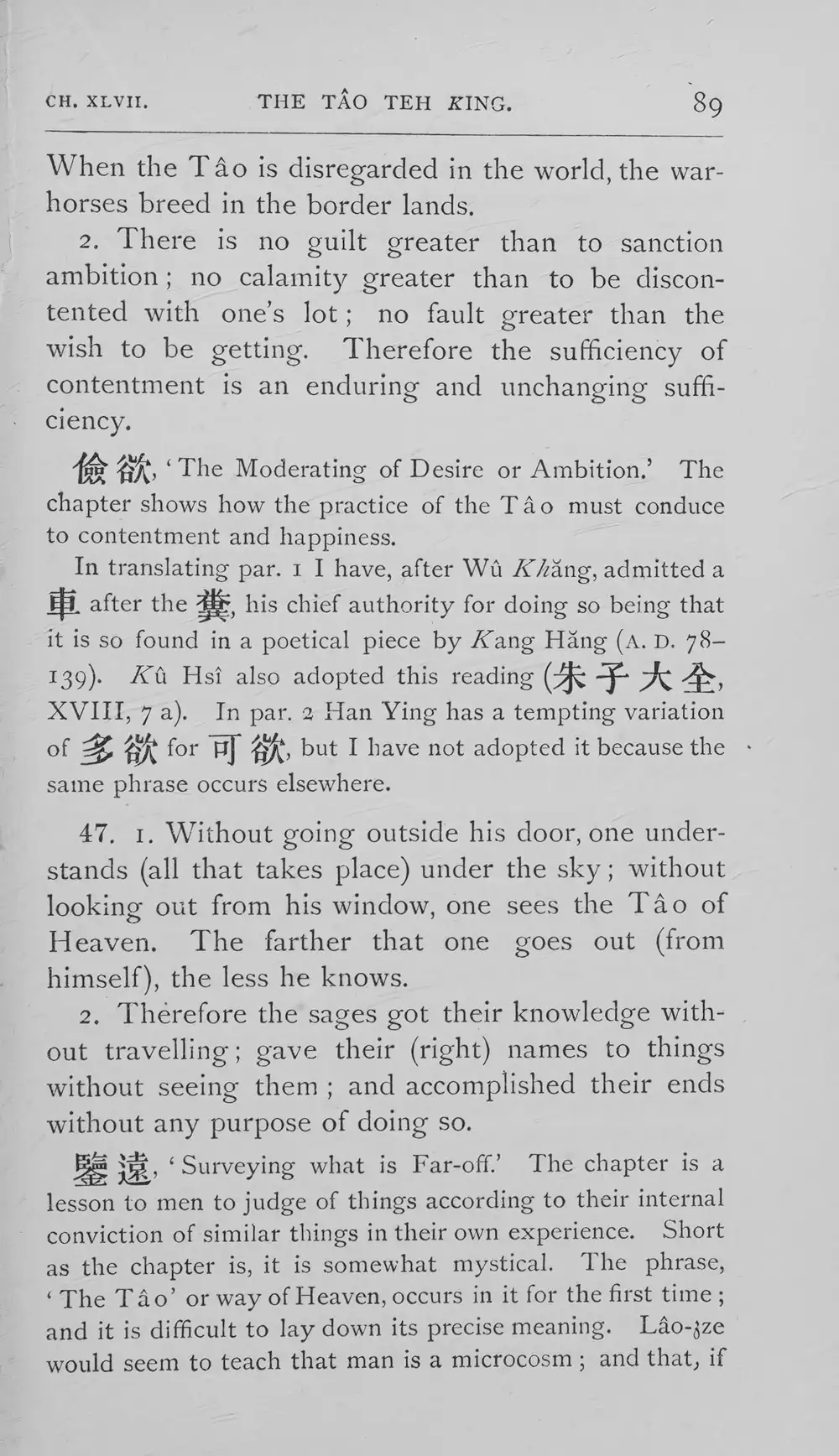
2. There is no guilt greater than to sanction ambition; no calamity greater than to be discontented with one’s lot; no fault greater than the wish to be getting. Therefore the sufficiency of contentment is an enduring and unchanging sufficiency.
儉欲, ‘The Moderating of Desire or Ambition.’ The chapter shows how the practice of the Tâo must lead to contentment and happiness.
In translating par. 1 I have, following Wû Khăng, admitted a 車 [Press: carriage, cart] after the 糞 [Press: to manure (the fields)], his chief authority for doing so being that it is found so in a poetical piece by Kang Hang (A.D. 78-139). Kû Hsî also adopted this reading (朱子大全 [Press: The Complete Works of Master Kû (Kû Hsî) (a title)], XVIII, 7a). In par. 2 Han Ying has a tempting variant, 多欲 [Press: many desires] for 可欲 [Press: what may be desired], but I have not adopted it because the same phrase occurs elsewhere.
47. 1. Without going outside his door, one understands (all that takes place) under the sky; without looking out of his window, one sees the Tâo of Heaven. The farther one goes out (from oneself), the less one knows.
2. Therefore the sages got their knowledge without travelling; gave their (right) names to things without seeing them; and accomplished their ends without any purpose of doing so.
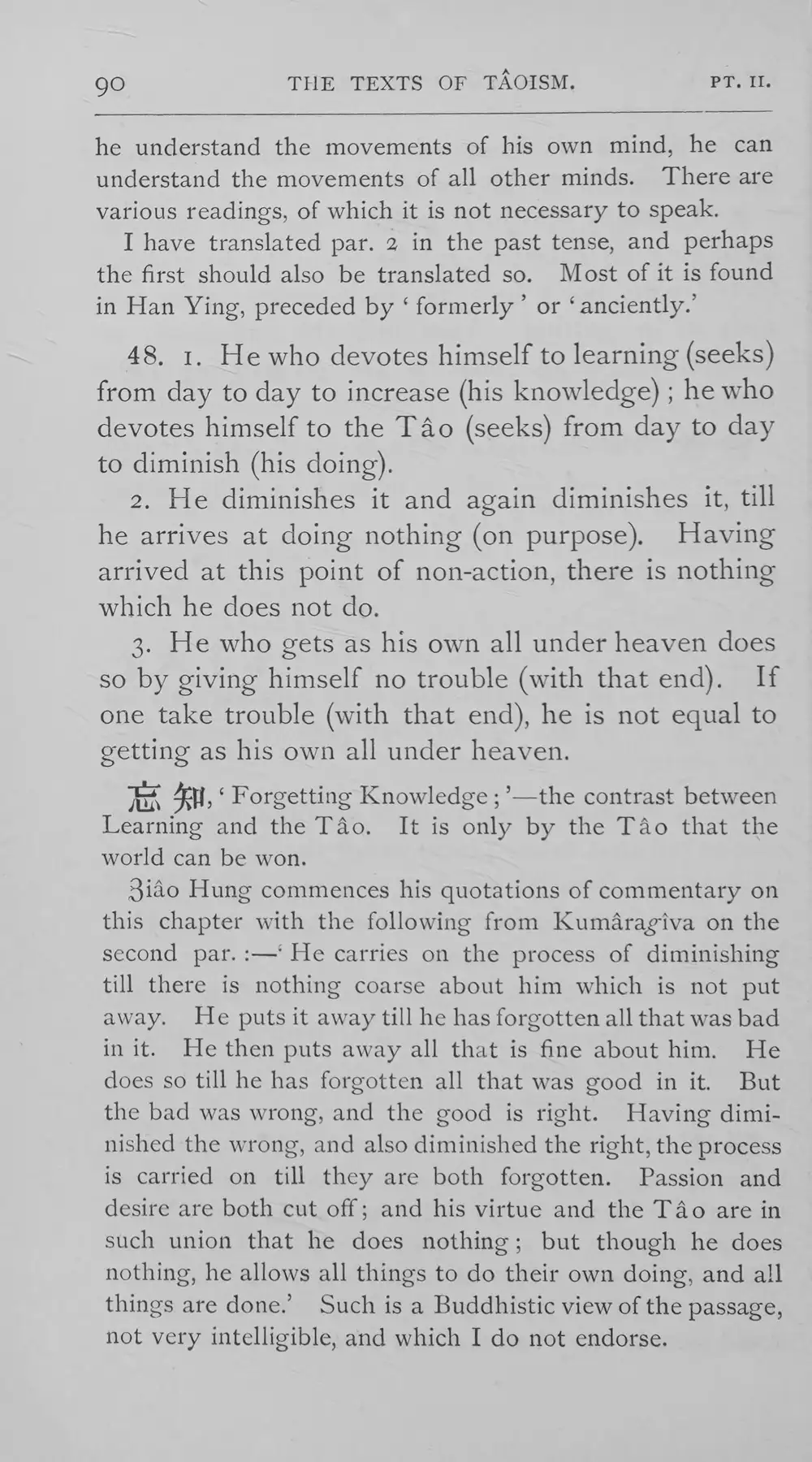
鑒遠, ‘Surveying what is Far-off.’ The chapter is a lesson to men to judge of things by their inner conviction of similar things in their own experience. Short as the chapter is, it is somewhat mystical. The phrase ‘the Tâo,’ or way, of Heaven occurs in it for the first time; and it is difficult to lay down its precise meaning. Lâo-ȝze would seem to teach that man is a microcosm; and that, if he understands the movements of his own mind, he can understand the movements of all other minds. There are various readings, of which it is not necessary to speak.