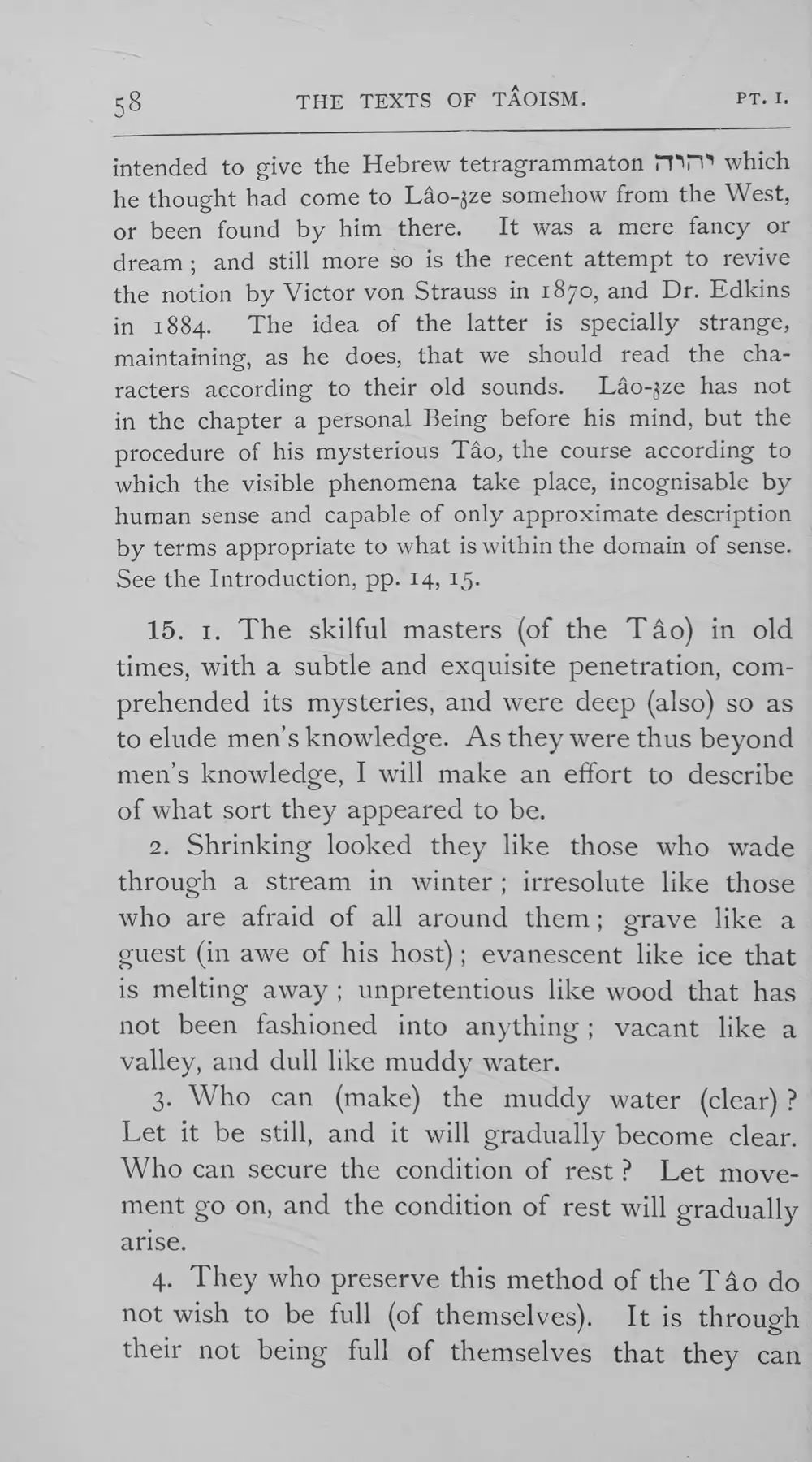
Legge dismisses as ‘a mere fancy or dream’ the theory that the three names of par. 1 encode the Hebrew divine name, held by Rémusat and revived by von Strauss and Edkins. The rejection carries weight because Legge is no hostile witness: he looks for intimations of God in the King elsewhere (pp. 50, 68). His reason is the text’s own, that the chapter describes the procedure of the Tao, not a personal Being.
The Tâo Teh King — Sacred Books of China Part I, SBE Vol. 39 (trans. James Legge, 1891)
Open to all
page 57
No image is selected for this page; its own page image is shown.
page 57
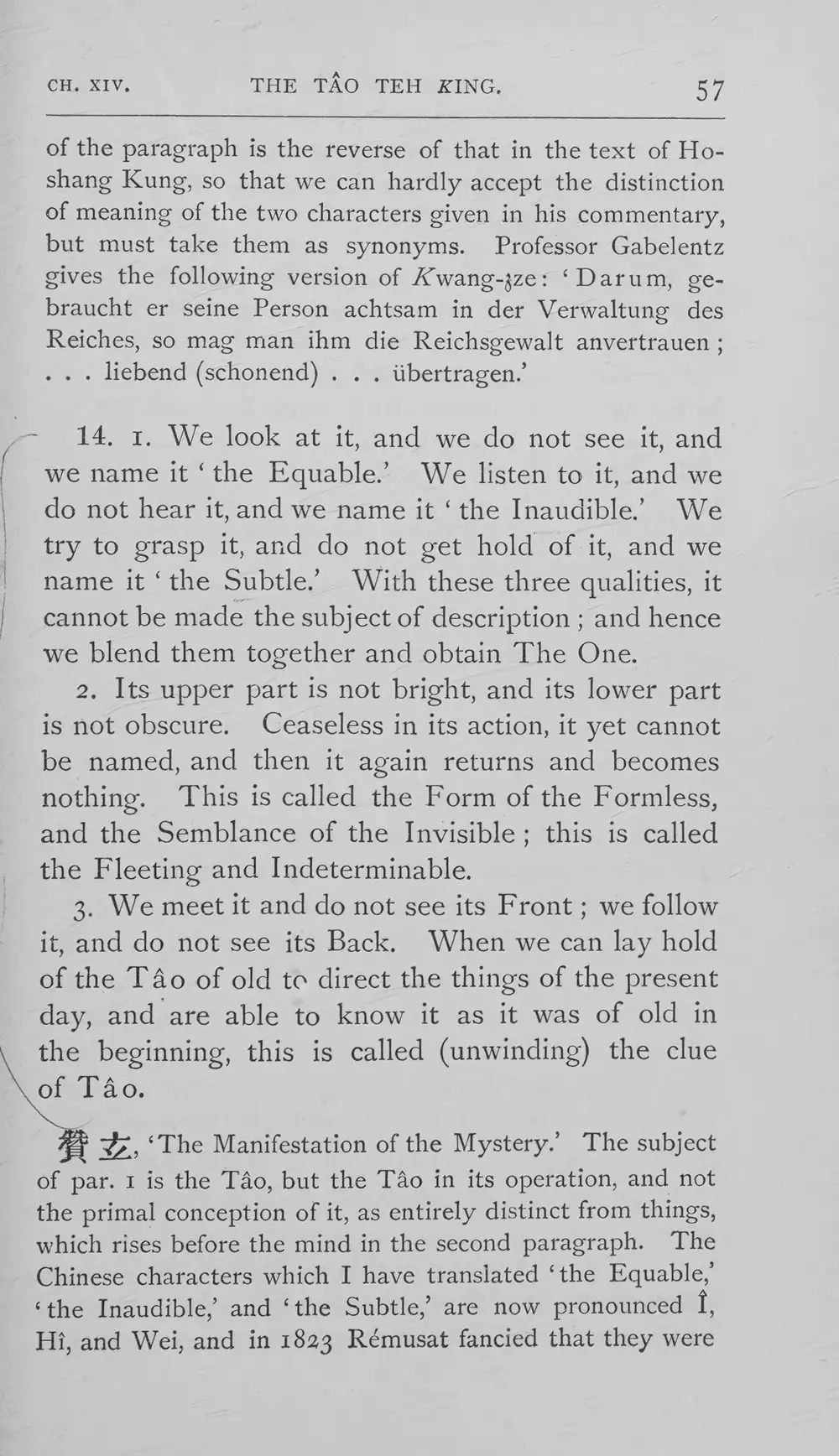
14. 1. We look at it and do not see it, and we name it ‘the Equable.’ We listen to it and do not hear it, and we name it ‘the Inaudible.’ We try to grasp it and cannot get hold of it, and we name it ‘the Subtle.’ With these three qualities it cannot be made the subject of description; and so we blend them together and obtain The One.
2. Its upper part is not bright, and its lower part is not obscure. Ceaseless in its action, it still cannot be named, and then it returns again and becomes nothing. This is called the Form of the Formless and the Semblance of the Invisible; this is called the Fleeting and Indeterminable.
3. We meet it and do not see its Front; we follow it and do not see its Back. When we can lay hold of the Tâo of old to direct the things of the present day, and are able to know it as it was of old in the beginning, this is called (unwinding) the clue of Tao.
贊玄, ‘The Manifestation of the Mystery.’ The subject of par. 1 is the Tao, but the Tâo in its operation, and not the primal conception of it, as entirely distinct from things, which rises before the mind in the second paragraph. The Chinese characters which I have translated ‘the Equable,’ ‘the Inaudible,’ and ‘the Subtle’ are now pronounced Î, Hî, and Wei, and in 1823 Rémusat imagined that they were intended to give the Hebrew tetragrammaton יהוה, which he thought had somehow reached Lâo-ȝze from the West, or been found by him there.
It was a mere fancy or dream; and still more so is the recent attempt to revive the notion by Victor von Strauss in 1870 and by Dr. Edkins in 1884. The latter’s idea is especially strange, since he maintains that we should read the characters according to their old sounds. Lâo-ȝze has no personal Being before his mind in this chapter, but the procedure of his mysterious Tao: the course according to which visible phenomena take place, unknowable by human sense and capable only of approximate description in terms appropriate to what lies within the domain of sense. See the Introduction, pp. 14, 15.