Legge suggests the founder of the Khin dynasty might have made Taoism a religion had his dynasty lasted, citing his sacrifices to eight spirits. The footnote's list, Lords of Heaven, Earth, War, Yang, Yin, Moon, Sun and Seasons, describes a state cult of natural powers, and Khien traces it to Thai Kung in the twelfth century B.C., long before Lâo-ȝze. On Legge's own evidence the eight spirits are older than Taoism and no sign of a Taoist church.
The Tâo Teh King — Sacred Books of China Part I, SBE Vol. 39 (trans. James Legge, 1891)
Open to all
page 41
No image is selected for this page; its own page image is shown.
page 41
Wastheold
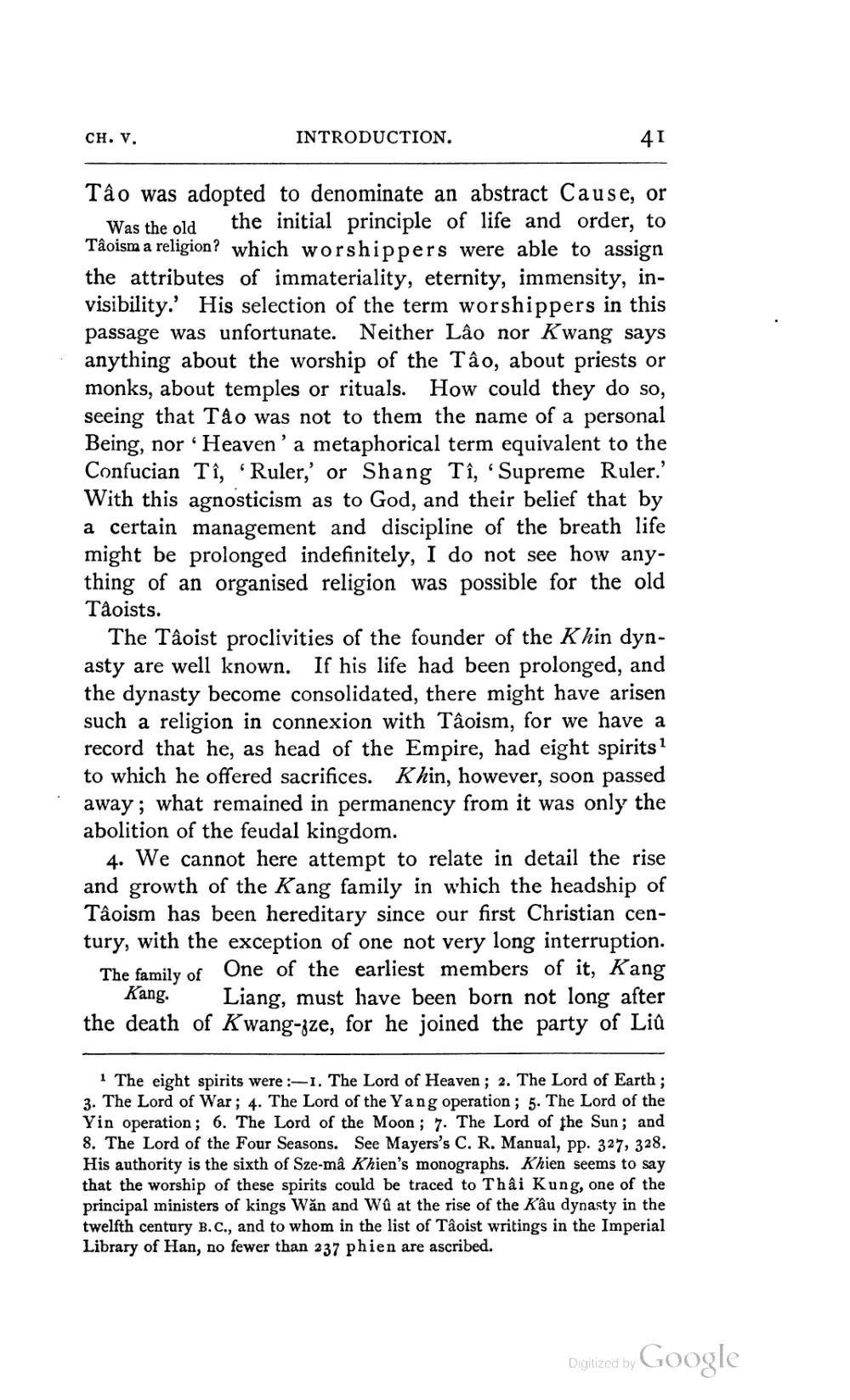
The Taoist leanings of the founder of the Khin dynasty are well known. Had his life been prolonged and the dynasty become consolidated, such a religion might have arisen in connection with Taoism, for we have a record that, as head of the Empire, he had eight spirits1 to which he offered sacrifices. Khin, however, soon passed away; all that remained of it permanently was the abolition of the feudal kingdom.
4. We cannot attempt here to relate in detail the rise and growth of the Kang family, in which the headship of Taoism has been hereditary since our first Christian century, with the exception of one not very long interruption. One of its earliest members, Kang Liang, must have been born not long after the death of Kwang-ȝze, for he joined the party of Liû Pang, the founder of the dynasty of Han, in B.C. 208, and by his wisdom and bravery contributed greatly to his success over the adherents of Khin and the other contenders for the sovereignty of the empire. Then, abandoning a political career, he spent the last years of his life in a vain quest for the elixir of life.
The family of Kang.
1 The eight spirits were:—1. The Lord of Heaven; 2. The Lord of Earth; 3. The Lord of War; 4. The Lord of the Yang operation; 5. The Lord of the Yin operation; 6. The Lord of the Moon; 7. The Lord of the Sun; and 8. The Lord of the Four Seasons. See Mayers’s C. R. Manual, pages 327, 328. His authority is the sixth of Sze-mâ Khien’s monographs. Khien seems to say that the worship of these spirits could be traced to Thai Kung, one of the principal ministers of kings Wan and Wé at the rise of the Kâu dynasty in the twelfth century B.C., to whom no fewer than 237 phien are ascribed in the list of Taoist writings in the Imperial Library of Han.