Legge dates the Kan Ying Phien from its neighbours in a list: a bibliography of 1586 notes a commentary on it just after one by a scholar who lived 1042-1102 and just before other eleventh-century works. That places a commentary, and only by adjacency, so it gives at most a date by which the text existed, not when it was written. The Preface states “of our eleventh century” as settled; the evidence here supports it less firmly than that.
The Tâo Teh King — Sacred Books of China Part I, SBE Vol. 39 (trans. James Legge, 1891)
Open to all
page 39
No image is selected for this page; its own page image is shown.
page 39
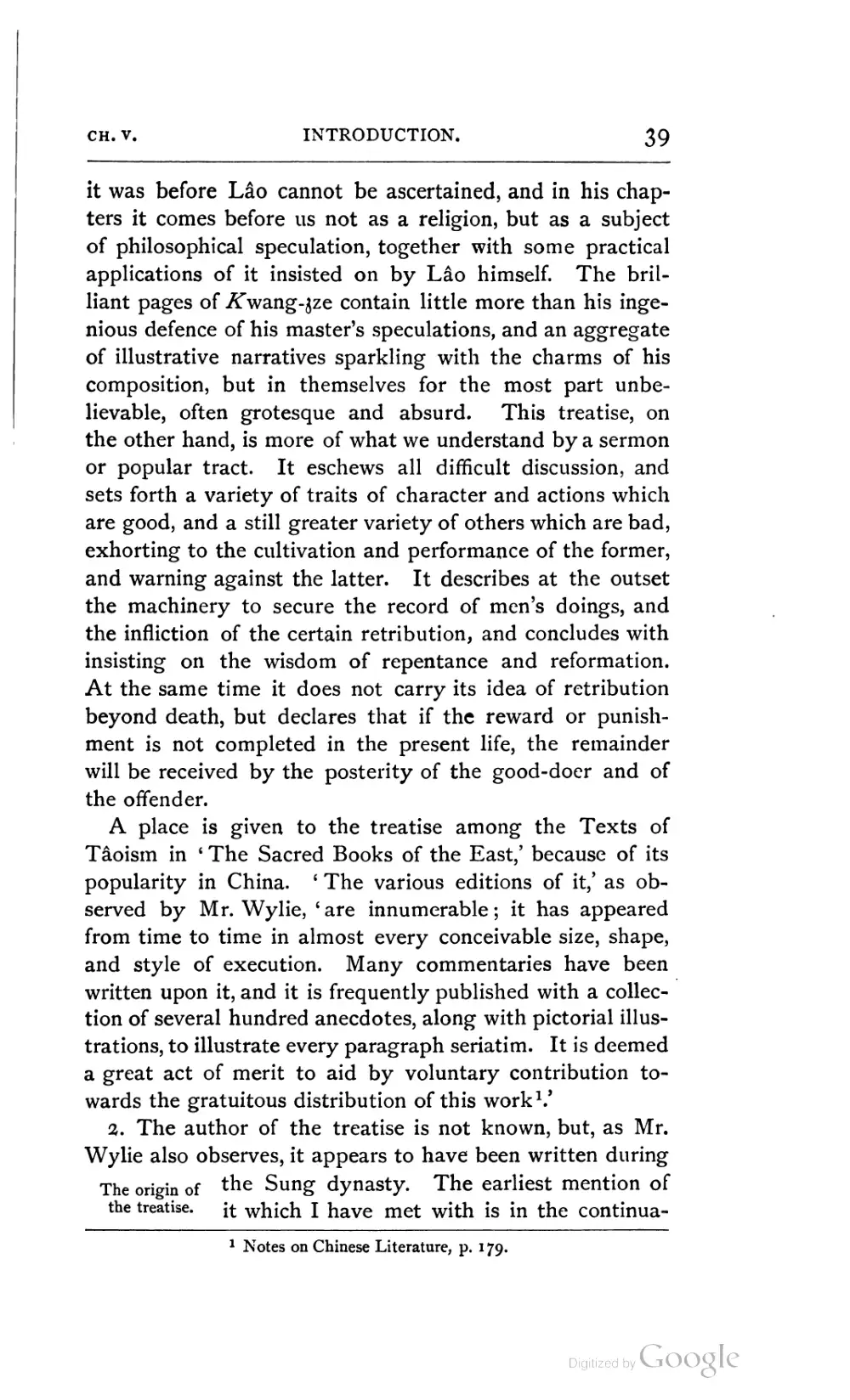
A place is given to the treatise among the Texts of Taoism in ‘The Sacred Books of the East’ because of its popularity in China. ‘Its various editions,’ as Mr. Wylie observes, ‘are innumerable; it has appeared from time to time in almost every conceivable size, shape and style of execution. Many commentaries have been written on it, and it is often published with a collection of several hundred anecdotes, along with pictures, to illustrate every paragraph one by one. It is thought a great act of merit to help by voluntary contribution towards the free distribution of this work1.’
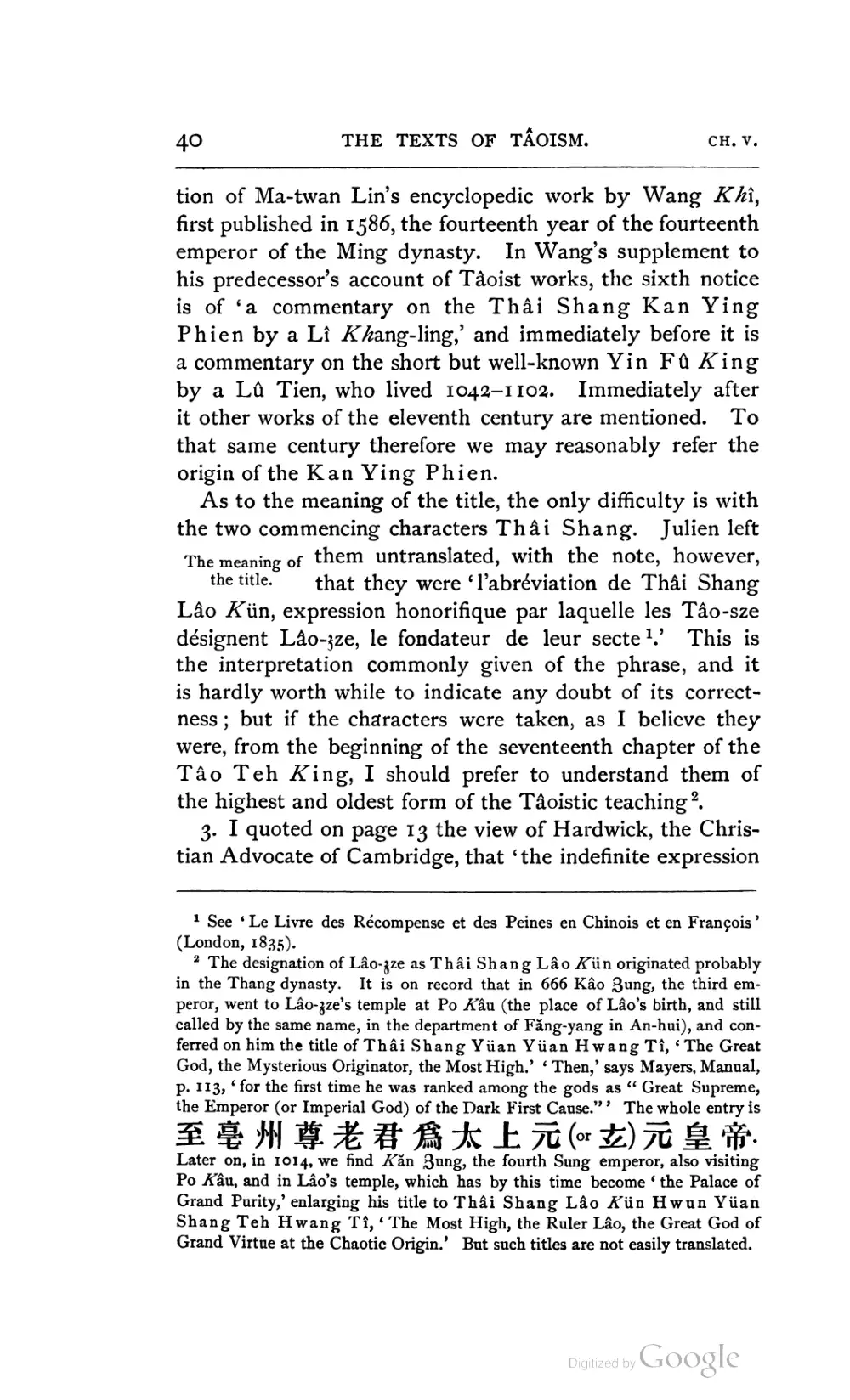
2. The author of the treatise is not known, but, as Mr. Wylie also observes, it appears to have been written during the Sung dynasty. The earliest mention of it that I have met with is in the continuation of Ma-twan Lin’s encyclopedic work by Wang Khî, first published in 1586, the fourteenth year of the fourteenth emperor of the Ming dynasty. In Wang’s supplement to his predecessor’s account of Taoist works, the sixth notice is of ‘a commentary on the Thai Shang Kan Ying Phien by a Li Khang-ling,’ and immediately before it is a commentary on the short but well-known Yin Fû King by a Lû Tien, who lived 1042–1102. Immediately after it, other works of the eleventh century are mentioned. We may reasonably, therefore, assign the origin of the Kan Ying Phien to that same century.
The origin of the treatise.
1 Notes on Chinese Literature, page 179.