Legge doubts the usual reading of Thâi Shang in the Tractate's title as an honorific of Lâo-ȝze and suggests it means “the highest and oldest form of the Taoistic teaching”, taken from chapter 17. His own footnote tells against him: it shows Thâi Shang conferred on Lâo-ȝze by emperors in 666 and again in 1014, before or near the eleventh-century date he assigns the Tractate. By then the honorific sense was current, and the common reading is the likelier.
The Tâo Teh King — Sacred Books of China Part I, SBE Vol. 39 (trans. James Legge, 1891)
Open to all
page 40
No image is selected for this page; its own page image is shown.
page 40
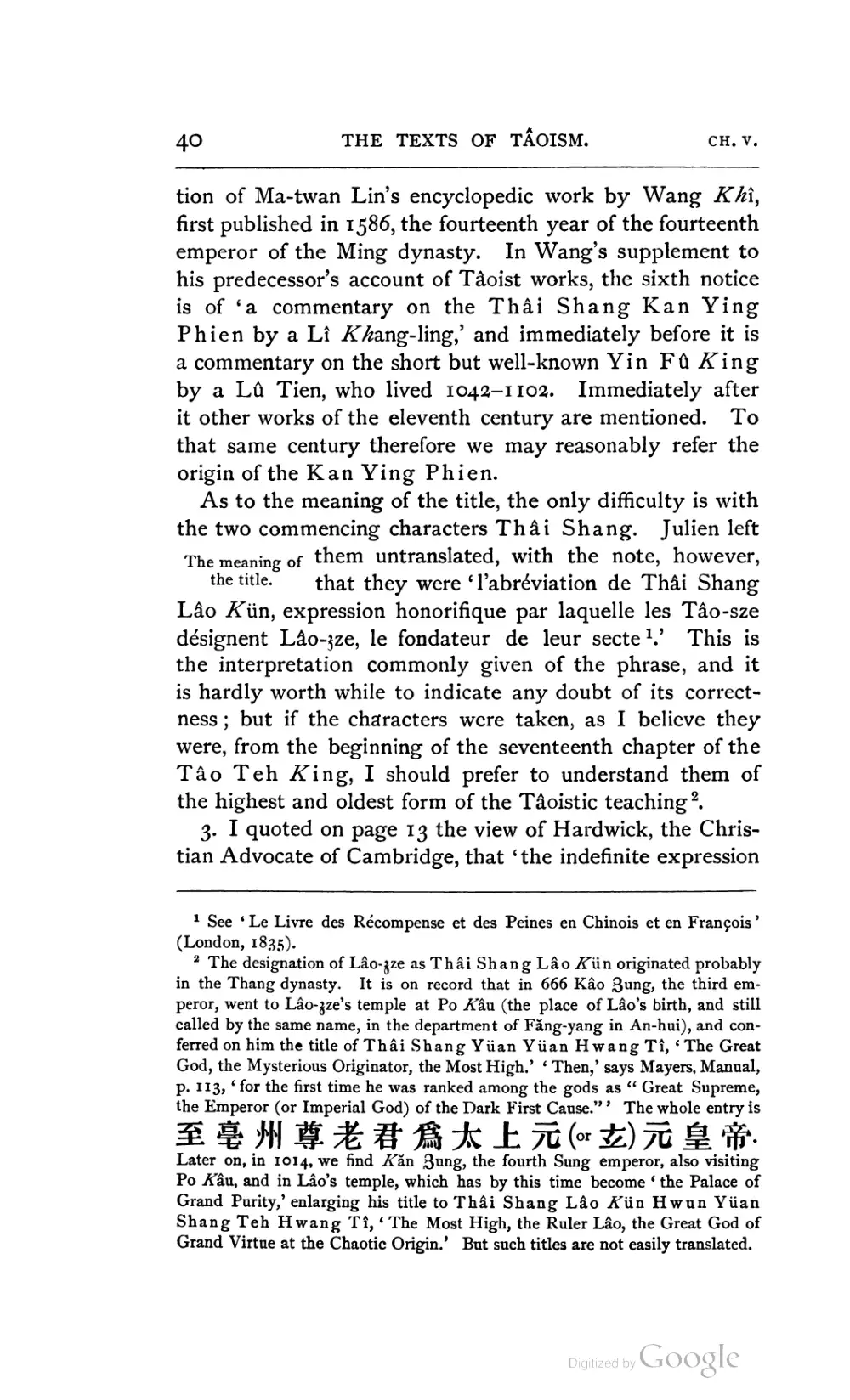
As to the meaning of the title, the only difficulty lies with the two opening characters, Thai Shang. Julien left them untranslated, with the note, however, that they were ‘the abbreviation of Thai Shang Lao Kün, an honorific expression by which the Tao-sze designate Lâo-ȝze, the founder of their sect1.’ This is the interpretation commonly given of the phrase, and it is hardly worth while to suggest any doubt of its correctness; but if the characters were taken, as I believe they were, from the beginning of the seventeenth chapter of the Tao Teh King, I should prefer to understand them of the highest and oldest form of the Taoist teaching2.
The meaning of the title
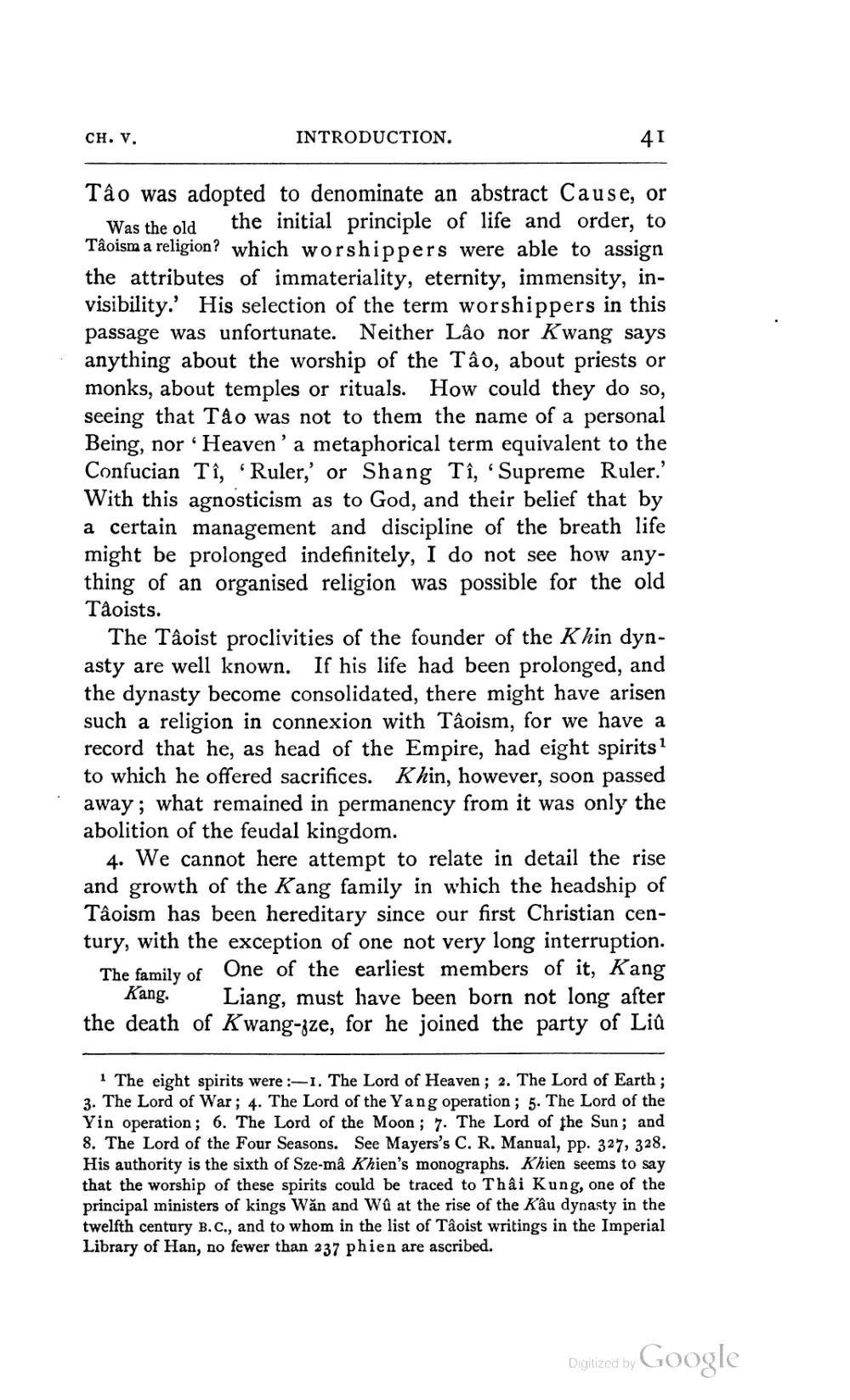
3. On page 13 I quoted the view of Hardwick, the Christian Advocate of Cambridge, that ‘the ind… Tao was adopted to denote an abstract Cause, or the initial principle of life and order, to which worshippers were able to assign the attributes of immateriality, eternity, immensity and invisibility.’ His choice of the term worshippers in this passage was unfortunate.
Neither Lao nor Kwang says anything about the worship of the Tao, about priests or monks, about temples or rituals. How could they, when Tao was not to them the name of a personal Being, nor ‘Heaven’ a metaphorical term equivalent to the Confucian Ti, ‘Ruler,’ or Shang Ti, ‘Supreme Ruler’? With this agnosticism as to God, and their belief that by a certain management and discipline of the breath life might be prolonged indefinitely, I do not see how anything like an organised religion was possible for the old Taoists.
1 See ‘The Book of Rewards and Punishments (Le Livre des Récompense et des Peines en Chinois et en François)’ (London, 1835).
* The designation of Lâo-ȝze as Thai Shang Lao Kün probably originated in the Thang dynasty. It is on record that in 666 Kao Ȝung, the third emperor, went to Lâo-ȝze’s temple at Po Kâu (the place of Lao’s birth, still called by the same name, in the department of Fing-yang in An-hui), and conferred on him the title of Thai Shang Yüan Yüan Hwang Tî, ‘The Great God, the Mysterious Originator, the Most High.’ ‘Then,’ says Mayers, Manual, page 113, ‘for the first time he was ranked among the gods as “Great Supreme, the Emperor (or Imperial God) of the Dark First Cause.”’
The whole entry is 至亳州尊老君爲太上元 [Press: went to Po-chau and honoured Lord Lâo as Most High Primal](or 玄 [Press: dark, mysterious])元皇帝 [Press: Primal Emperor].
Later on, in 1014, we find Kăn Ȝung, the fourth Sung emperor, also visiting Po Kâu, and in Lao’s temple, which has by this time become ‘the Palace of Grand Purity,’ enlarging his title to Thai Shang Lao Kün Hwun Yüan Shang Teh Hwang Tî, ‘The Most High, the Ruler Lao, the Great God of Grand Virtue at the Chaotic Origin.’ But such titles are not easily translated.