Legge grants that Kwang-ȝze's narratives “are for the most part fictions”, then takes Kwang-ȝze's belief in the age of his ideas as “a ground for believing myself” that Taoism is older than Lâo-ȝze. By his own standard the step is weak: a writer who invents his ancients is evidence of what he believed about the past, not of the past. The Bunyan comparison makes the point against him, since The Pilgrim's Progress is true of minds, not of history.
The Tâo Teh King — Sacred Books of China Part I, SBE Vol. 39 (trans. James Legge, 1891)
Open to all
page 3
No image is selected for this page; its own page image is shown.
page 3
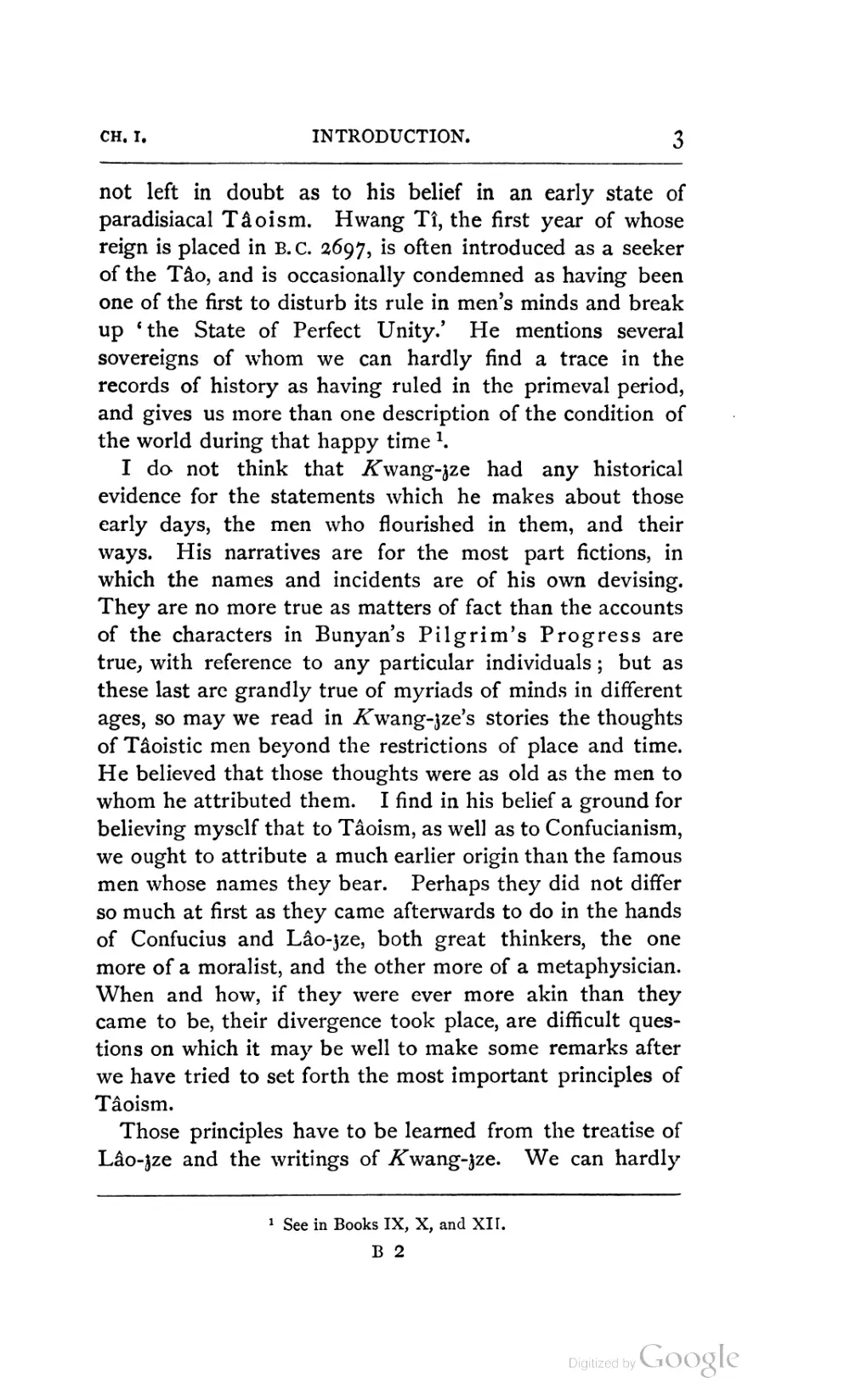
I do not think that Kwang-ȝze had any historical evidence for the statements he makes about those early days, the men who flourished in them, and their ways. His narratives are for the most part fictions, in which the names and incidents are of his own devising. They are no more true as matters of fact than the accounts of the characters in Bunyan’s Pilgrim’s Progress are true of any particular individuals; but as these last are grandly true of myriads of minds in different ages, so we may read in Kwang-ȝze’s stories the thoughts of Taoistic men beyond the limits of place and time. He believed that those thoughts were as old as the men to whom he attributed them.
I find in his belief a ground for believing myself that to Taoism, as well as to Confucianism, we ought to assign a much earlier origin than the famous men whose names they bear. Perhaps they did not differ so much at first as they came to do afterwards in the hands of Confucius and Lâo-ȝze, both great thinkers, the one more of a moralist, the other more of a metaphysician. When and how their divergence took place, if they were ever more akin than they came to be, are difficult questions, on which it may be well to make some remarks after we have tried to set out the most important principles of Taoism.
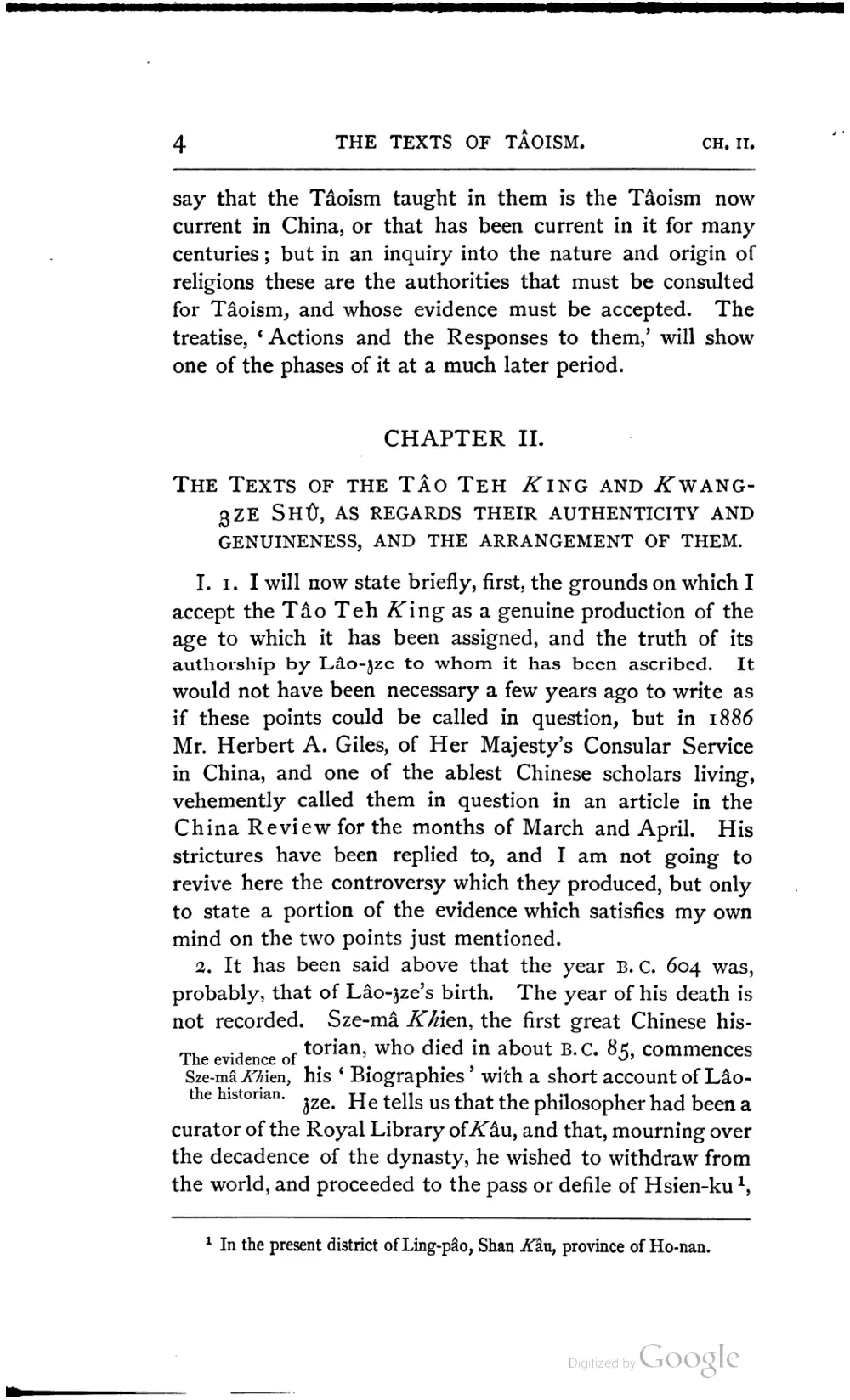
Those principles have to be learned from the treatise of Lâo-ȝze and the writings of Kwang-ȝze. … say that the Taoism taught in them is the Taoism now current in China, or that has been current in it for many centuries; but in an inquiry into the nature and origin of religions these are the authorities that must be consulted for Taoism, and whose evidence must be accepted. The treatise ‘Actions and the Responses to them’ will show one of its phases at a much later period.
1 See Books IX, X, and XII.