Legge calls the society of chapter 17 “a paradisiacal state”, a word that brings Eden with it. The chapter's claim, as he reports it, is political: the best rulers were scarcely known, and the people said “We are what we are of ourselves.” Lâo-ȝze's golden age is one of unfelt government rather than of unfallen innocence, and reading it through Eden prepares Legge's later charge that the Taoists turned against knowledge itself.
The Tâo Teh King — Sacred Books of China Part I, SBE Vol. 39 (trans. James Legge, 1891)
Open to all
page 2
No image is selected for this page; its own page image is shown.
page 2
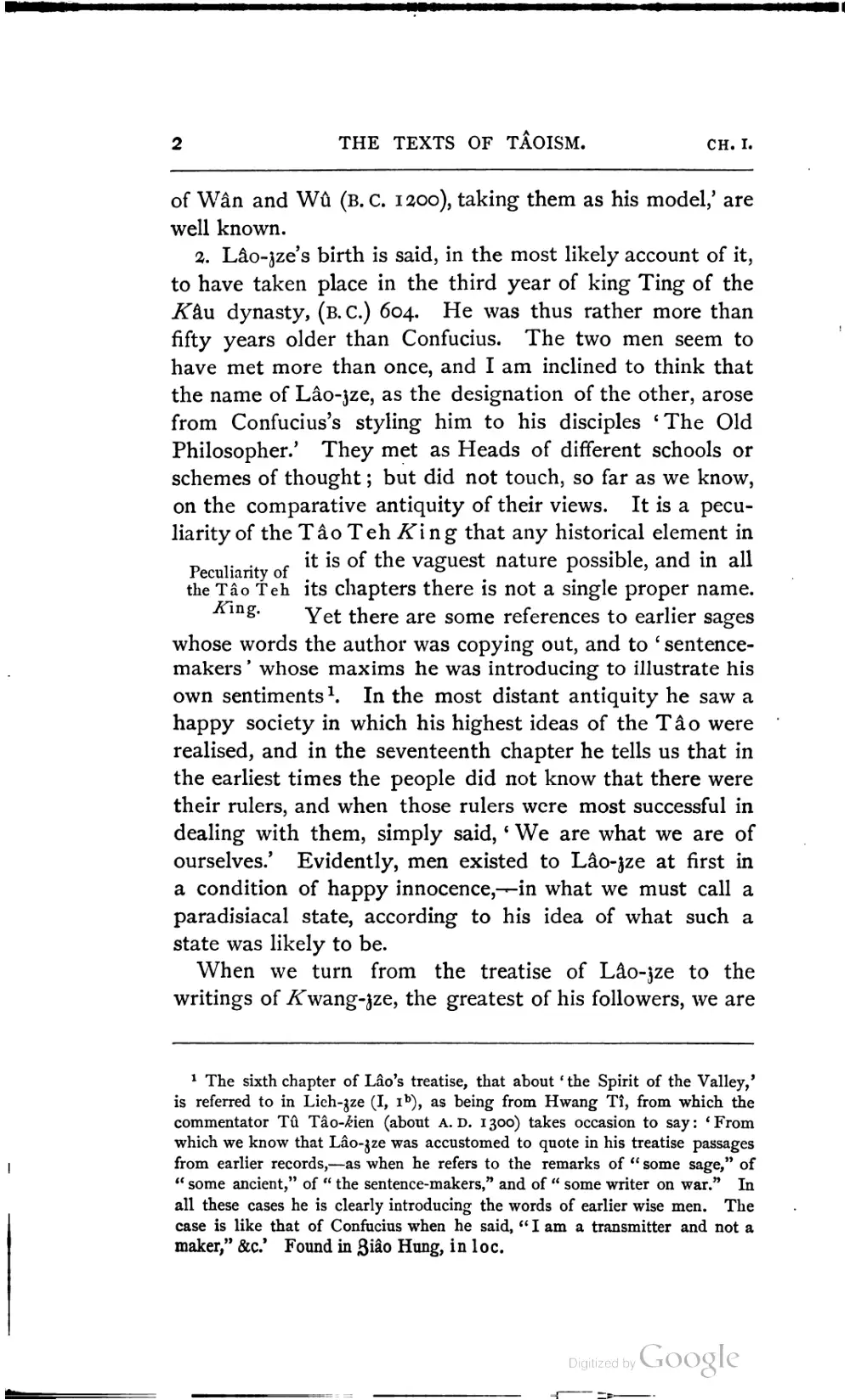
2. Lâo-ȝze’s birth is said, in the most likely account of it, to have taken place in the third year of king Ting of the Kau dynasty, (B.C.) 604. He was thus rather more than fifty years older than Confucius. The two men seem to have met more than once, and I am inclined to think that the name Lâo-ȝze, as the designation of the other, arose from Confucius’s calling him ‘The Old Philosopher’ to his disciples. They met as heads of different schools or schemes of thought, but did not touch, so far as we know, on the comparative antiquity of their views.
It is a peculiarity of the Tao Teh King that any historical element in it is of the vaguest nature possible, and in all its chapters there is not a single proper name. Yet there are some references to earlier sages whose words the author was copying out, and to ‘sentence-makers’ whose maxims he was bringing in to illustrate his own sentiments1. In the most distant antiquity he saw a happy society in which his highest ideas of the Tao were realised, and in the seventeenth chapter he tells us that in the earliest times the people did not know that they had rulers, and when those rulers were most successful in dealing with them, they simply said, ‘We are what we are of ourselves.’ Evidently, to Lâo-ȝze men existed at first in a condition of happy innocence,—in what we must call a paradisiacal state, according to his idea of what such a state was likely to be.
the Tao Teh Aing.
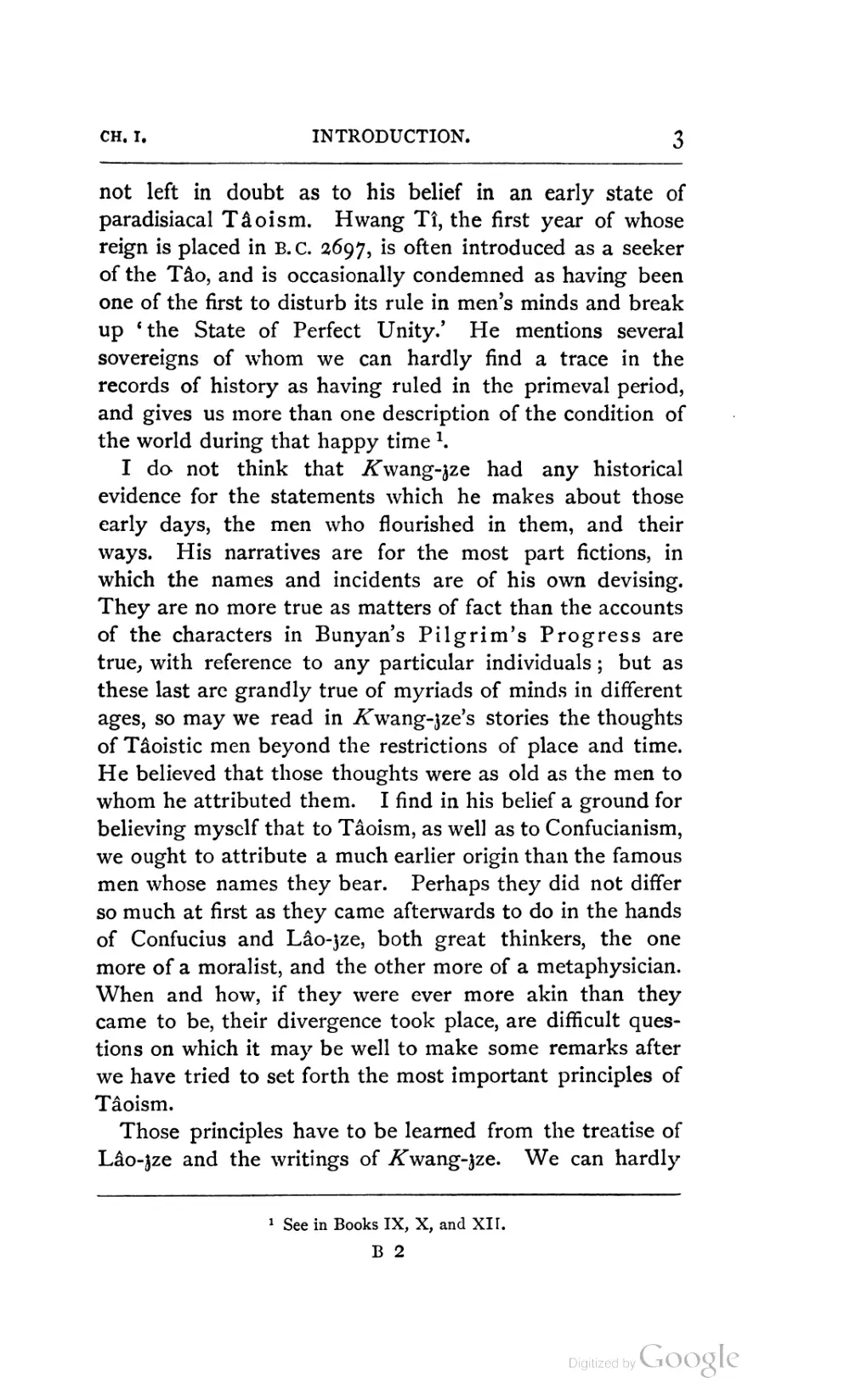
When we turn from the treatise of Lâo-ȝze to the writings of Kwang-ȝze, the greatest of his followers, we are not left in doubt as to his belief in an early state of paradisiacal Taoism. Hwang Ti, the first year of whose reign is placed in B.C. 2697, is often brought in as a seeker of the Tao, and is sometimes condemned as having been one of the first to disturb its rule in men’s minds and to break up ‘the State of Perfect Unity.’ He mentions several sovereigns, of whom we can hardly find a trace in the records of history, as having ruled in the primeval period, and gives us more than one description of the condition of the world during that happy time1.
* The sixth chapter of Lao’s treatise, the one about ‘the Spirit of the Valley,’ is referred to in Lieh-ȝze (I, 1) as being from Hwang Ti; on which the commentator Tû Tao-kien (about A.D. 1300) takes occasion to say: ‘From this we know that Lao-ȝze was accustomed to quote in his treatise passages from earlier records,—as when he refers to the remarks of “some sage,” of “some ancient,” of “the sentence-makers,” and of “some writer on war.” In all these cases he is clearly bringing in the words of earlier wise men. The case is like that of Confucius when he said, “I am a transmitter and not a maker,” etc.’ Found in Ȝiâo Hung, in loc.