The quotation argument is Legge's strongest, and he gives it numbers: the whole or part of seventy-one of the eighty-one chapters appear in Han Fei, who died in B.C. 230, and Hwai-nan Ȝze, who died in 122. That shows a text close to ours was current by the third century B.C. It does not by itself show one author in the sixth, which is what Giles disputed; Legge's remark that variant readings mean copies “had been multiplied from the very first” assumes that date rather than proving it.
The Tâo Teh King — Sacred Books of China Part I, SBE Vol. 39 (trans. James Legge, 1891)
Open to all
page 5
No image is selected for this page; its own page image is shown.
page 5
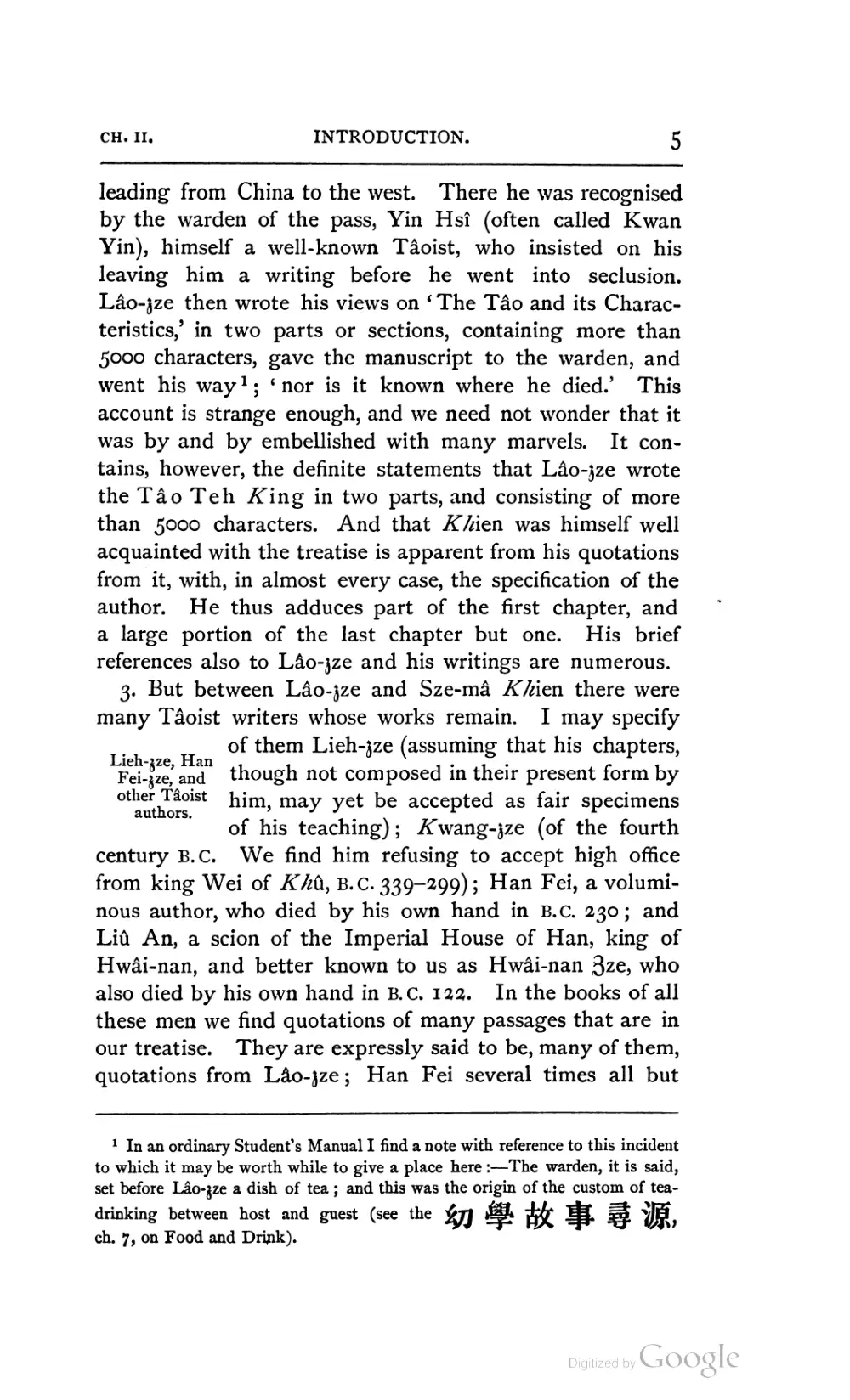
3. But between Lâo-ȝze and Sze-ma Khien there were many Taoist writers whose works remain. I may name among them Lieh-ȝze (assuming that his chapters, though not composed in their present form by him, may yet be accepted as fair specimens of his teaching); Kwang-ȝze (of the fourth century B.C.; we find him refusing to accept high office from king Wei of Khû, B.C. 339-299); Han Fei, a voluminous author, who died by his own hand in B.C. 230; and Liû An, a scion of the Imperial House of Han, king of Hwai-nan, and better known to us as Hwai-nan Ȝze, who also died by his own hand in B.C. 122. In the books of all these men we find quotations of many passages that are in our treatise. Many of them are expressly said to be quotations from Lâo-ȝze; Han Fei several times all but shows the book beneath his eyes.
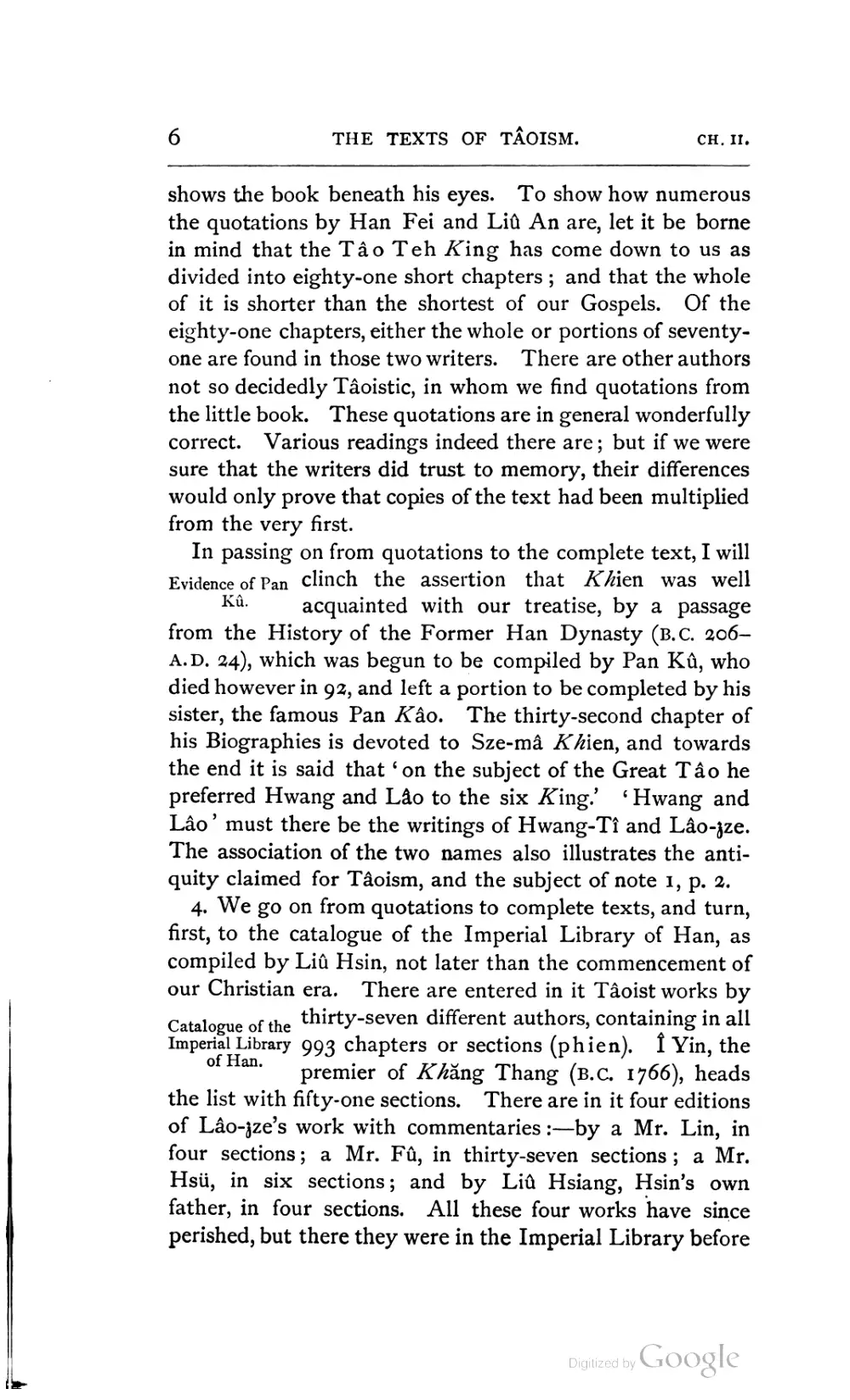
To show how numerous the quotations by Han Fei and Liû An are, let it be borne in mind that the Tao Teh King has come down to us divided into eighty-one short chapters, and that the whole of it is shorter than the shortest of our Gospels. Of the eighty-one chapters, either the whole or portions of seventy-one are found in those two writers. There are other authors, not so decidedly Taoistic, in whom we find quotations from the little book. These quotations are in general wonderfully correct. There are indeed various readings; but if we were sure that the writers did trust to memory, their differences would only prove that copies of the text had been multiplied from the very first.
Lieh-ȝze, Han ; :
Fei-ȝze, and other Taoist
1 In an ordinary Student’s Manual I find a note on this incident to which it may be worth giving a place here:—The warden, it is said, set a dish of tea before Lâo-ȝze; and this was the origin of the custom of tea between host and guest (see the 幼學故事尋源 [Press: Youxue gushi xunyuan, a book title: ‘Sources of Old Stories for Young Learners’], ch. 7, on Food and Drink).
drinking between