Legge treats this scene as evidence, concluding that the tradition of Lâo-ȝze going west "must be without foundation." Yet on later pages he says Kwang-ȝze "fabricates" his characters and that a figure here is "Kwang-ȝze's own fabrication." A mourning visit used to make a point about grief cannot settle where a man died. The page is better read for its argument: that the mourners' excess shows the dead teacher drew men to himself too much.
The Tâo Teh King — Sacred Books of China Part I, SBE Vol. 39 (trans. James Legge, 1891)
Open to all
page 201
No image is selected for this page; its own page image is shown.
page 201
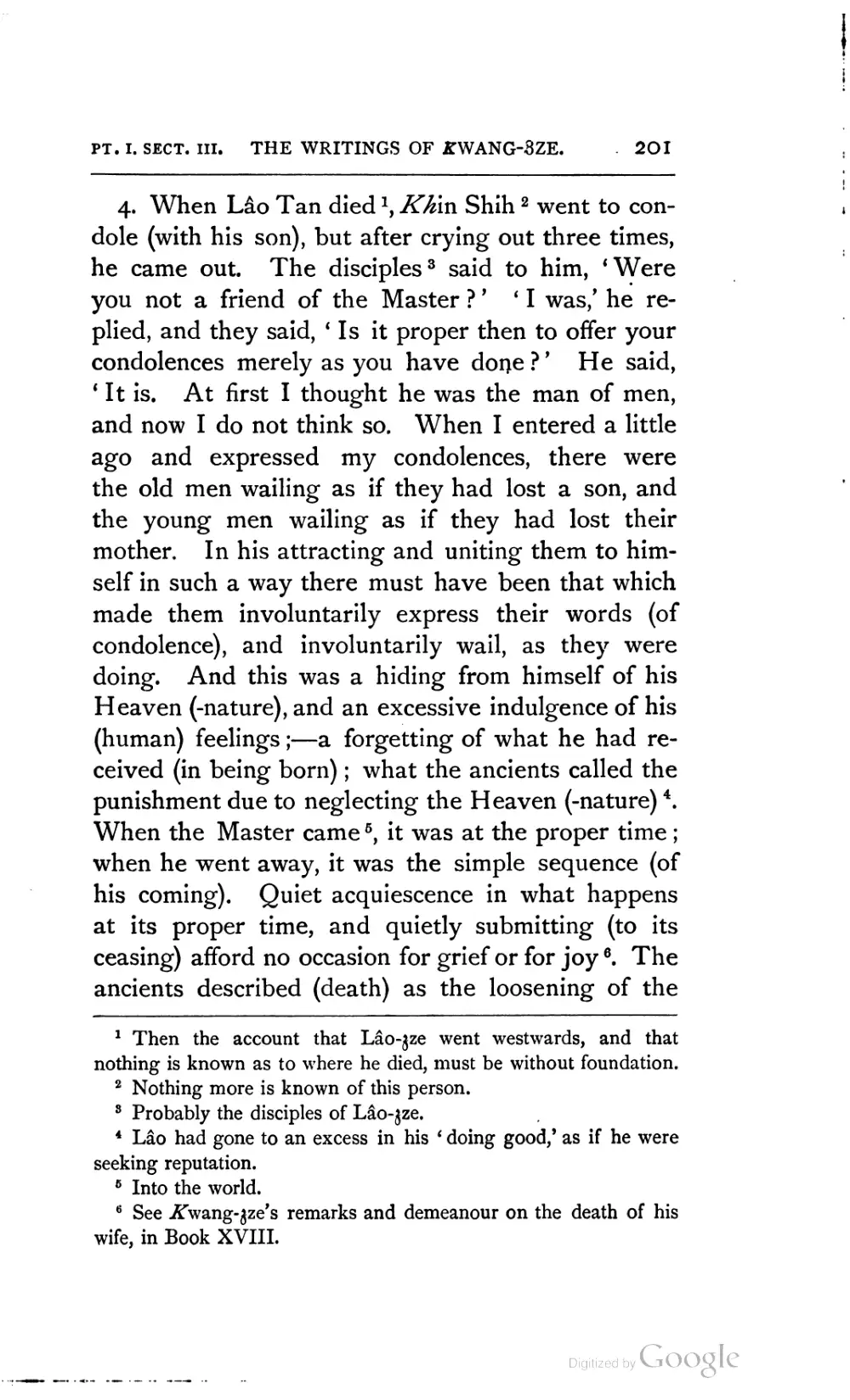
4. When Lâo Tan died1, Khin Shih2 went to condole (with his son), but after crying out three times, he came out. The disciples3 said to him, ‘Were you not a friend of the Master?’ ‘I was,’ he replied, and they said, ‘Is it proper then to offer your condolences merely as you have done?’ He said, ‘It is. At first I thought he was the man of men, and now I do not think so.
When I went in a little while ago and expressed my condolences, there were the old men wailing as if they had lost a son, and the young men wailing as if they had lost their mother. In his attracting and uniting them to himself in such a way there must have been that which made them involuntarily express their words (of condolence), and involuntarily wail, as they were doing. And this was a hiding from himself of his Heaven (-nature), and an excessive indulgence of his (human) feelings;—a forgetting of what he had received (in being born); what the ancients called the punishment due to neglecting the Heaven (-nature)4.
When the Master came5, it was at the proper time; when he went away, it was the simple sequence (of his coming). Quiet acquiescence in what happens at its proper time, and quietly submitting (to its ceasing), afford no occasion for grief or for joy6. The ancients described (death) as the loosening of the cord on which God suspended (the life)1. What we can point to are the faggots that have been consumed; but the fire is transmitted (elsewhere), and we do not know that it is over and ended2.
1 Then the account that Lâo-ȝze went westwards, and that nothing is known of where he died, must be without foundation.
2 Nothing more is known of this person.
5 Probably Lâo-ȝze’s disciples.
4 Lâo had gone to excess in his ‘doing good,’ as if he were seeking reputation.
5 Into the world.
6 See Kwang-ȝze’s remarks and demeanour on the death of his wife, in Book XVIII.