Legge's note supplies a crime the page never mentions, saying the Master of the Left "had done 'evil,'" and so suffered punishment. The speaker himself concludes the reverse: "It must be from Heaven,and not from Man." Whatever cut off the foot, the story asks that the condition be received as Heaven's making. The pheasant that will not trade its hard foraging for "a royal abundance" in a coop then reads as freedom over comfort, not as a moral on wisdom and penalty.
The Tâo Teh King — Sacred Books of China Part I, SBE Vol. 39 (trans. James Legge, 1891)
Open to all
page 200
No image is selected for this page; its own page image is shown.
page 200
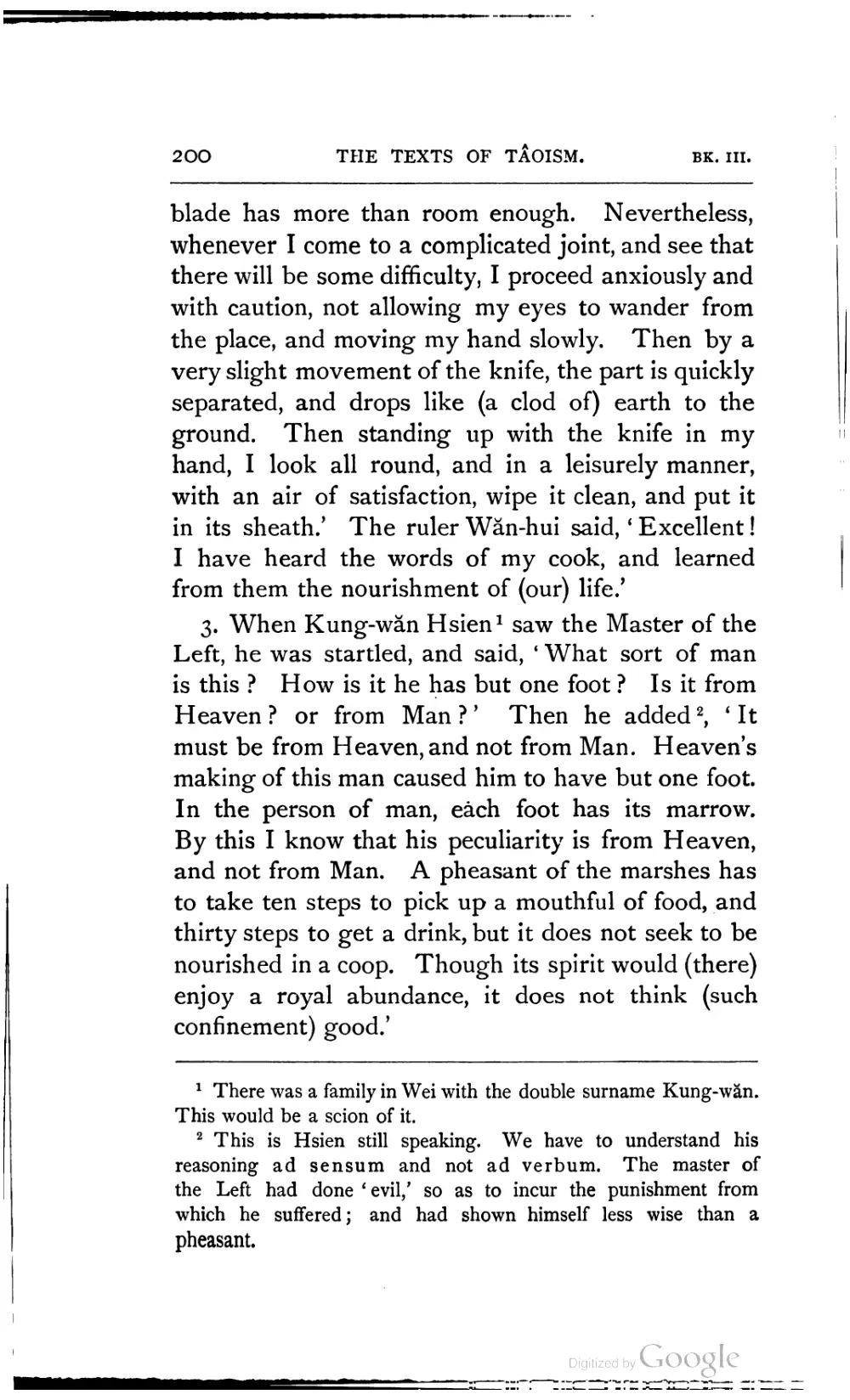
3. When Kung-wan Hsien1 saw the Master of the Left, he was startled, and said, ‘What sort of man is this? How is it that he has but one foot? Is it from Heaven? or from Man?’ Then he added2, ‘It must be from Heaven, and not from Man. Heaven’s making of this man caused him to have but one foot. In the person of man, each foot has its fellow. By this I know that his peculiarity is from Heaven, and not from Man. A pheasant of the marshes has to take ten steps to pick up a mouthful of food, and thirty steps to get a drink, but it does not seek to be nourished in a coop. Though its spirit would (there) enjoy a royal abundance, it does not think (such confinement) good.’
* There was a family in Wei with the double surname Kung-wan. This would be a scion of it.
2 This is Hsien still speaking. We have to understand his reasoning by its sense and not by its words. The Master of the Left had done ‘evil,’ so as to incur the punishment from which he suffered; and had shown himself less wise than a pheasant.