Legge warns that two different states must both be written "Wei" in English though their characters differ. The warning matters for every page that follows, because his romanisation cannot carry the distinction the Chinese makes on sight. A reader meeting "Wei" in this volume has to rely on context, or on the notes, to know which state is meant; the translator is right to say so rather than let the collision pass silently.
The Tâo Teh King — Sacred Books of China Part I, SBE Vol. 39 (trans. James Legge, 1891)
Open to all
page 203
No image is selected for this page; its own page image is shown.
page 203
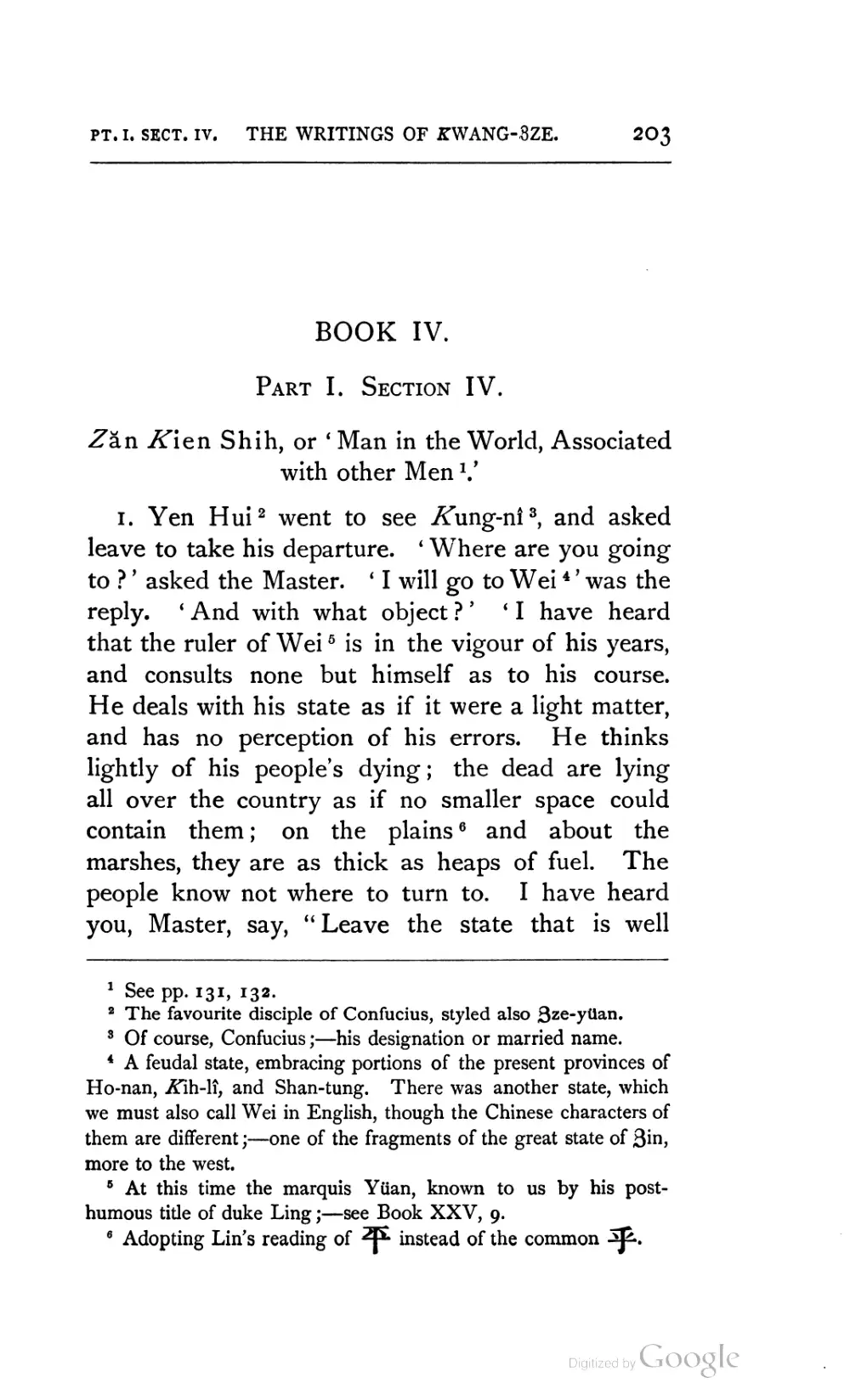
p. 203BOOK IV.
Part I. Section IV.
Zan Kien Shih, or ‘Man in the World, Associated with other Men1.’
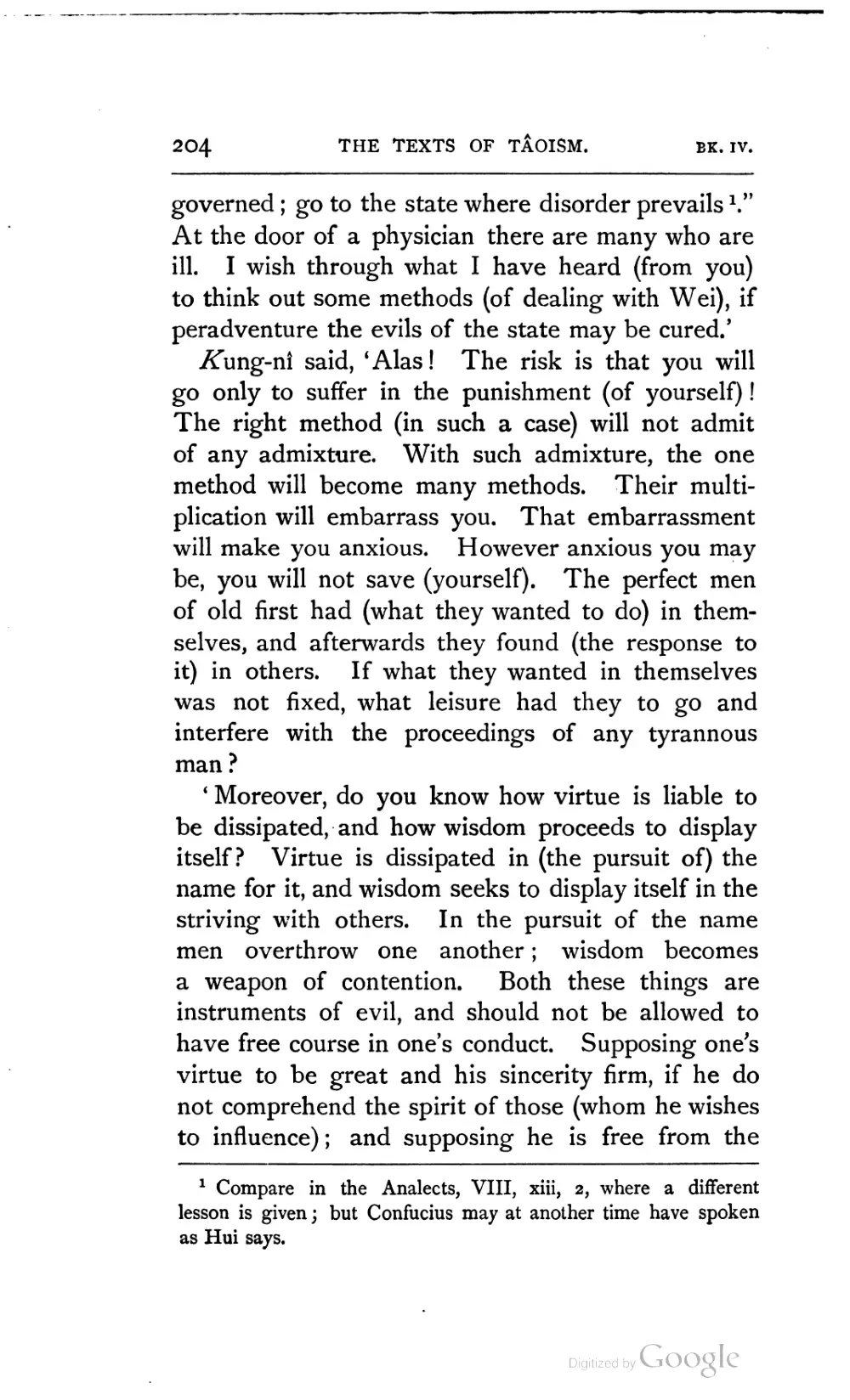
1. Yen Hui went to see Kung-nî³, and asked leave to take his departure. ‘Where are you going?’ asked the Master. ‘I will go to Wei*,’ was the reply. ‘And with what object?’ ‘I have heard that the ruler of Wei is in the vigour of his years, and consults no one but himself about his course. He deals with his state as if it were a light matter, and has no perception of his errors. He thinks lightly of his people’s dying; the dead lie all over the country as if no smaller space could hold them; on the plains and about the marshes, … fuel. The people do not know where to turn. I have heard you, Master, say, “Leave the state that is well governed; go to the state where disorder prevails.” At the door of a physician there are many who are ill. I wish, through what I have heard (from you), to think out some methods (of dealing with Wei), if perhaps the evils of the state may be cured.’
1 See pp. 131, 132.
2 The favourite disciple of Confucius, also styled Ȝze-yüan.
8 Confucius, of course; this is his designation, or married name.
4 A feudal state, embracing portions of the present provinces of Ho-nan, Kih-lî, and Shan-tung. There was another state, which we must also call Wei in English, though the Chinese characters for them are different;—one of the fragments of the great state of Ȝin, further to the west.
5 At this time the marquis Yüan, known to us by his posthumous title of duke Ling;—see Book XXV, 9.
6 Adopting Lin’s reading of 平 [Press: level, even; peaceful] instead of the common 乎 [Press: an interrogative or exclamatory particle].