Legge admits that the sentence on doing good without thought of fame and evil without nearing punishment "is not easily construed," and asks that the "doing evil" be "lightly understood." The request is his, not the text's. The line plainly allows some wrongdoing so long as it stays clear of penalty, which is startling and is meant to be. His supplement "(which it will incur)" and his softening note turn a provocation into a counsel about motive.
The Tâo Teh King — Sacred Books of China Part I, SBE Vol. 39 (trans. James Legge, 1891)
Open to all
page 198
No image is selected for this page; its own page image is shown.
page 198
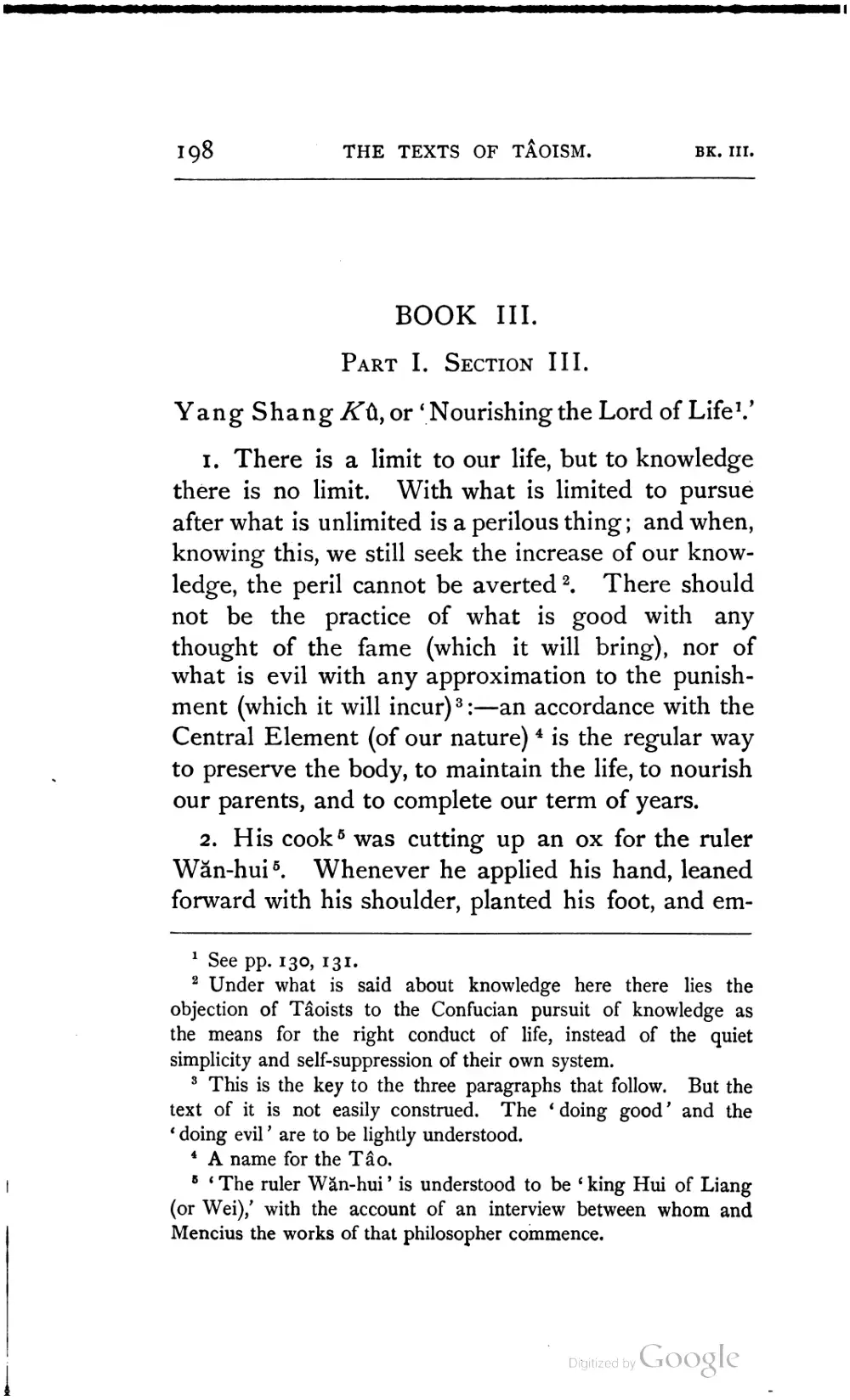
BOOK III.
Part I, Section III.
Yang Shang Kû, or ‘Nourishing the Lord of Life.’
1. There is a limit to our life, but to knowledge there is no limit. To pursue what is unlimited with what is limited is a perilous thing; and when, knowing this, we still seek to increase our knowledge, the peril cannot be averted1. There should be no practice of what is good with any thought of the fame (which it will bring), nor of what is evil with any approach to the punishment (which it will incur)2:—an accordance with the Central Element (of our nature)3 is the regular way to preserve the body, to maintain the life, to nourish our parents, and to complete our term of years.
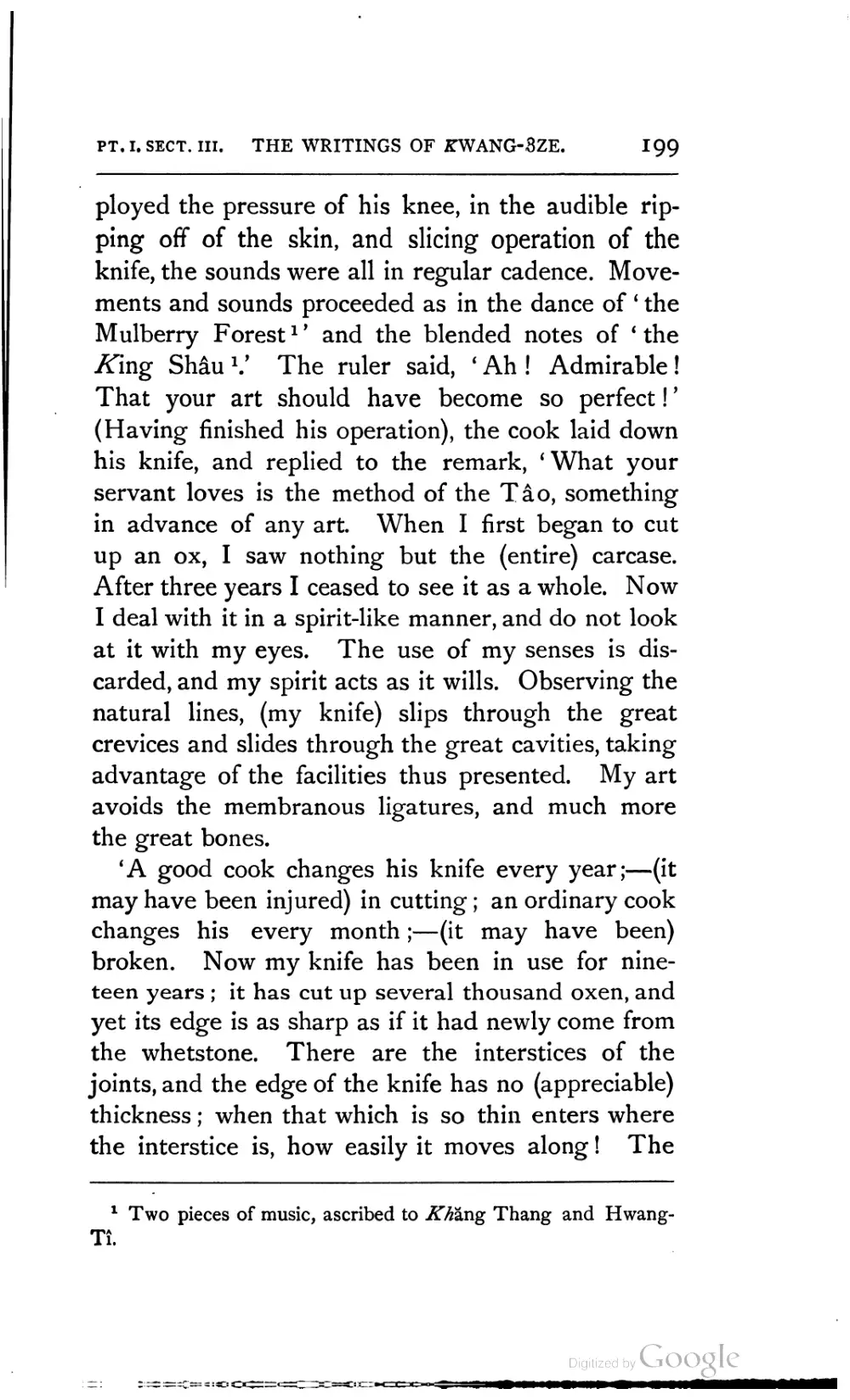
2. His cook5 was cutting up an ox for the ruler Wan-hui5. Whenever he applied his hand, leaned forward with his shoulder, planted his foot, and employed the pressure of his knee, in the audible ripping off of the skin, and in the slicing operation of the knife, the sounds were all in regular cadence. Movements and sounds proceeded as in the dance of ‘the Mulberry Forest1’ and the blended notes of ‘the King Shâu1.’ The ruler said, ‘Ah! Admirable! That your art should have become so perfect!’
(Having finished his operation), the cook laid down his knife, and replied to the remark, ‘What your servant loves is the method of the Tâo, something in advance of any art. When I first began to cut up an ox, I saw nothing but the (entire) carcass. After three years I ceased to see it as a whole. Now I deal with it in a spirit-like manner, and do not look at it with my eyes. The use of my senses is discarded, and my spirit acts as it wills. Observing the natural lines, (my knife) slips through the great crevices and slides through the great cavities, taking advantage of the openings thus presented. My art avoids the membranous ligatures, and much more the great bones.
* See pp. 130, 131.
* Under what is said about knowledge here lies the objection of the Taoists to the Confucian pursuit of knowledge as the means for the right conduct of life, instead of the quiet simplicity and self-suppression of their own system.
* This is the key to the three paragraphs that follow. But its text is not easily construed. The ‘doing good’ and the ‘doing evil’ are to be understood lightly.
* A name for the Tâo.
° ‘The ruler Wan-hui’ is understood to be ‘king Hui of Liang (or Wei),’ with the account of whose interview with Mencius the works of that philosopher begin.
The cook says what he loves is "the method of the Tâo, something in advance of any art," yet everything he then describes is practice: three years before he stops seeing the whole carcase, nineteen years with one knife. The Tâo is not offered as a substitute for skill but as what skill becomes when it no longer needs the eyes. The story is about technique carried past its own rules, not about bypassing it.