The Tâo Teh King — Sacred Books of China Part I, SBE Vol. 39 (trans. James Legge, 1891)

Open to allEdited by F. Max Müller; translated by Müller, Legge, Bühler, West, Darmesteter, Palmer, Telang, Thibaut, Jolly, Rhys Davids, Oldenberg, Jacobi, Bloomfield and others1850 segments · 383 pp
page 124

No image is selected for this page; its own page image is shown.

The Tâo Teh King — Sacred Books of China Part I, SBE Vol. 39 (trans. James Legge, 1891), photo of the original · p. 124
Photo of the original · p. 124
page 124

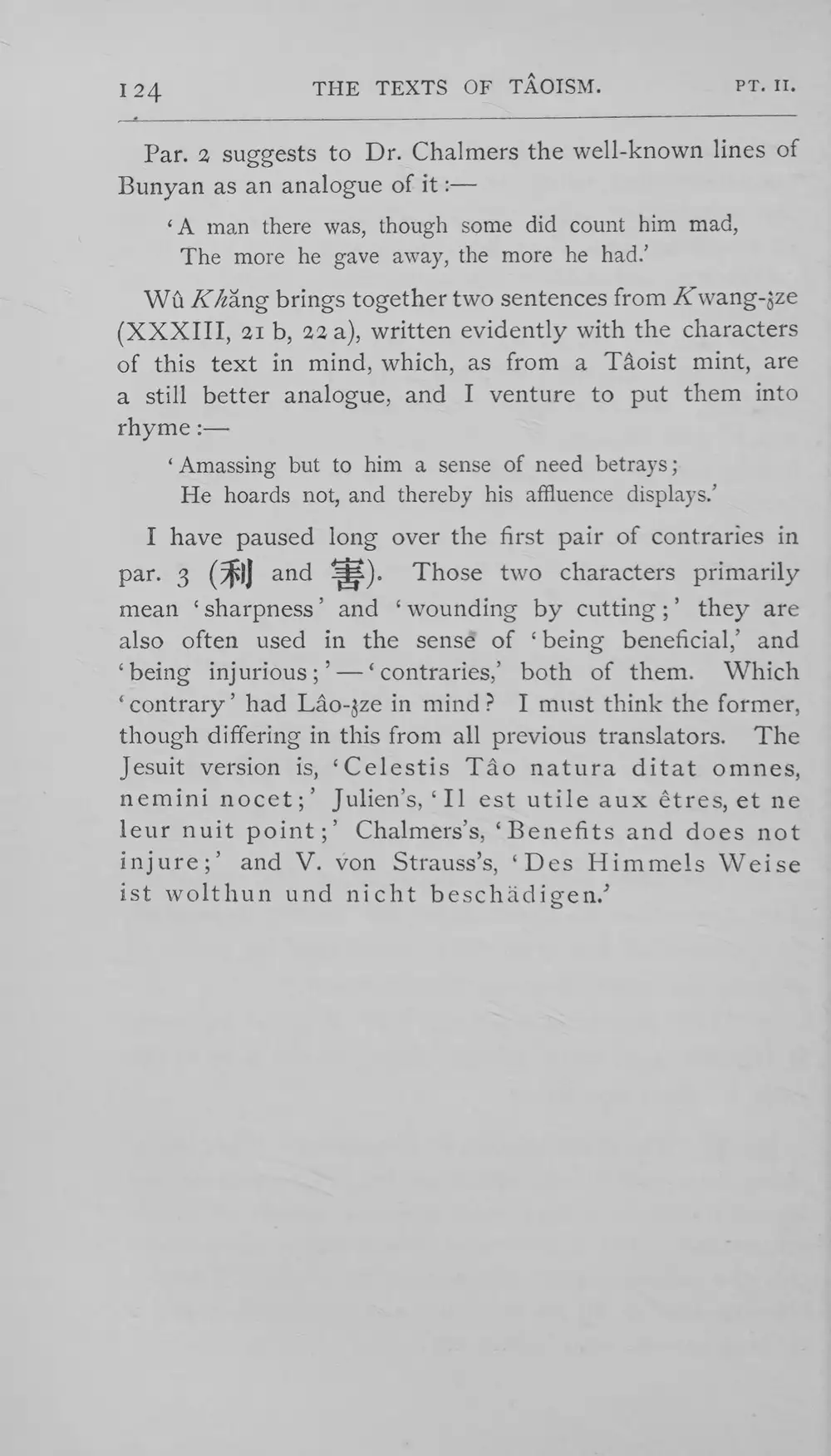
Par. 2 suggests to Dr. Chalmers, as a parallel to it, the well-known lines of Bunyan:—

‘A man there was, though some did count him mad, The more he gave away, the more he had.’

Wû Khăng brings together two sentences from Kwang-ȝze (XXXIII, 21 b, 22a), written evidently with the characters of this text in mind, which, as if from a Tâoist mint, are a still better parallel, and I venture to put them into rhyme:—

‘Amassing but to him a sense of need betrays; He hoards not, and thereby his affluence displays.’

I have paused long over the first pair of contraries in par. 3 (利 [Press: sharpness; profit, advantage] and 害 [Press: injury, harm]). Those two characters mean primarily ‘sharpness’ and ‘wounding by cutting;’ they are also often used in the sense of ‘being beneficial’ and ‘being injurious;’—‘contraries,’ both of them. Which ‘contrary’ did Lâo-ȝze have in mind? I must think the former, though in this I differ from all previous translators. The Jesuit version is, ‘The heavenly Tao by its nature enriches all, and harms no one;’ Julien’s, ‘It is useful to beings, and does them no harm at all;’ Chalmers’s, ‘Benefits and does not injure;’ and V. von Strauss’s, ‘Heaven’s way is to do good and not to harm.’

Commentary
page 124 ·
Cross-Estate§103

The two sentences Wû Khăng adduces come from Kwang-ȝze's Book XXXIII, the last, which this shelf holds in the second volume. There they are not one saying. ‘To see deficiency in accumulation’ belongs to the ancient Tâo that Kwan Yin and Lâo Tan are said to have admired; ‘He does not store, and therefore he has a superabundance’ is among the words given to Lâo Tan himself, which Legge's note there calls quotation from the Tâo Teh King. The pair is less an independent reading of chapter 81, paragraph 2, than the King's own thought returned to it, which is why it suits his rhyme so well.

cites The Writings of Kwang-tze — Sacred Books of China Part II, SBE Vol. 40 (trans. James Legge, 1891)

Historical§105

Legge takes 利 in chapter 81 as “sharpness”, against the Jesuits, Julien, Chalmers and von Strauss, who all read benefit. The book supports him: in chapter 58 the sage is “a square which cuts no one”, sharp yet not wounding, and the sentence here pairs a sharpness that “injures not” with the sage's doing that “does not strive”, each an active quality without its usual effect. That is the pattern of contraries the book runs on, and the benefit reading loses it.