Legge's reason for refusing Wû Khăng's and Ȝiâo Hung's “implements of agriculture” is a sound rule of method: a reading built on “a custom of the Han dynasty” cannot fix the sense of a far older text, and it depends besides on dropping a 人 from Ho-shang Kung's text. He applies the same rule to the Shwo Wăn's late definition of the True Man in his notice of Kwang-ȝze's Book VI. The reader should hold him to it where he leans on Han witnesses himself, as with Liû Hsiang at chapter 53.
The Tâo Teh King — Sacred Books of China Part I, SBE Vol. 39 (trans. James Legge, 1891)
Open to all
page 123
No image is selected for this page; its own page image is shown.
page 123
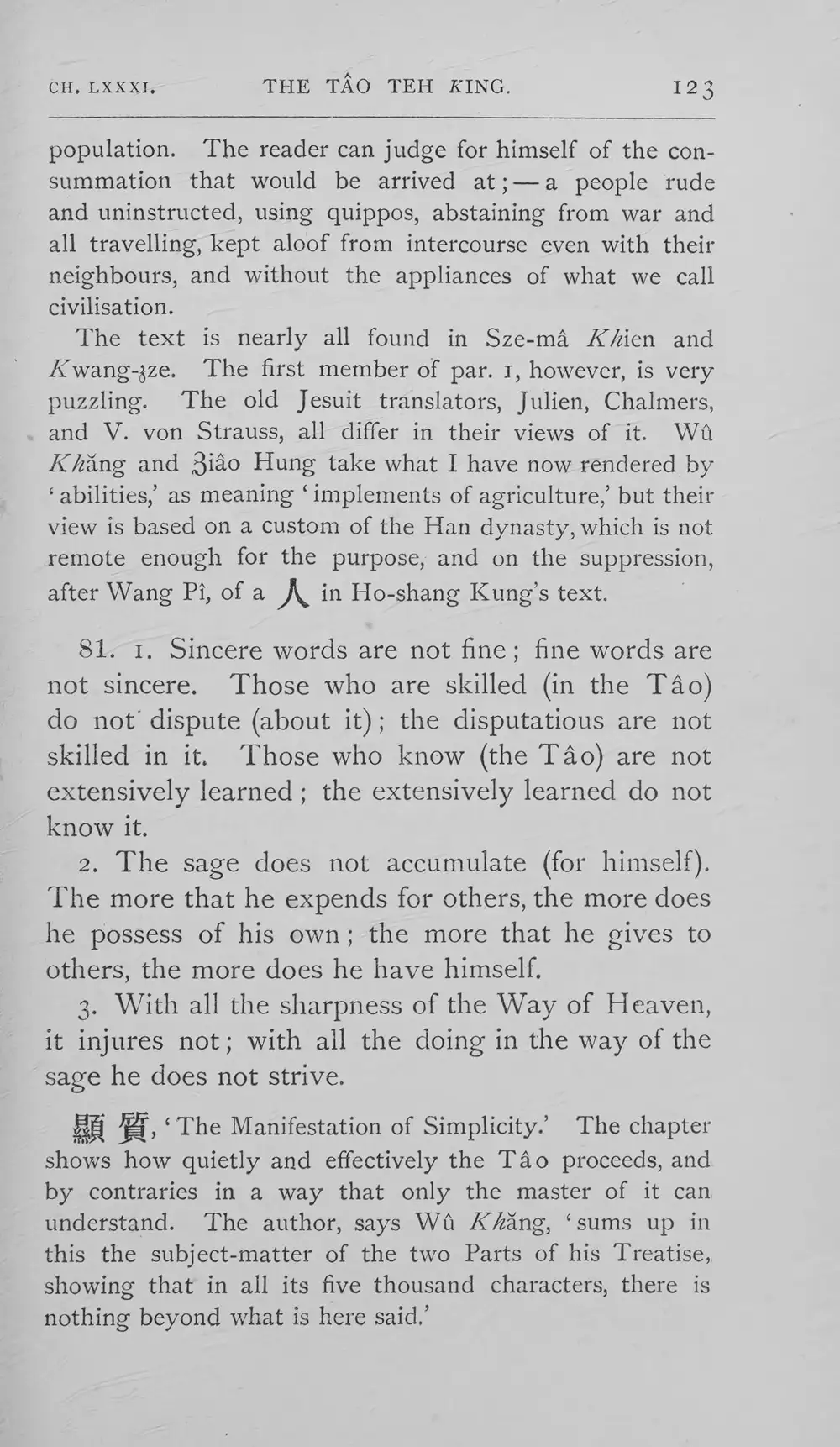
The text is nearly all found in Sze-ma Khien and Kwang-ȝze. The first part of par. 1, however, is very puzzling. The old Jesuit translators, Julien, Chalmers, and V. von Strauss all differ in their views of it. Wû Khăng and Ȝiâo Hung take what I have now rendered ‘abilities’ as meaning ‘implements of agriculture,’ but their view rests on a custom of the Han dynasty, which is not ancient enough for the purpose, and on the suppression, after Wang Pî, of a 人 [Press: man; a person] in Ho-shang Kung’s text.
81. 1. Sincere words are not fine; fine words are not sincere. Those who are skilled (in the Tao) do not dispute (about it); the disputatious are not skilled in it. Those who know (the Tâo) are not widely learned; the widely learned do not know it.
2. The sage does not accumulate (for himself). The more he spends for others, the more he possesses of his own; the more he gives to others, the more he has himself.
3. With all the sharpness of the Way of Heaven, it does not injure; with all the doing in the way of the sage, he does not strive.
顯質, ‘The Manifestation of Simplicity.’ The chapter shows how quietly and effectively the Tao proceeds, and by contraries, in a way that only its master can understand. The author, says Wû Khăng, ‘sums up in this the subject-matter of the two Parts of his Treatise, showing that in all its five thousand characters there is nothing beyond what is said here.’