To show how “startling” the spirit-like man of Book I is, Legge sets beside him scriptural praises of God: the “Blessed and only Potentate”, he who “covereth Himself with light as with a garment” and “maketh the clouds His chariot”. The measure is revealing. He judges the language extravagant because it claims what his own canon reserves for God, whereas the Book offers the figure as what the Tao makes of a man, an account of human possibility rather than a rival theology.
The Tâo Teh King — Sacred Books of China Part I, SBE Vol. 39 (trans. James Legge, 1891)
Open to all
page 127
No image is selected for this page; its own page image is shown.
page 127
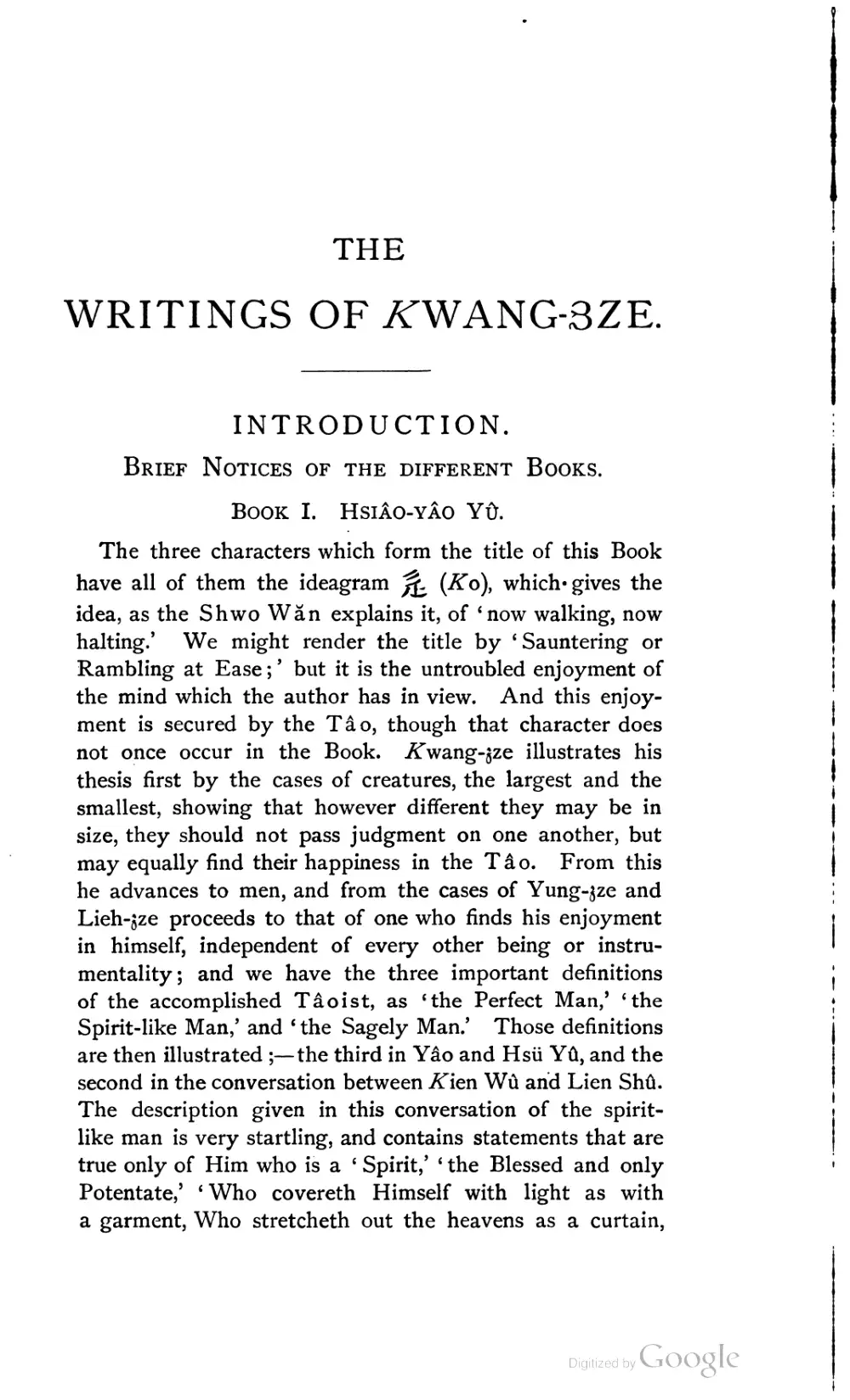
THE
WRITINGS OF KWANG-ȜZE.
INTRODUCTION.
Brief Notices of the Different Books.
Book I. HSIÂO-YÂO YÛ.
The three characters that form the title of this Book all have the ideogram 辵 (Ko), which gives the idea, as the Shwo Wan explains it, of ‘now walking, now halting.’ We might render the title ‘Sauntering or Rambling at Ease;’ but it is the untroubled enjoyment of the mind that the author has in view. And this enjoyment is secured by the Tao, though that character does not occur once in the Book. Kwang-ȝze illustrates his thesis first by the cases of creatures, the largest and the smallest, showing that however different they may be in size, they should not pass judgment on one another, but may equally find their happiness in the Tao. From this he advances to men, and from the cases of Yung-ȝze and Lieh-ȝze proceeds to that of one who finds his enjoyment in himself, independent of every other being or agency; and we have the three important definitions of the accomplished Taoist, as ‘the Perfect Man,’ ‘the Spirit-like Man,’ and ‘the Sagely Man.’
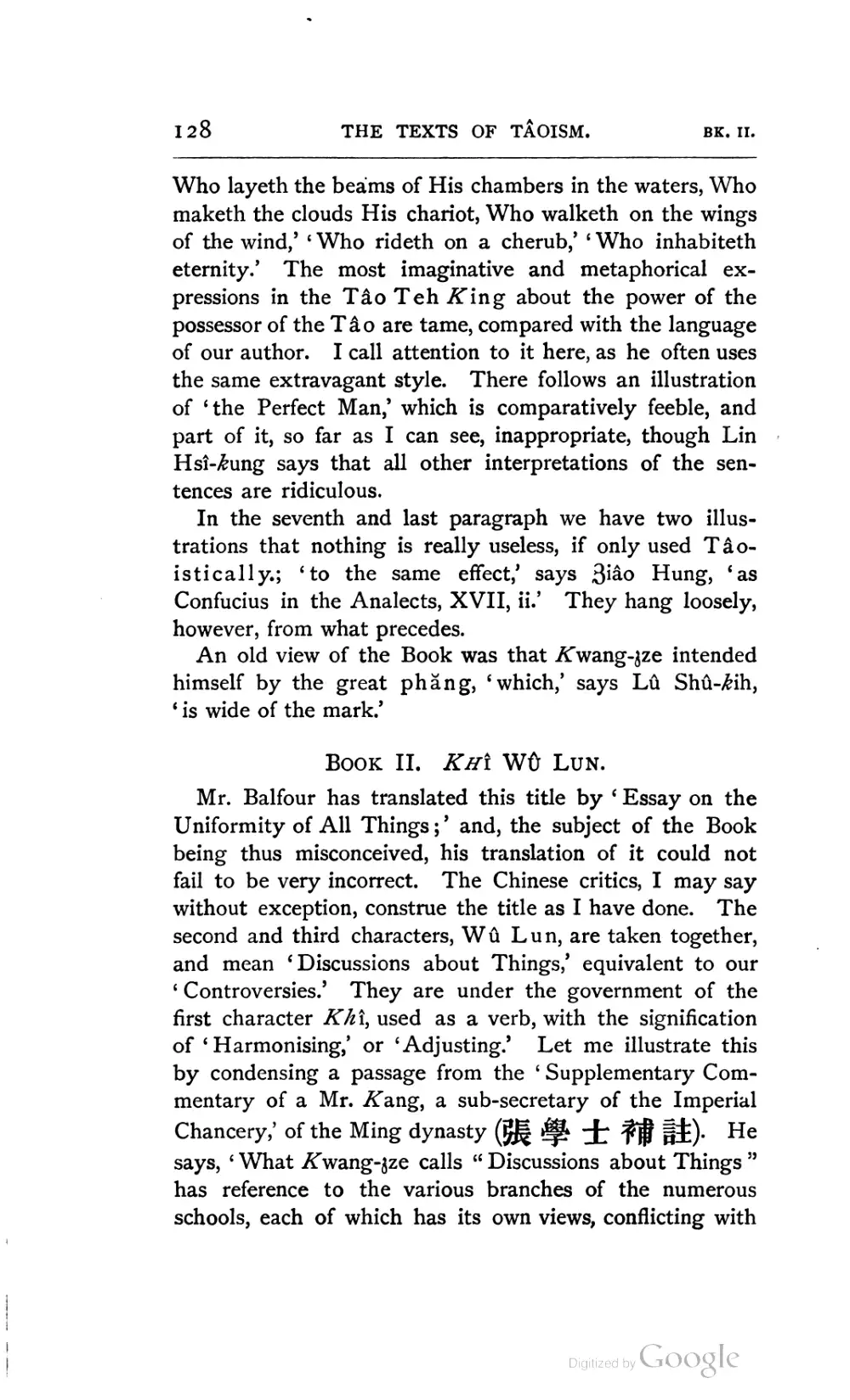
Those definitions are then illustrated;—the third in Yâo and Hsü Yû, and the second in the conversation between Kien Wû and Lien Shû. The description given in this conversation of the spirit-like man is very startling, and contains statements that are true only of Him who is a ‘Spirit,’ ‘the Blessed and only Potentate,’ ‘Who covereth Himself with light as with a garment, Who stretcheth out the heavens as a curtain, Who layeth the beams of His chambers in the waters, Who maketh the clouds His chariot, Who walketh on the wings of the wind,’ ‘Who rideth on a cherub,’ ‘Who inhabiteth eternity.’ The most imaginative and metaphorical expressions in the Tao Teh King about the power of the possessor of the Tâo are tame compared with the language of our author. I draw attention to it here, as he often uses the same extravagant style.
There follows an illustration of ‘the Perfect Man,’ which is comparatively feeble, and part of it, so far as I can see, inappropriate, though Lin Hsi-kung says that all other interpretations of the sentences are ridiculous.