Legge asks whether rulers or people are meant in “the concluding sentence” of paragraph 2. Paragraph 2 ends plainly on the people being hard to govern; the sentence where the question is real, that to leave living out of view is better than to set a high value on it, closes paragraph 3. The number looks like a slip, and the question belongs to paragraph 3, where both the rulers and the people have just been named.
The Tâo Teh King — Sacred Books of China Part I, SBE Vol. 39 (trans. James Legge, 1891)
Open to all
page 118
No image is selected for this page; its own page image is shown.
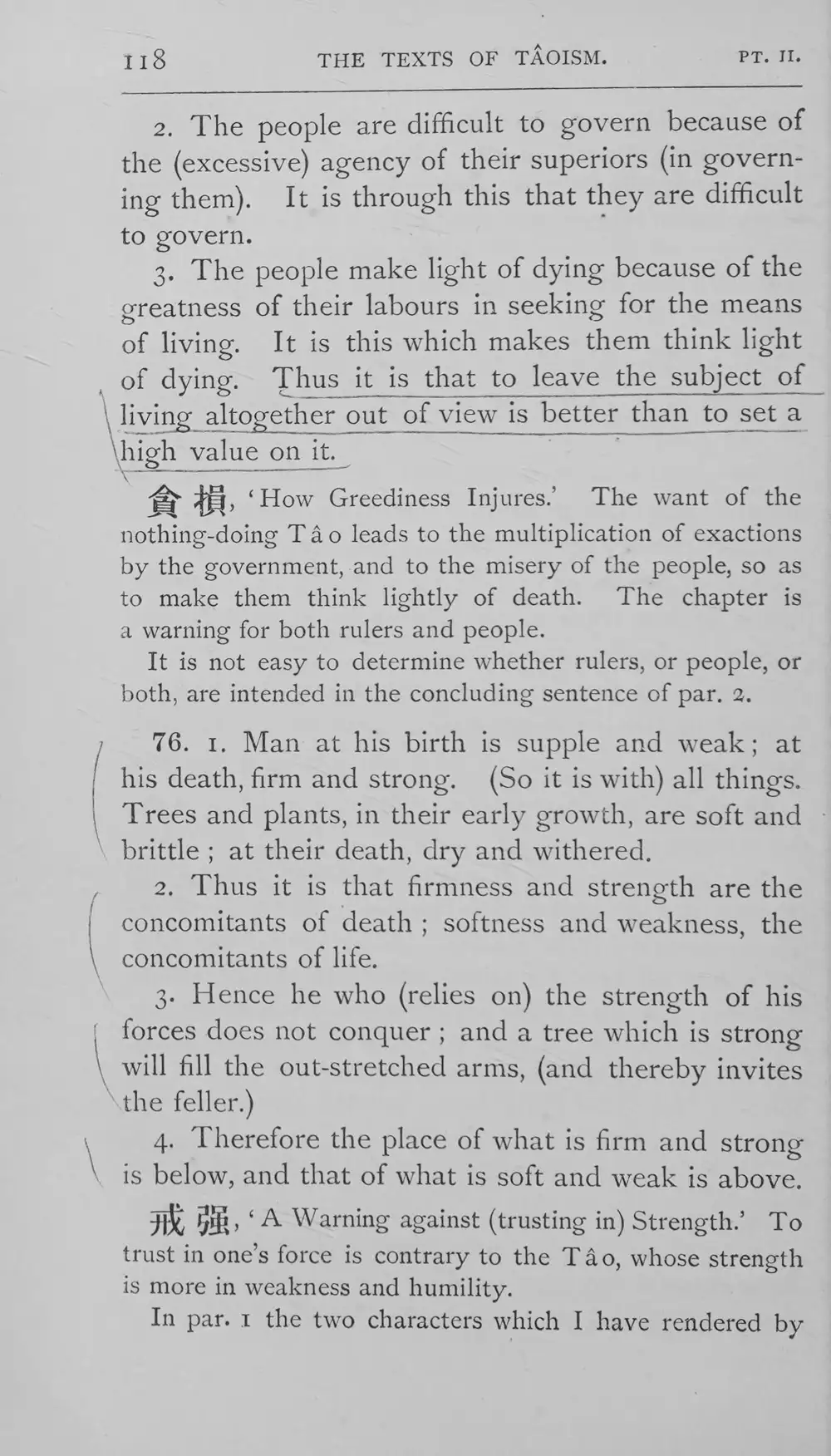
page 118
2. The people are difficult to govern because of the (excessive) activity of their superiors (in governing them). It is through this that they are difficult to govern.
3. The people make light of dying because of the greatness of their labours in seeking the means of living. It is this that makes them think lightly of dying. So it is that to leave the matter of living out of view altogether is better than to set a high value on it.
貪損, ‘How Greediness Injures.’ The want of the Tao that does nothing leads to the multiplying of exactions by the government, and to the misery of the people, so that they come to think lightly of death. The chapter is a warning to rulers and people alike.
It is not easy to determine whether rulers, or people, or both, are meant in the closing sentence of par. 2.
76. 1. Man at his birth is supple and weak; at his death, firm and strong. (So it is with) all things. Trees and plants, in their early growth, are soft and brittle; at their death, dry and withered.
2. So it is that firmness and strength go with death; softness and weakness go with life.
3. Hence he who (relies on) the strength of his forces does not conquer; and a tree that is strong will fill the outstretched arms (and so invites the feller).
4. Therefore the place of what is firm and strong is below, and that of what is soft and weak is above.
戒强, ‘A Warning against (trusting in) Strength.’ To trust in one’s force is contrary to the Tâo, whose strength lies rather in weakness and humility.
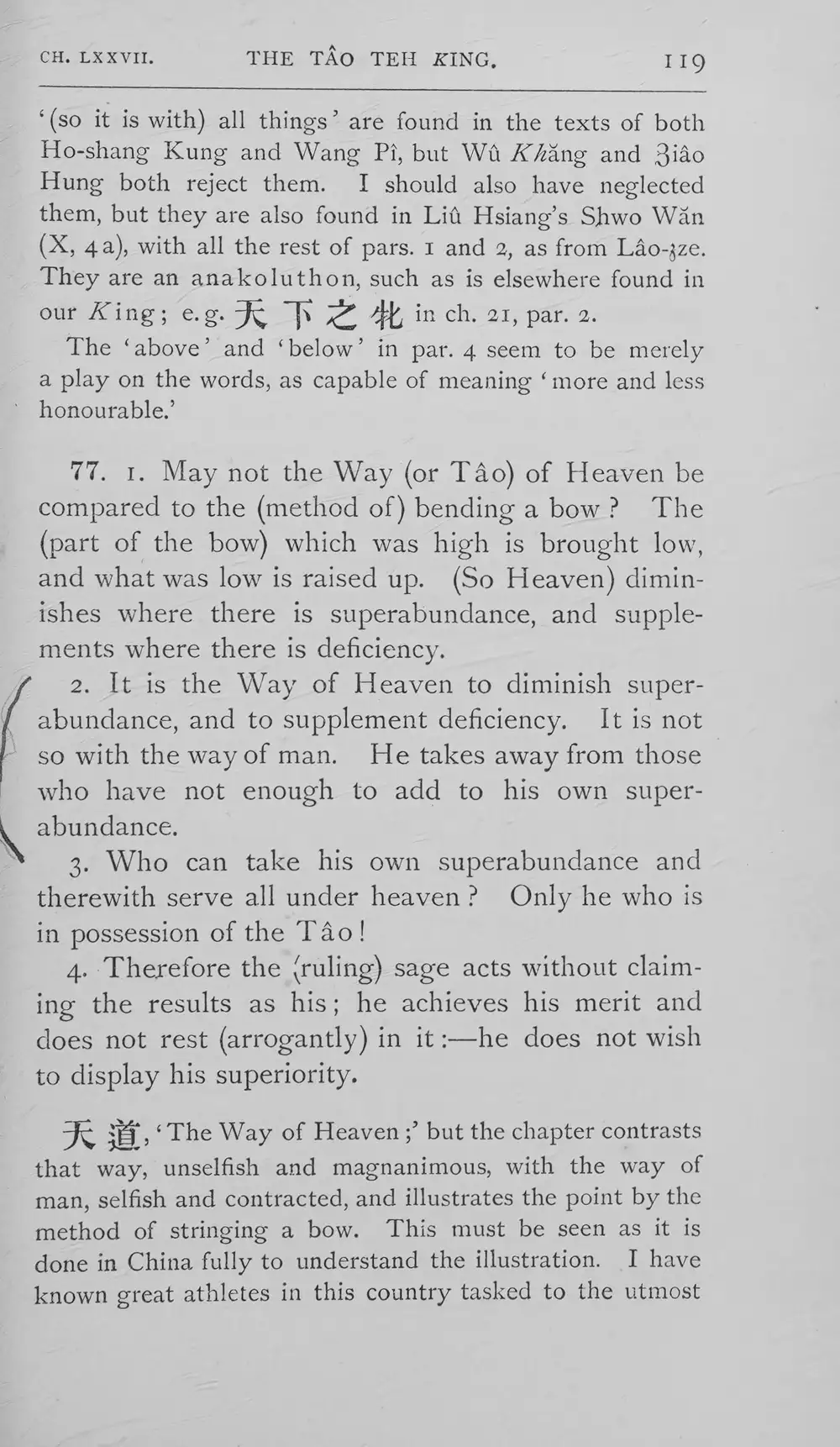
In par. 1 the two characters which I have translated as ‘(so it is with) all things’ are found in the texts of both Ho-shang Kung and Wang Pi, but Wa Kang and 3ido Hung both reject them. I would have left them out too, but they are also found in Liti Hsiang's Shwo Wan (X, 4a), with all the rest of pars. 1 and 2, as from Lâo-ȝze. They are an anacoluthon, such as is found elsewhere in our King; e.g. 天下之牝 [Press: the female of all under heaven] in ch. 21, par. 2.