Here Heaven “hates the ill-doer”, has “Its judgments” with a capital, and is matched with the Psalm's “Clouds and darkness are round about Him”. In his note on chapter 59 the same translator insisted Heaven is not “any personal Power” but the heavenly element in our nature, and on chapter 67 that it is “the course of events”. His rhyme “When Heaven's anger smites a man” supplies an anger that “the way of Heaven not to strive” sits uneasily with.
The Tâo Teh King — Sacred Books of China Part I, SBE Vol. 39 (trans. James Legge, 1891)
Open to all
page 116
No image is selected for this page; its own page image is shown.
page 116
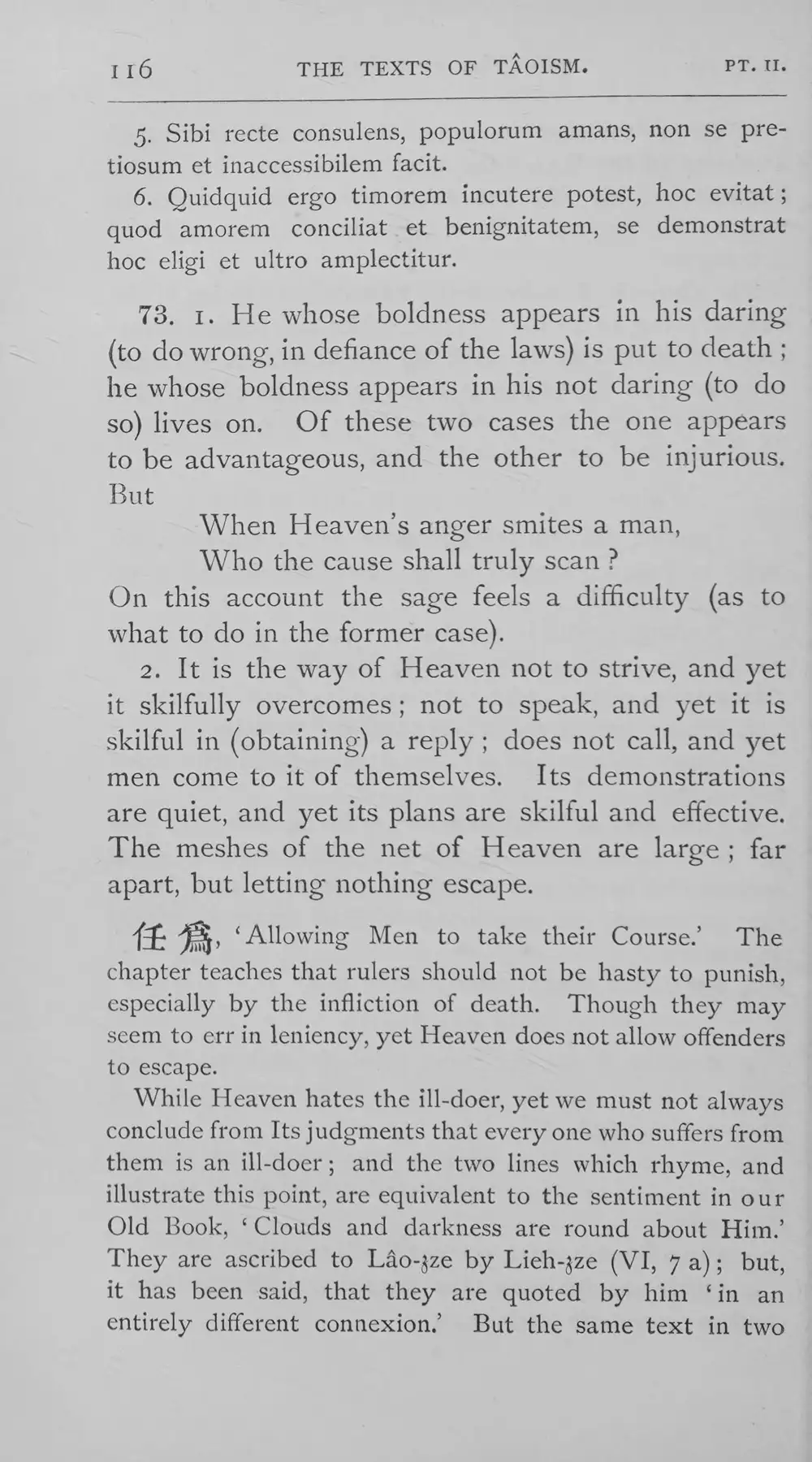
5. Taking right thought for himself, and loving the peoples, he does not make himself precious and inaccessible.
6. Whatever, therefore, can strike fear, he avoids; what wins love and shows kindness, he chooses and willingly embraces.
73. 1. He whose boldness shows itself in daring (to do wrong, in defiance of the laws) is put to death; he whose boldness shows itself in not daring (to do so) lives on. Of these two cases the one seems to be advantageous, and the other harmful. But When Heaven’s anger strikes a man, Who shall truly discern the cause? For this reason the sage feels a difficulty (as to what to do in the former case).
2. It is the way of Heaven not to strive, and yet it skilfully overcomes; not to speak, and yet it is skilful in (obtaining) a reply; not to call, and yet men come to it of their own accord. Its workings are quiet, and yet its plans are skilful and effective. The meshes of the net of Heaven are large and far apart, but they let nothing escape.
任爲, ‘Allowing Men to take their Course.’ The chapter teaches that rulers should not be hasty to punish, especially by inflicting death. Though they may seem to err on the side of leniency, Heaven does not let offenders escape.
While Heaven hates the wrongdoer, we must not always conclude from Its judgments that everyone who suffers by them is a wrongdoer; and the two rhyming lines that illustrate this point are equivalent to the sentiment in our Old Book, ‘Clouds and darkness are round about Him.’ They are ascribed to Lâo-ȝze by Lieh-ȝze (VI, 7a); but it has been said that they are quoted by him ‘in an entirely different connexion.’
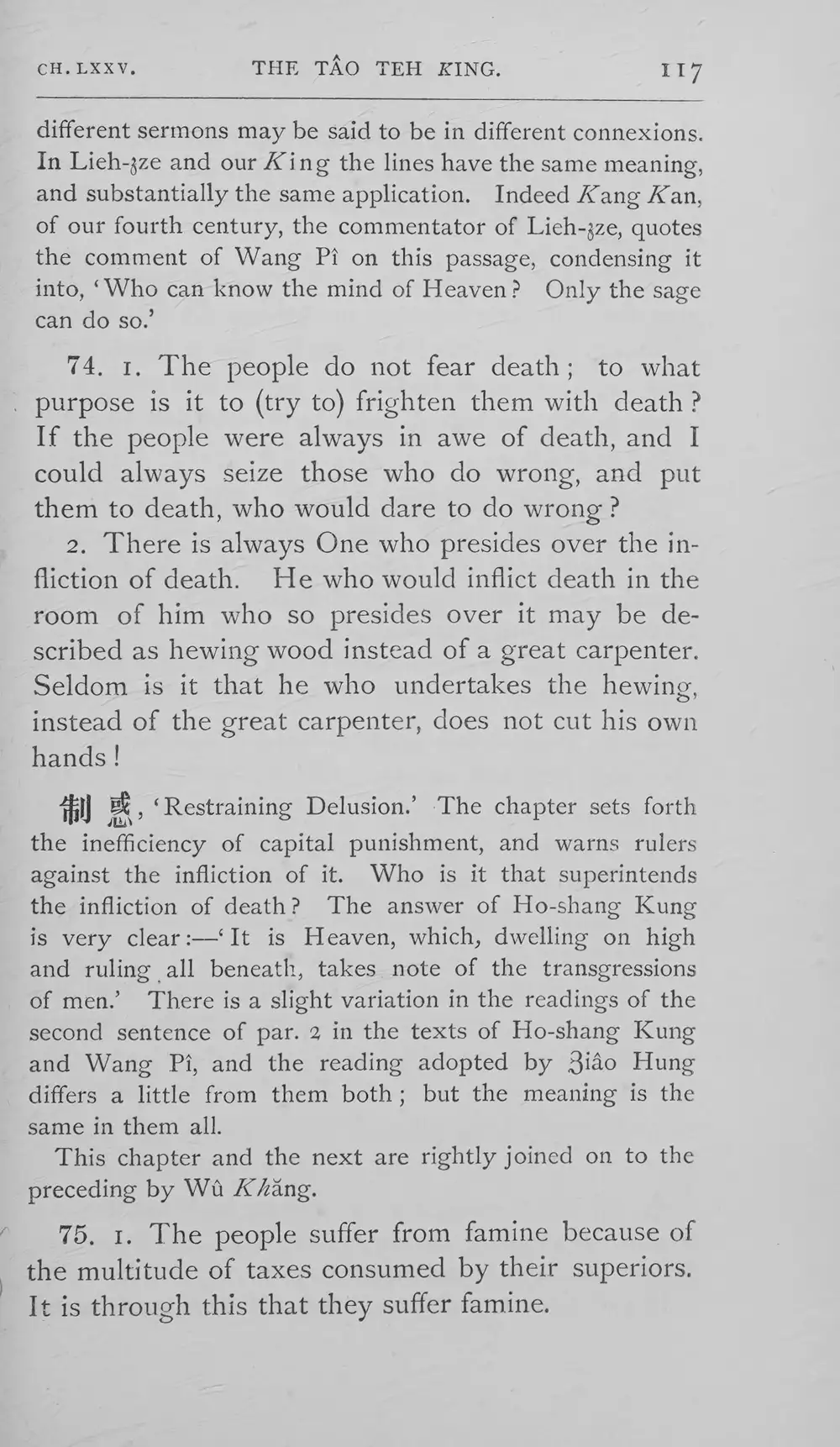
But the same text in two different sermons may be said to be in different connexions. In Lieh-ȝze and our King the lines have the same meaning, and substantially the same application. Indeed Kang Kan, of our fourth century, the commentator on Lieh-ȝze, quotes Wang Pî’s comment on this passage, condensing it into, ‘Who can know the mind of Heaven? Only the sage can do so.’