Legge's summary says the chapter sets forth “the inefficiency of capital punishment”. Paragraph 1 argues that, but paragraph 2 argues something else: there is “One who presides over the infliction of death”, and the ruler who kills in his place is hewing wood instead of the great carpenter and will cut his own hands. That objection is usurpation, not ineffectiveness, and it is the stronger of the chapter's two arguments.
The Tâo Teh King — Sacred Books of China Part I, SBE Vol. 39 (trans. James Legge, 1891)
Open to all
page 117
No image is selected for this page; its own page image is shown.
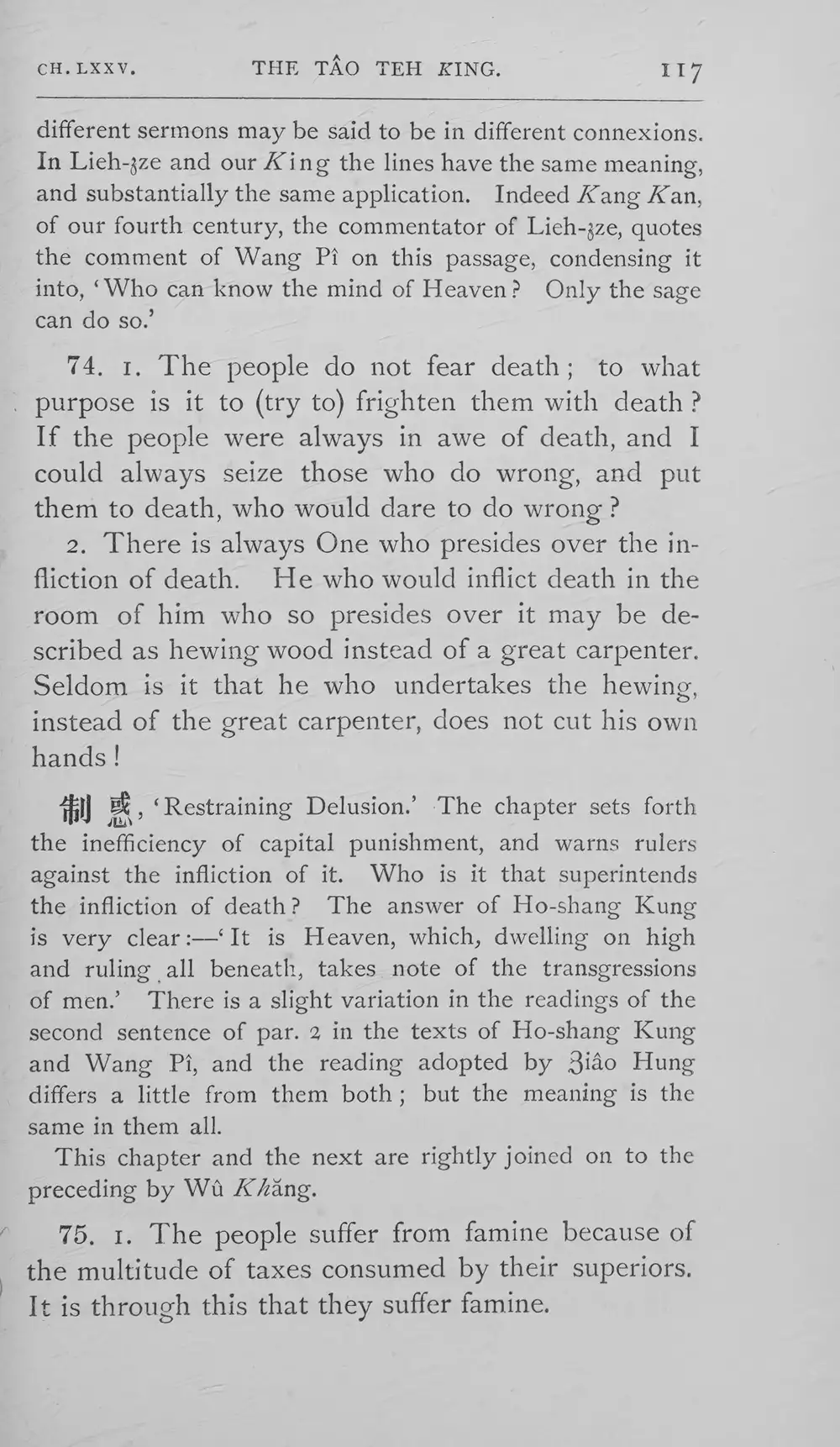
page 117
74. 1. The people do not fear death; what is the use of (trying to) frighten them with death? If the people were always in awe of death, and I could always seize those who do wrong and put them to death, who would dare to do wrong?
2. There is always One who presides over the infliction of death. He who would inflict death in place of the one who so presides over it may be described as hewing wood in place of a great carpenter. Seldom is it that he who undertakes the hewing in place of the great carpenter does not cut his own hands!
制惑, ‘Restraining Delusion.’ The chapter sets out the ineffectiveness of capital punishment, and warns rulers against inflicting it. Who is it that oversees the infliction of death? Ho-shang Kung’s answer is very clear:—‘It is Heaven, which, dwelling on high and ruling all below, takes note of the transgressions of men.’ There is a slight variation in the readings of the second sentence of par. 2 in the texts of Ho-shang Kung and Wang Pî, and the reading adopted by Ȝiâo Hung differs a little from both; but the meaning is the same in all of them.
This chapter and the next are rightly joined on to the preceding one by Wû Khăng.
75. 1. The people suffer from famine because of the multitude of taxes consumed by their superiors. It is through this that they suffer famine.