The Satapatha-Brâhmana, Part IV — SBE Vol. 43 — trans. Julius Eggeling (1897)
The translator’s English as printed (Julius Eggeling). The original-language text is not held; names are romanised as the translator printed them.
369:2 Or, finally comes to; viz. inasmuch as it is by the placing of the Lokamprinâ bricks that the altar is completed (Sây.); and inasmuch as Agni passes into the sun.
369:3 Purusho mithunam yoshid ity etasmin mithunam hy âtmanoऽrdham ardhabhâgah, ardho vâ esha âtmano yat patnîti taittirîyasruteh. Sây.
369:4 When the layers are filled up with 'space-fillers,' two Lokamprinâs are first laid down in one of the four corners, and from them the available spaces are then filled up, in two turns, in the sunwise direction; cf. p. 22, note 1.
369:5 Cf. I, 9, 2, 12, 'whenever women here eat, they do so apart from men;' where the use of the 'gighatsanti' (swallow their food)--as against asnîyât in our passage--is not meant disrespectfully, but as the regular desiderative of 'ad' (Pân. II, 4, 37), for which no doubt 'asisishanti' (Sat. Br. III, 1, 2, 1) might have been used.
370:1 Or, 'act most in secrecy.' Sâyana explains it: manushyânâm madhye râganyabandhavoऽnutamâm gopâyanti atyartham rahasyatvena kurvanti tasmât teshu viryavân putro gâyate. The St. Petersb. Dict., on the other hand, takes it in the sense of 'they protect most of all;' though it is difficult to see how the, 'protection' afforded by princes or rulers could have any bearing on men taking their food apart from their wives. If the above interpretation is right we may compare 'anu-gup' in the sense of 'to conceal.' See, however, the next note, where Sâyana takes 'gopâyati' in the sense of 'observes (that law),' which might also have suited here. Princes, having their seraglio, would naturally have less occasion for coming into contact with their wives at mealtime than men of lower stations of life. On the superlative of the preposition, see p. 287, note 1.
370:2 ? The swift eagle,--vayasâm pakshinâm madhye amritavâkâ nâma pakshigâtir etad vratam gopâyati, atah sâ kshipram sîghragâminam syenam nâma pakshinam ganayati. Sây.
370:3 Hridayasyâkâsam daharam prâpya. Sây.
370:4 That is, 'unconscious,' with something of 'indifferent, apathetic,' implied:--Loke mânushasya maithunasyântam gatvâऽ samvidâ agânâneva nrâ strî bhavati (marg. corr. agânânâv eva strîpurushau bhavatah) evam tadâ tayor mithunabhâve (? mithunâbhâve) purushoऽsamvida iva bhavati. Sây.
371:1 Viz. because it is the union of Indra and Indrânî.
371:2 Or, perhaps, it is the usual practice (lokyam), as the St. Petersb. Dict. takes it.
371:3 Dhureva pîdayaiva na bodhayet, na prabuddham kuryât, dhûrvater himsârthat kvipi tâblope rûpam. Sây.
371:4 ? His (life) has been cut off; or, his (life-string) has been severed. Sâyana (unless there is an omission in the MS.) does not explain 'kâkhedy asya,' but seems to take 'pretam' (passed away) as the word on which the stress lies:--tasmâd imam pretam ity âhuh, prapûrvâd eteh ktapratyaye rûpam; katham, akshipurushanirgame purushasya maranam.
372:1 Or, they keep within him, they nestle in him,--apiyanti prâpnuvanti, âliyanta ity arthah. Sây.
373:1 Esha purusha idam sarvam gagad yunakti sarvatra svayam samgata iti. Sây.
373:2 Etasmin paramâtmani kârane sarvam kâryagâtam samânam iti. Sây.
373:3 The characteristic attributes of the Gandharvas and Apsaras are evidently exchanged in the text as it stands; cf. IX, 4, 1, 4.
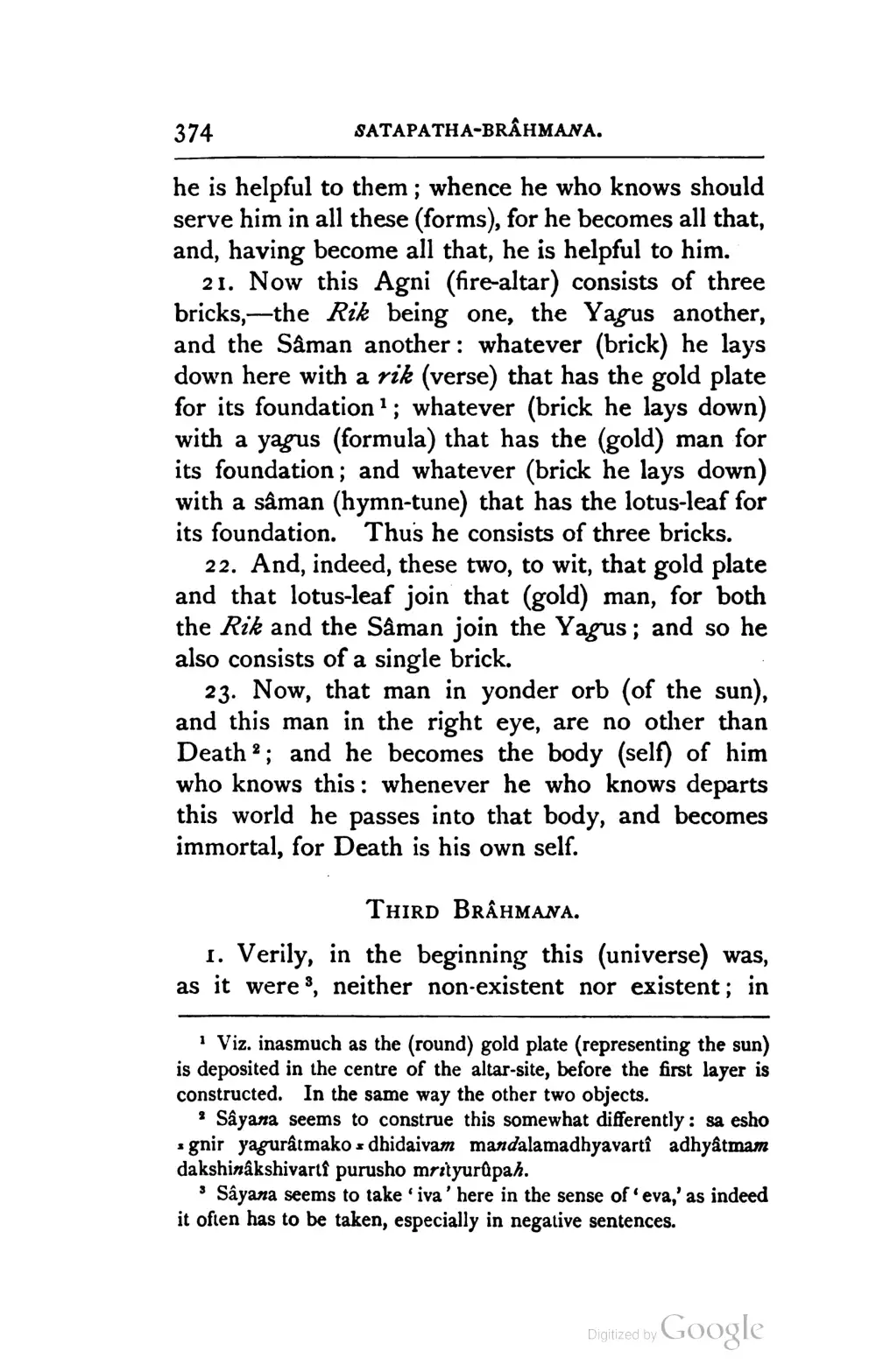
374:1 Viz. inasmuch as the (round) gold plate (representing the sun) is deposited in the centre of the altar-site, before the first layer is constructed. In the same way the other two objects.
374:2 Sâyana seems to construe this somewhat differently: sa esho gnir yagurâtmakoऽdhidaivam mandalamadhyavartî adhyâtmam dakshinâkshivartî purusho mrityurûpah.
10:5:3
THIRD BRÂHMANA.
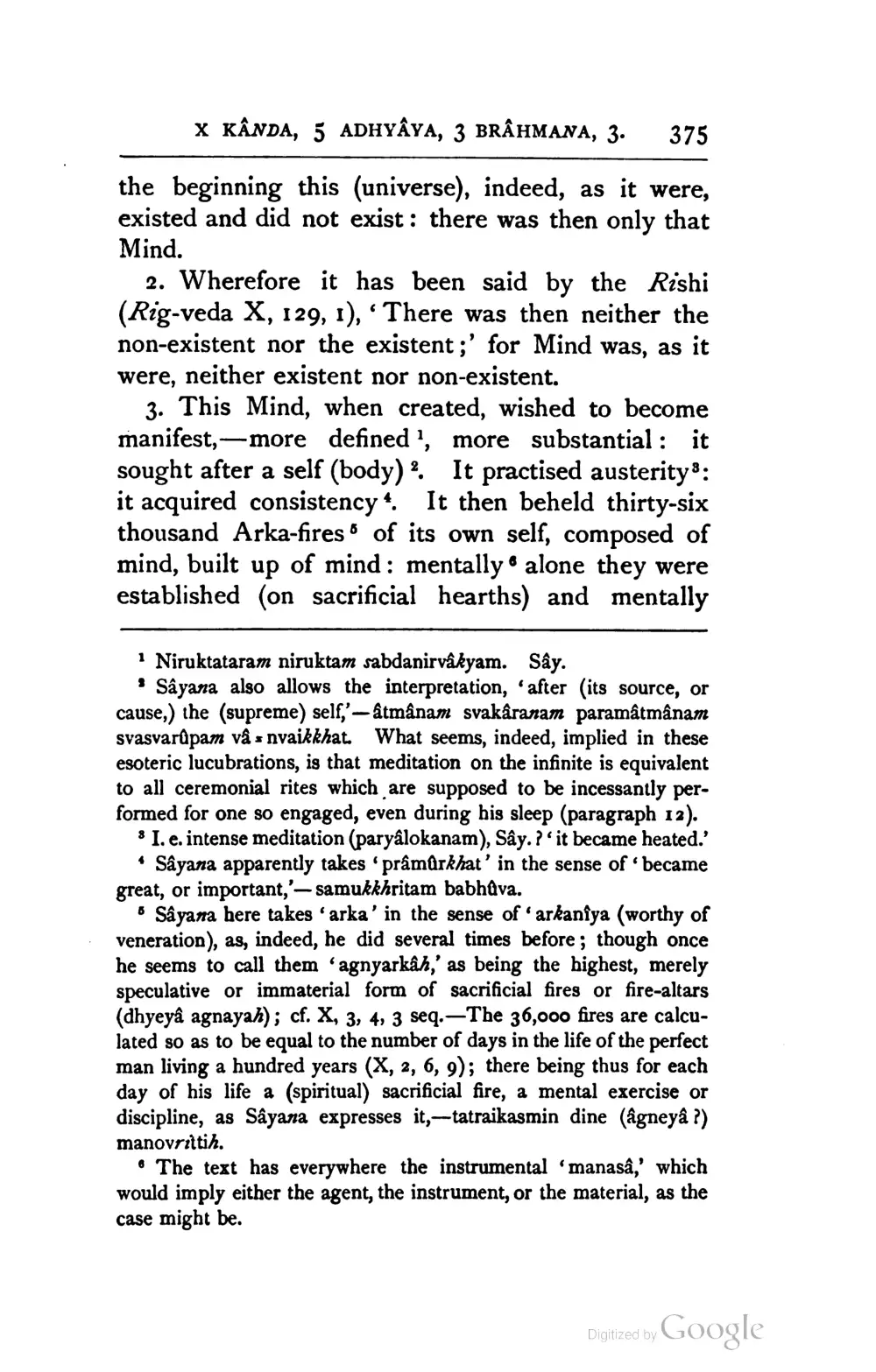
10:5:3:11. Verily, in the beginning this (universe) was, as it were , neither non-existent nor existent; in the beginning this (universe), indeed, as it were, existed and did not exist: there was then only that Mind.
10:5:3:22. Wherefore it has been said by the Rishi (Rig-veda X, 129, 1), 'There was then neither the non-existent nor the existent;' for Mind was, as it were, neither existent nor non-existent.
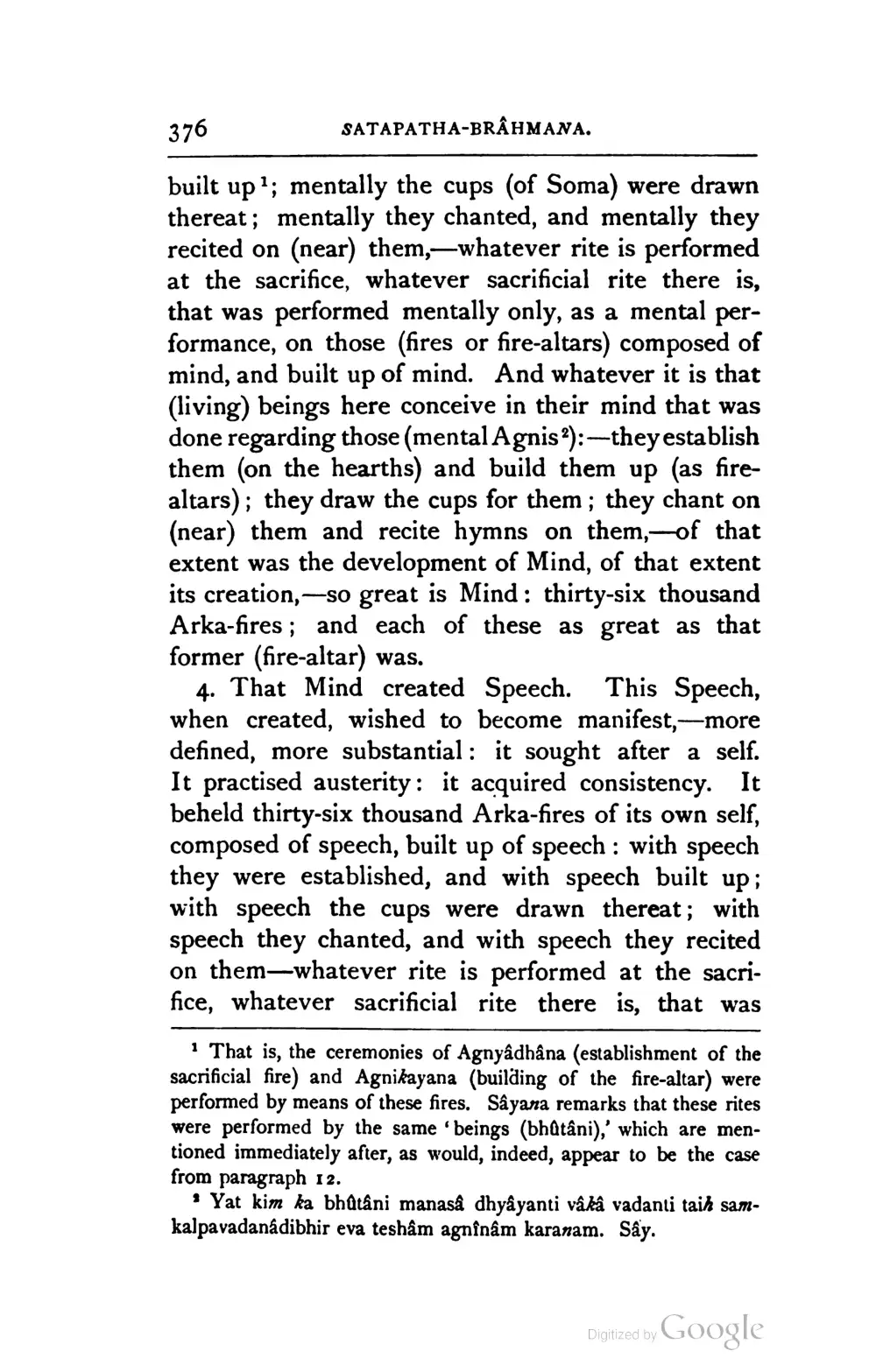
10:5:3:33. This Mind, when created, wished to become manifest,--more defined , more substantial: it sought after a self (body) . It practised austerity : it acquired consistency . It then beheld thirty-six thousand Arka-fires of its own self, composed of mind, built up of mind: mentally alone they were established (on sacrificial hearths) and mentally built up ; mentally the cups (of Soma) were drawn thereat mentally they chanted, and mentally they recited on (near) them,--whatever rite is performed at the sacrifice, whatever sacrificial rite there is, that was performed mentally only, as a mental performance, on those (fires or fire-altars) composed of mind, and built up of mind. And whatever it is that (living) beings here conceive in their mind that was done regarding those (mental Agnis ):--they establish them (on the hearths) and build them up (as fire-altars); they draw the cups for them; they chant on (near) them and recite hymns on them,--of that extent was the development of Mind, of that extent its creation,--so great is Mind: thirty-six thousand Arka-fires; and each of these as great as that former (fire-altar) was.
No commentary for this page.