The Satapatha-Brâhmana, Part IV — SBE Vol. 43 — trans. Julius Eggeling (1897)
The translator’s English as printed (Julius Eggeling). The original-language text is not held; names are romanised as the translator printed them.
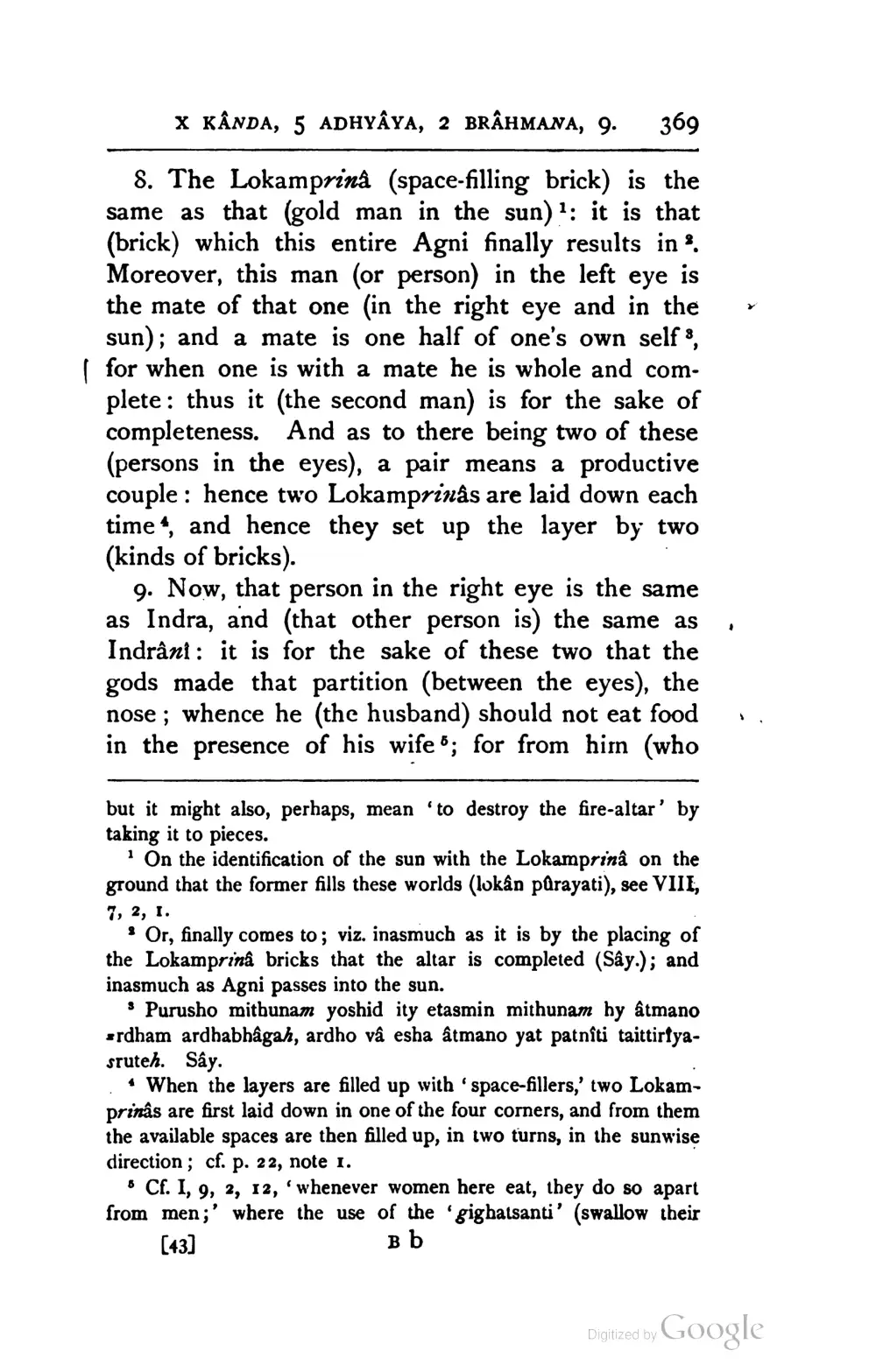
10:5:2:88. The Lokamprinâ (space-filling brick) is the same as that (gold man in the sun) : it is that (brick) which this entire Agni finally results in . Moreover, this man (or person) in the left eye is the mate of that one (in the right eye and in the sun); and a mate is one half of one's own self , for when one is with a mate he is whole and complete: thus it (the second man) is for the sake of completeness. And as to there being two of these (persons in the eyes), a pair means a productive couple: hence two Lokamprinâs are laid down each time , and hence they set up the layer by two (kinds of bricks).
10:5:2:99. Now, that person in the right eye is the same as Indra, and (that other person is) the same as Indrânî: it is for the sake of these two that the gods made that partition (between the eyes), the nose; whence he (the husband) should not eat food in the presence of his wife ; for from him (who does not do so) a vigorous son is born, and she in whose presence (the husband) does not eat food bears a vigorous (son):--
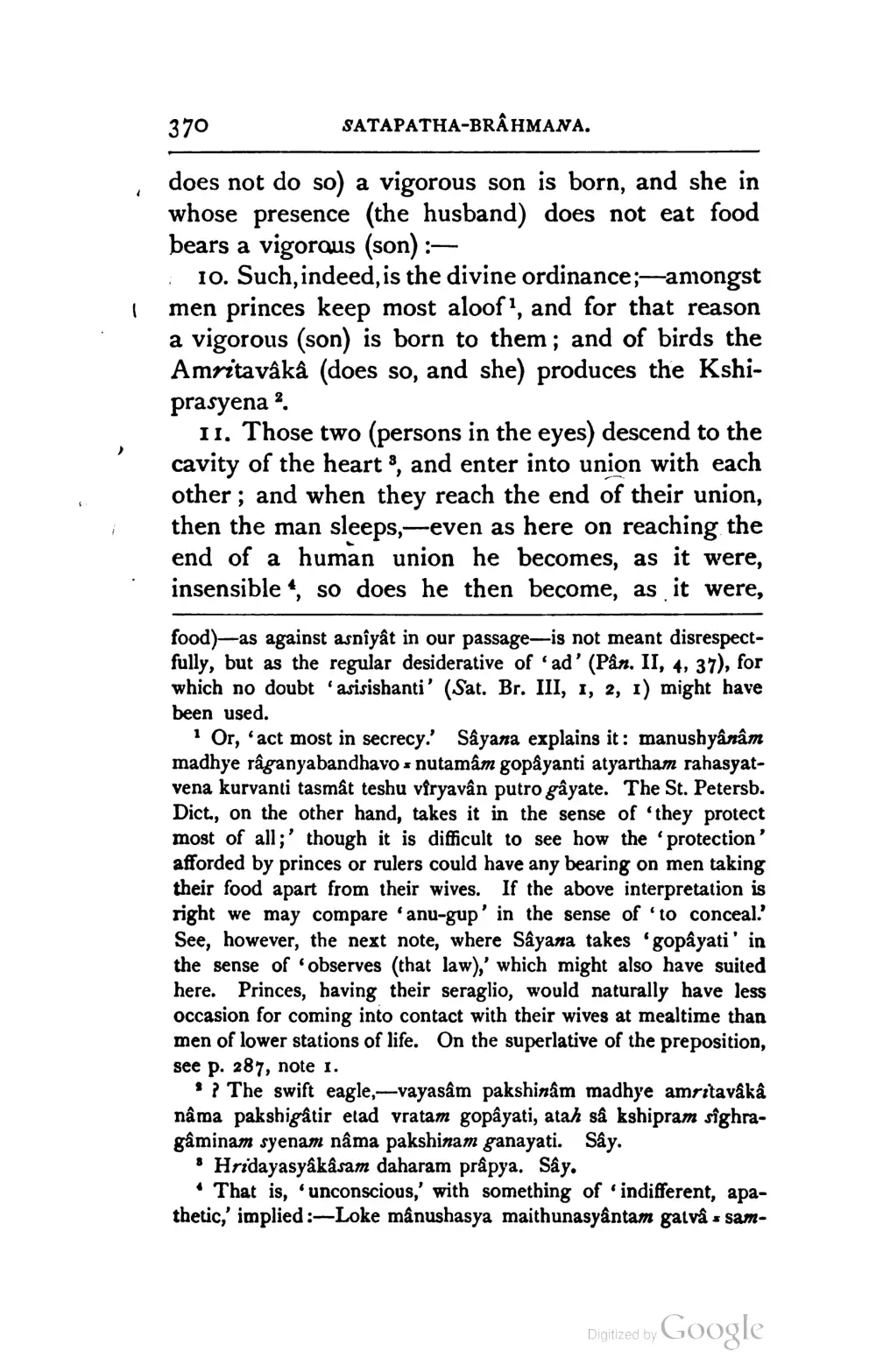
10:5:2:1010. Such, indeed, is the divine ordinance;--amongst men princes keep most aloof , and for that reason a vigorous (son) is born to them; and of birds the Amritavâkâ (does so, and she) produces the Kshiprasyena .
10:5:2:1111. Those two (persons in the eyes) descend to the cavity of the heart , and enter into union with each other; and when they reach the end of their union, then the man sleeps,--even as here on reaching the end of a human union he becomes, as it were, insensible , so does he then become, as it were, insensible; for this is a divine union , and that is the highest bliss.
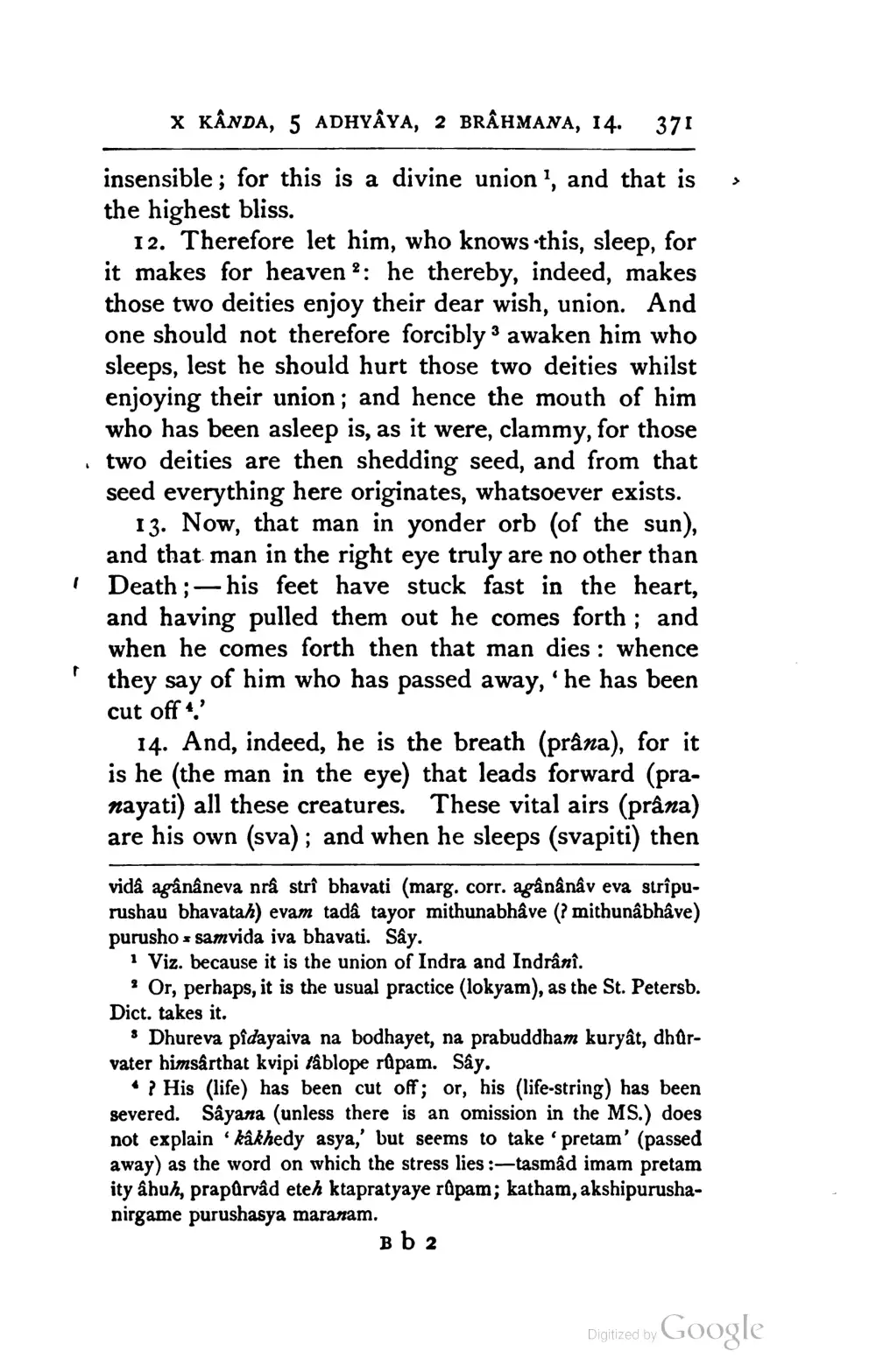
10:5:2:1212. Therefore let him, who knows this, sleep, for it makes for heaven : he thereby, indeed, makes those two deities enjoy their dear wish, union. And one should not therefore forcibly awaken him who sleeps, lest he should hurt those two deities whilst enjoying their union; and hence the mouth of him who has been asleep is, as it were, clammy, for those two deities are then shedding seed, and from that seed everything here originates, whatsoever exists.
10:5:2:1313. Now, that man in yonder orb (of the sun), and that man in the right eye truly are no other than Death;--his feet have stuck fast in the heart, and having pulled them out he comes forth; and when he comes forth then that man dies: whence they say of him who has passed away, 'he has been cut off .'
10:5:2:1414. And, indeed, he is the breath (prâna), for it is he (the man in the eye) that leads forward (pranayati) all these creatures. These vital airs (prâna) are his own (sva); and when he sleeps (svapiti) then these vital airs take possession of him as his own (svâ api-yanti): hence (the term) 'svâpyaya (being taken possession of by one's own people),' 'svâpyaya' doubtless being what they mystically call 'svapna (sleep),' for the gods love the mystic.
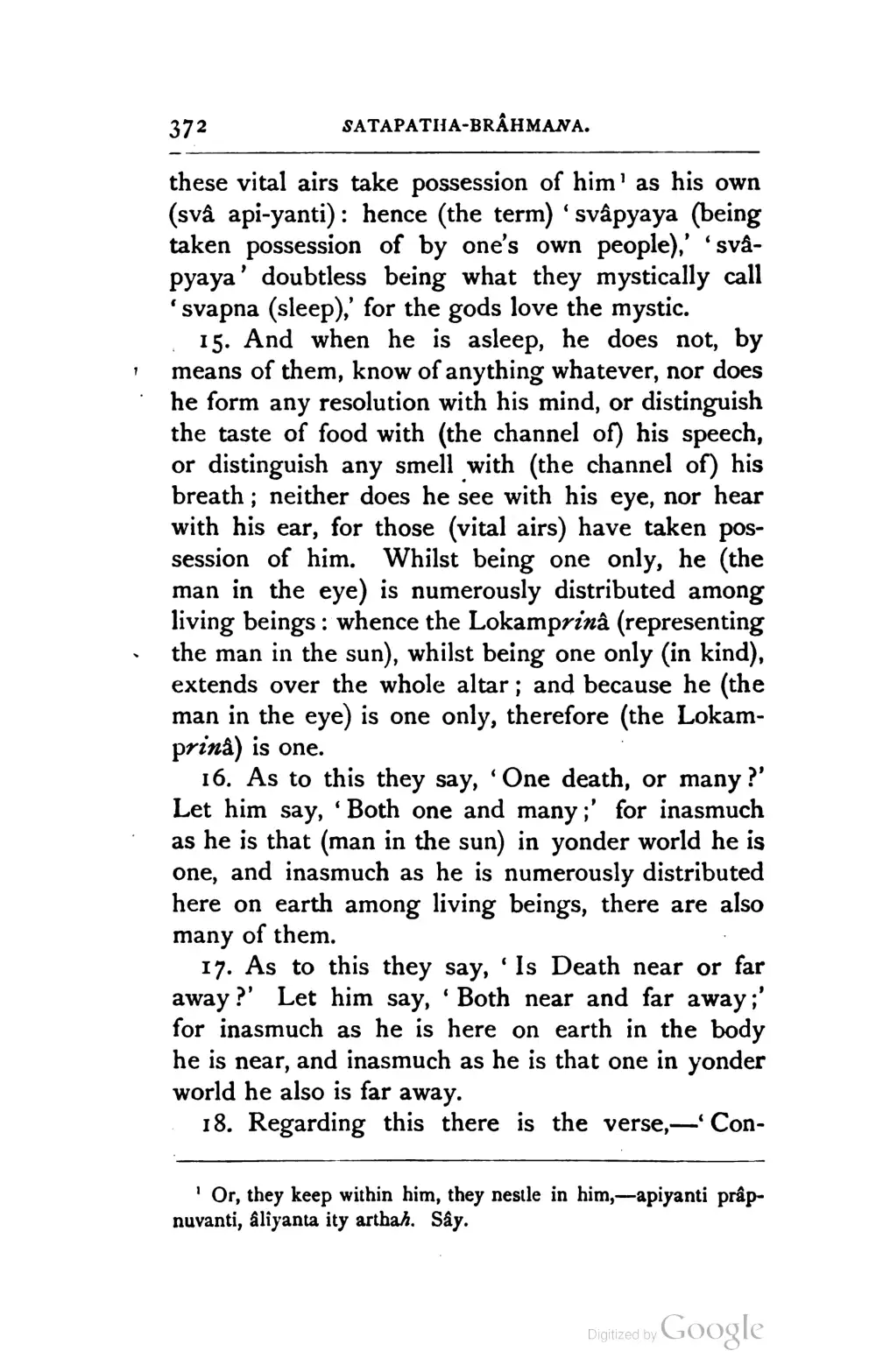
10:5:2:1515. And when he is asleep, he does not, by means of them, know of anything whatever, nor does he form any resolution with his mind, or distinguish the taste of food with (the channel of) his speech, or distinguish any smell with (the channel of) his breath; neither does he see with his eye, nor hear with his ear, for those (vital airs) have taken possession of him. Whilst being one only, he (the man in the eye) is numerously distributed among living beings: whence the Lokamprinâ (representing the man in the sun), whilst being one only (in kind), extends over the whole altar; and because he (the man in the eye) is one only, therefore (the Lokamprinâ) is one.
10:5:2:1616. As to this they say, 'One death, or many?' Let him say, 'Both one and many;' for inasmuch as he is that (man in the sun) in yonder world he is one, and inasmuch as he is numerously distributed here on earth among living beings, there are also many of them.
10:5:2:1717. As to this they say, 'Is Death near or far away?' Let him say, 'Both near and far away;' for inasmuch as he is here on earth in the body he is near, and inasmuch as he is that one in yonder world he also is far away.
10:5:2:1818. Regarding this there is the verse,--'Concealed in food he, the immortal, shineth at the flowing together of vital saps;'--yonder shining orb is food, and the man in that orb is the eater: being concealed in that food, he shines. Thus much as to the deity.
10:5:2:1919. Now as to the body. This body indeed is food, and that man in the right eye is the eater: being concealed in that food he shines.
No commentary for this page.