The Satapatha-Brâhmana, Part IV — SBE Vol. 43 — trans. Julius Eggeling (1897)
The translator’s English as printed (Julius Eggeling). The original-language text is not held; names are romanised as the translator printed them.
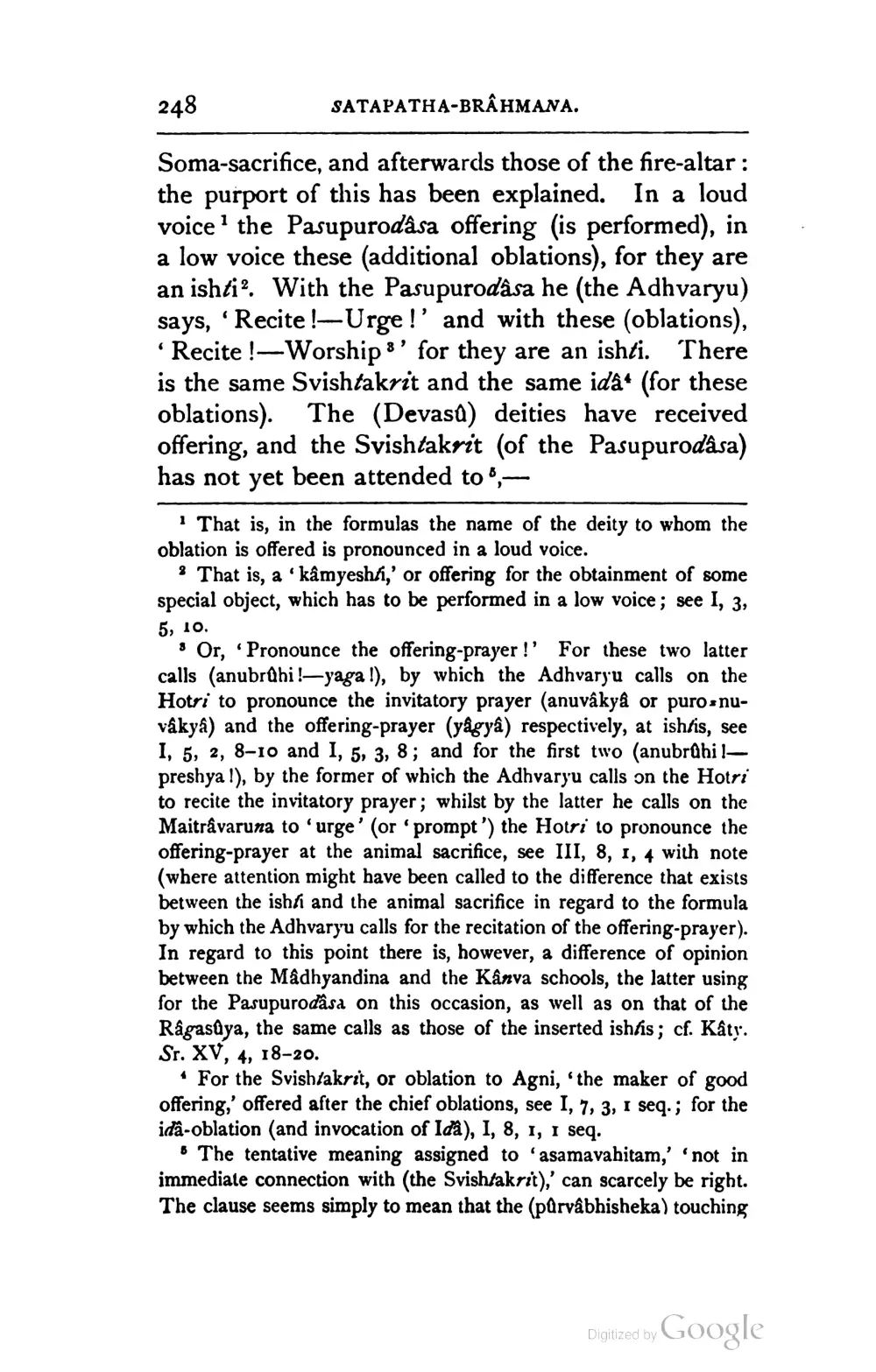
[paragraph continues] Soma-sacrifice, and afterwards those of the fire-altar the purport of this has been explained. In a loud voice the Pasupurodâsa offering (is performed), in a low voice these (additional oblations), for they are an ishti . With the Pasupurodâsa he (the Adhvaryu) says, 'Recite!--Urge!' and with these (oblations), 'Recite!--Worship ' for they are an ishti. There is the same Svishtakrit and the same idâ (for these oblations). The (Devasû) deities have received offering, and the Svishtakrit (of the Pasupurodâsa) has not yet been attended to ,--
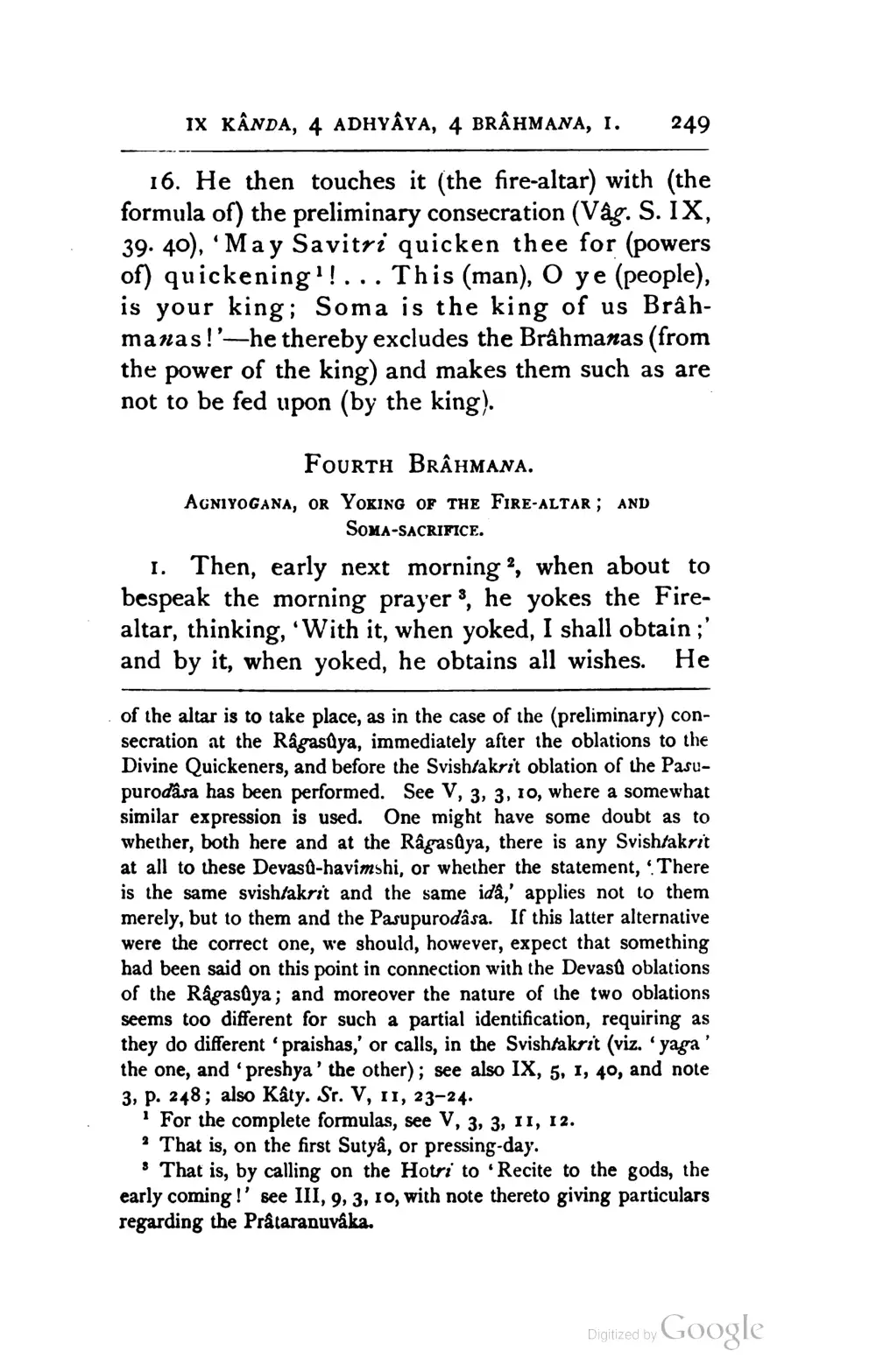
9:4:3:1616. He then touches it (the fire-altar) with (the formula of) the preliminary consecration (Vâg. S. IX, 39. 40), 'May Savitri quicken thee for (powers of) quickening ! . . . This (man), O ye (people), is your king; Soma is the king of us Brâhmanas!'--he thereby excludes the Brâhmanas (from the power of the king) and makes them such as are not to be fed upon (by the king).
Footnotes
241:1 A Soma-sacrifice being about to be performed on the newly erected fire-altar, now properly consecrated, all the necessary preparatory business and ceremonial enjoined for such a sacrifice have now to be gone through in the way detailed in part ii of this translation. The author here only alludes to those points in the Soma-ritual in regard to which the present performance offers any special feature either additional to, or modificatory of, the ordinary ceremonial. The construction of the Dhishnyas, or fire-hearths of the different priests (for which see part ii, p. 148, note 4), is one of these points.
242:1 See p. 132, note 2.
242:2 There are eight dhishnya-hearths at the Soma-sacrifice, two of which, the Âgnîdhrîya and Mârgâlîya, were raised north and south of the cart-shed (havirdhâna), whilst the others (viz. those of the Hotri, &c.) were raised inside the Sadas along its eastern side. They were merely mounds of earth covered with sand, whilst the additional hearths (of the fire-altar) now to be erected are partly built of bricks.
243:1 See VII, 1, 1, 21 seq., where the way in which the bricks of the Gârhapatya hearth are laid down is described in detail.
243:2 When Agni was led forwards from the Gârhapatya to be installed on his newly built altar, as the Âhavanîya or offering fire, a variegated stone, meant to represent the sun, was deposited near the place (on the northern edge of the Vedi) where the Âgnîdhra shed and hearth would afterwards have to be erected; see IX, 2, 3, 14-19.
243:3 That is, including the central one, the outlet of which is the navel; cf. VIII, 1, 3, 10.
243:4 The numbers of bricks and enclosing-stones are the same as for the Gârhapatya hearth, for which (with their symbolic meaning) see VII, I, I, 32-35.
244:1 Sâyana refers to a passage in the Taittirîyaka, according to which a dying man is changed to whatever season he dies in, whence the six seasons are the representatives of all the deceased ancestors. Since the Fathers reside in the southern region it is from that quarter that, by laying down the bricks, they are supposed to raise a rampart for the Mârgâlîya fire.
244:2 Viz. on the southern edge of the Vedi, exactly south of the Âgnîdhrîya, whilst the other dhishnyas run in a line from north to south to the left of the space between the Âgnîdhrîya and Mârgâlîya. The other hearths, together with the great fire-altar occupying the eastern part of the Vedi, would thus, as it were, face the Mârgâlîya in a semicircle. See the plan of the Sacrificial ground, part ii, p. 475.
244:3 That is, as the earth is surrounded by the ocean (VII, 1, 1, 13), or a stronghold by a moat.
244:4 Viz. inasmuch as the fire-altar and the Âhavanîya fire on it, as well as the dug-in circle of enclosing-stones, are identified with the ruling power; whilst the dhishnyas as well as the circles of stones lying loosely around them represent the clan.
245:1 This is not clear to me: whilst there are 395 such bricks with special formulas in the five layers of the great altar, it is enclosed by only 261 parisrits; see p. 158, note 1. Besides there are no 'yagushmatî' bricks in these hearths, but only 'lokamprinâs'; one would therefore expect 'ishtakâs' (bricks) for 'yagushmatyas' the first time (cf. comm. on Kâty. Sr. XVIII, 7, 13). The Hotri's hearth contains twenty-one bricks, the Brâhmanâkkhamsin's eleven, the Mârgâlîya six, and the others eight bricks; and in each case the common formula, 'Lokam prina, &c,' (see VIII, 7, 2, 6), is pronounced once after every ten bricks, and after any odd bricks remaining over at the end. Cf. Kâty. Sr. XVIII, 6, 8 seq.
245:2 See VIII, 7, 3, 1 seq.
245:3 He does not use any such formula as that used in covering each layer of the great altar with earth; see VIII, 7, 3, 7.
245:4 See part ii, p. 199, note 2 (where the reference at the end should be to IV, 2, 5, 22).
246:1 See part iii, introduction, p. xx seq.
No commentary for this page.