The Satapatha-Brâhmana, Part IV — SBE Vol. 43 — trans. Julius Eggeling (1897)
The translator’s English as printed (Julius Eggeling). The original-language text is not held; names are romanised as the translator printed them.
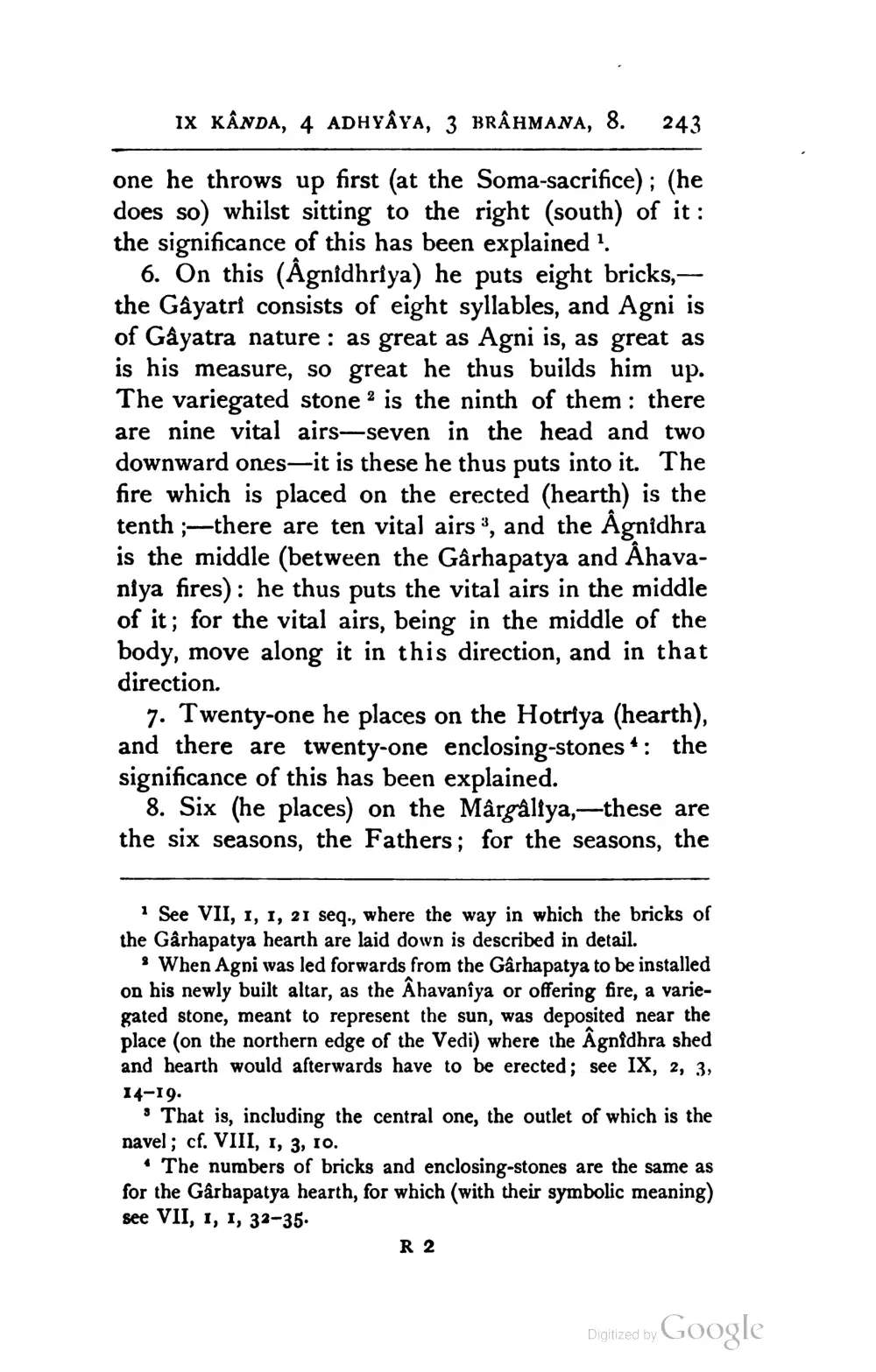
9:4:3:77. Twenty-one he places on the Hotrîya (hearth), and there are twenty-one enclosing-stones : the significance of this has been explained.
9:4:3:88. Six (he places) on the Mârgâlîya,--these are the six seasons, the Fathers; for the seasons, the
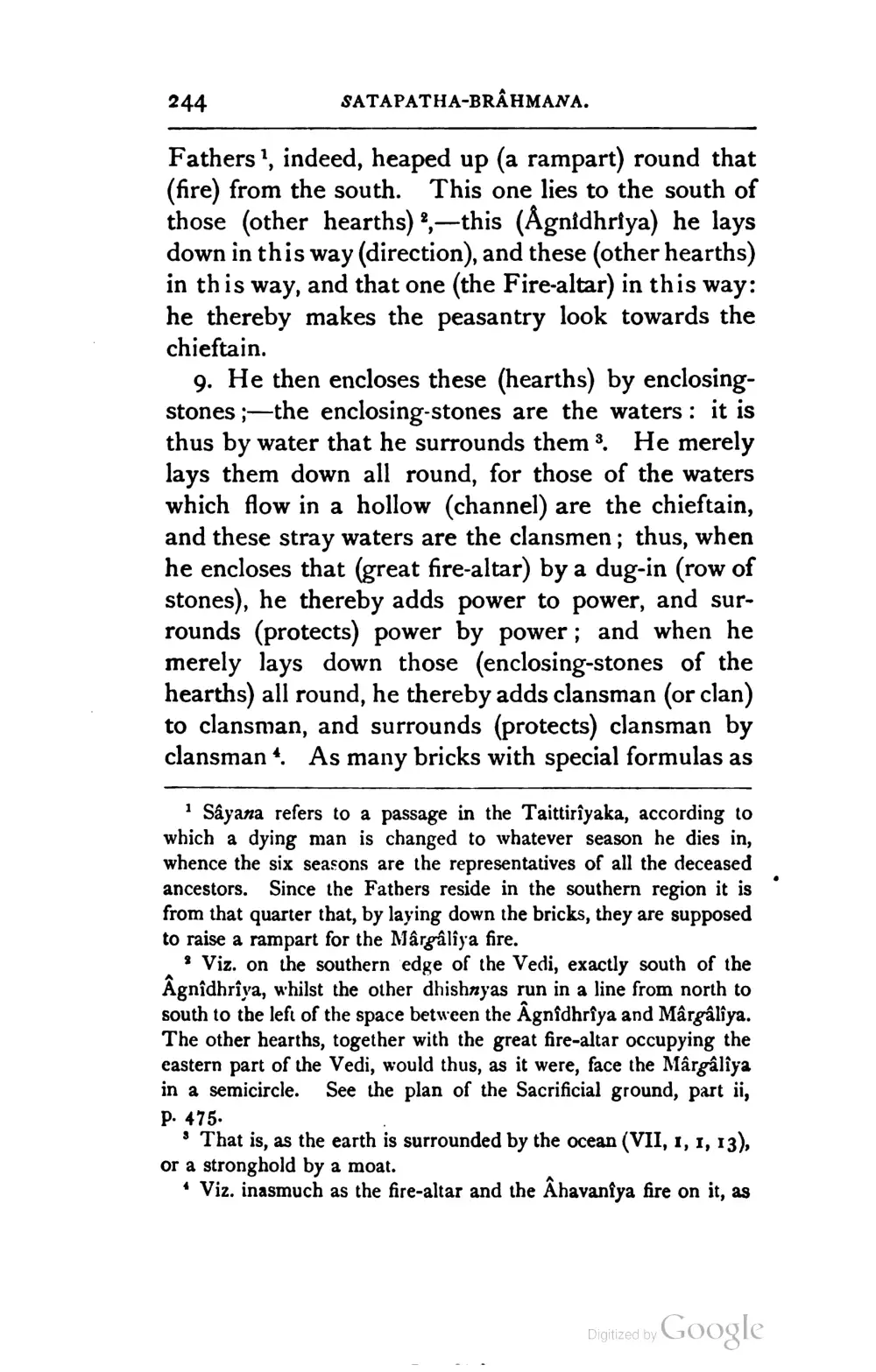
[paragraph continues] Fathers , indeed, heaped up (a rampart) round that (fire) from the south. This one lies to the south of those (other hearths) ,--this (Âgnîdhrîya) he lays down in this way (direction), and these (other hearths) in this way, and that one (the Fire-altar) in this way: he thereby makes the peasantry look towards the chieftain.
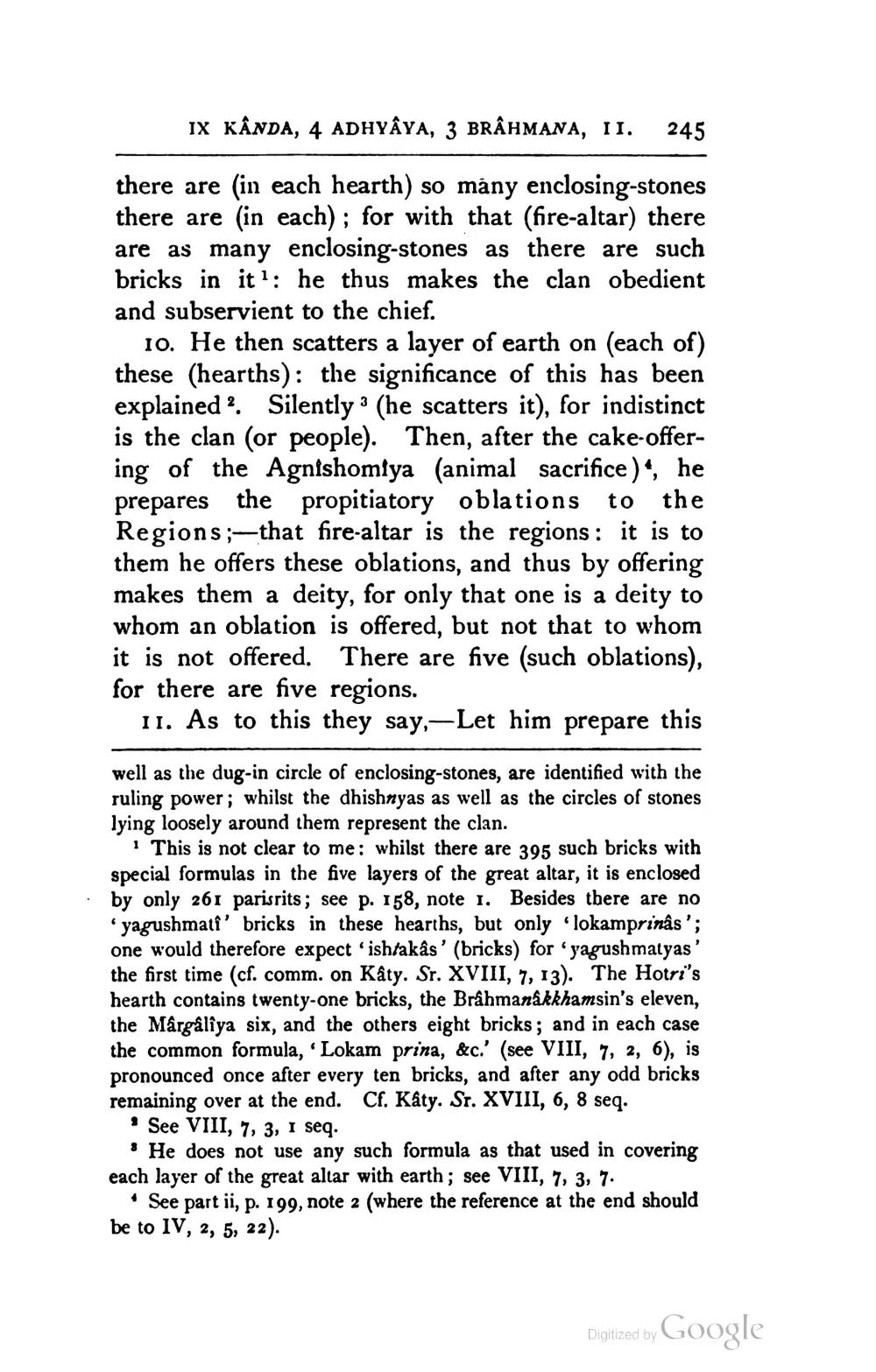
9:4:3:99. He then encloses these (hearths) by enclosing-stones;--the enclosing-stones are the waters: it is thus by water that he surrounds them . He merely lays them down all round, for those of the waters which flow in a hollow (channel) are the chieftain, and these stray waters are the clansmen; thus, when he encloses that (great fire-altar) by a dug-in (row of stones), he thereby adds power to power, and sure rounds (protects) power by power; and when he merely lays down those (enclosing-stones of the hearths) all round, he thereby adds clansman (or clan) to clansman, and surrounds (protects) clansman by clansman . As many bricks with special formulas as there are (in each hearth) so many enclosing-stones there are (in each); for with that (fire-altar) there are as many enclosing-stones as there are such bricks in it : he thus makes the clan obedient and subservient to the chief.
9:4:3:1010. He then scatters a layer of earth on (each of) these (hearths): the significance of this has been explained . Silently (he scatters it), for indistinct is the clan (or people). Then, after the cake-offering of the Agnîshomîya (animal sacrifice) , he prepares the propitiatory oblations to the Regions;--that fire-altar is the regions: it is to them he offers these oblations, and thus by offering makes them a deity, for only that one is a deity to whom an oblation is offered, but not that to whom if is. not offered. There are five (such oblations), for there are five regions.
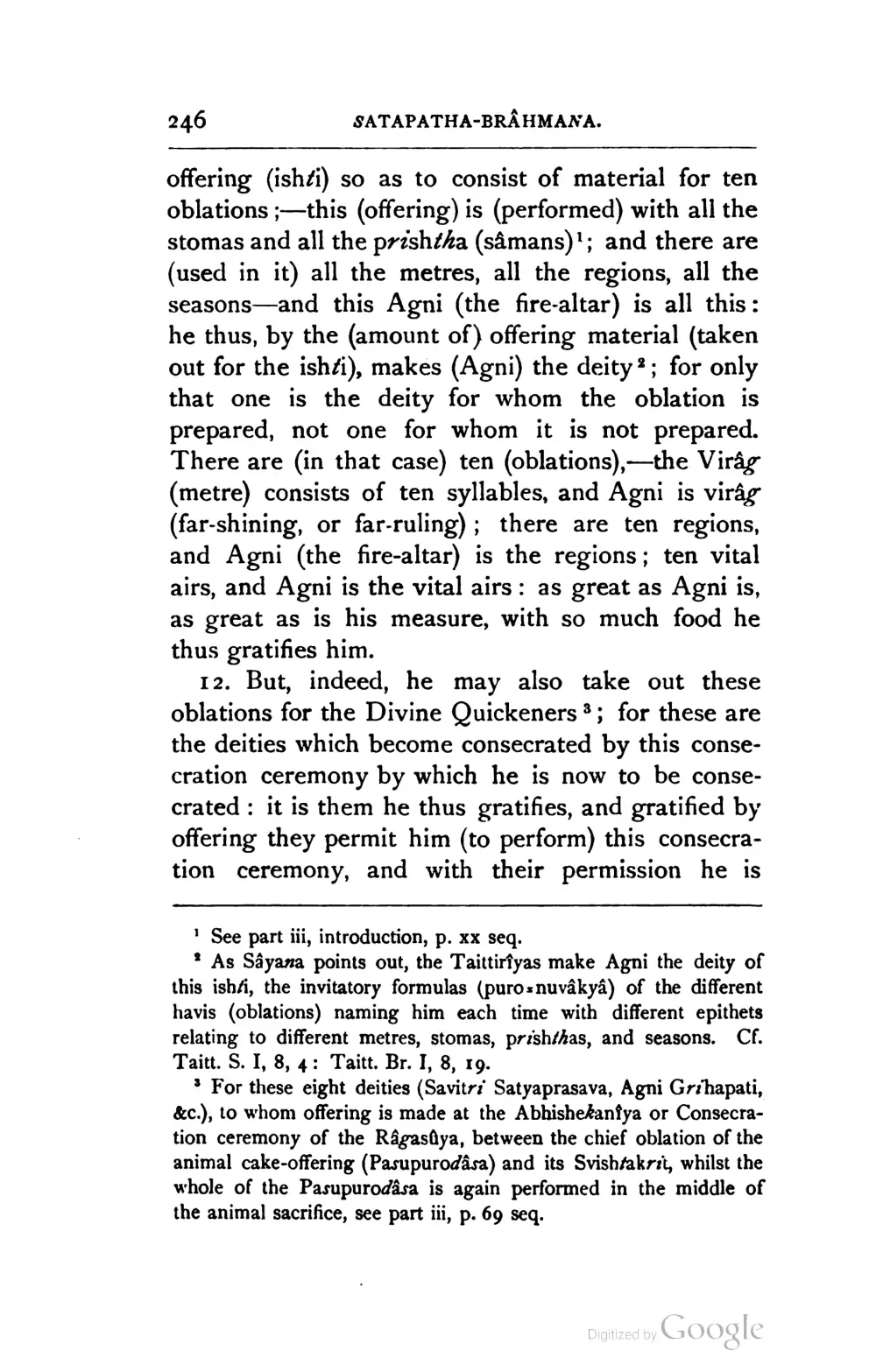
9:4:3:1111. As to this they say,--Let him prepare this offering (ishti) so as to consist of material for ten oblations;--this (offering) is (performed) with all the stomas and all the prishtha (sâmans) ; and there are (used in it) all the metres, all the regions, all the seasons--and this Agni (the fire-altar) is all this: he thus, by the (amount of) offering material (taken out for the ishti), makes (Agni) the deity ; for only that one is the deity for whom the oblation is prepared, not one for whom it is not prepared. There are (in that case) ten (oblations),--the Virâg (metre) consists of ten syllables, and Agni is virâg (far-shining, or far-ruling); there are ten regions, and Agni (the fire-altar) is the regions; ten vital airs, and Agni is the vital airs: as great as Agni is, as great as is his measure, with so much food he thus gratifies him.
9:4:3:1212. But, indeed, he may also take out these oblations for the Divine Quickeners ; for these are the deities which become consecrated by this consecration ceremony by which he is now to be consecrated: it is them he thus gratifies, and gratified by offering they permit him (to perform) this consecration ceremony, and with their permission he is consecrated; for only he becomes king whom the (other) kings allow (to assume) the royal dignity, but not he whom they do not (allow to assume it). And inasmuch as these deities are consecrated (quickened) by this consecration ceremony and quicken him for this consecration, they are (called) the Divine Quickeners.
9:4:3:1313. These (deities) come to have two. names, as he who is consecrated by the rite of consecration comes to have two names; for the very rite of consecration for which he is quickened, and by which he is consecrated (quickened), is his second name .
9:4:3:1414. There are eight (such deities),--the Gâyatrî consists of eight syllables, and Agni is of Gâyatra nature: as great as Agni is, as great as is his measure, by so much food he thus gratifies him.
9:4:3:1515. As to this they say,--He ought not to offer (any of) these oblations, lest he should do what is excessive. Let him nevertheless offer them; for these oblations are offered for (the obtainment of special) wishes, and in wishes there is nothing excessive. And whatsoever oblation he offers after the Pasupurodâsa (the cake-offering connected with the animal sacrifice), that is placed inside the animal victim itself as its sacrificial sap . He offers both kinds (of oblations), those of the Soma-sacrifice and those of the fire-altar (or Agnikayana), first those of the
No commentary for this page.