Legge supplies ‘(to me)’ in each clause, so a general statement about goodness and sincerity becomes a rule for answering how others treat oneself. His note links the passage to returning kindness for injury, which justifies the brackets. The Chinese says only that the sage is good to the good and to the not-good alike, and the result, that all become good, follows from what the sage is, not from how he responds.
The Tâo Teh King — Sacred Books of China Part I, SBE Vol. 39 (trans. James Legge, 1891)
Open to all
page 91
No image is selected for this page; its own page image is shown.
page 91
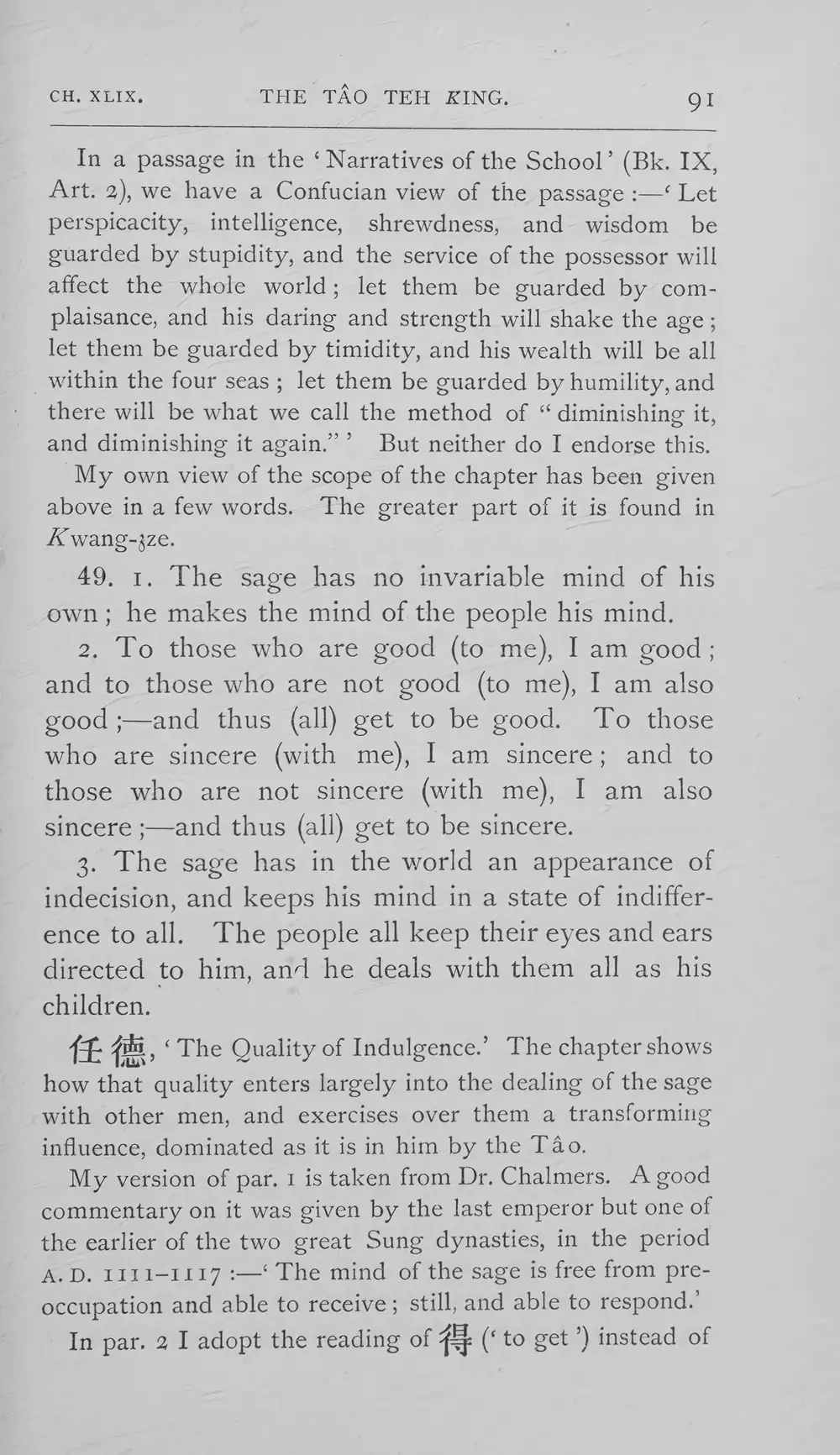
In a passage in the ‘Narratives of the School’ (Bk. IX, Art. 2), we have a Confucian view of the passage:—‘Let perspicacity, intelligence, shrewdness, and wisdom be guarded by stupidity, and the service of their possessor will affect the whole world; let them be guarded by complaisance, and his daring and strength will shake the age; let them be guarded by timidity, and his wealth will be all within the four seas; let them be guarded by humility, and there will be what we call the method of “diminishing it, and diminishing it again.”’ But I do not endorse this either.
My own view of the scope of the chapter has been given above in a few words. The greater part of it is found in Kwang-ȝze.
49. 1. The sage has no fixed mind of his own; he makes the mind of the people his mind.
2. To those who are good (to me), I am good; and to those who are not good (to me), I am also good;—and so (all) come to be good. To those who are sincere (with me), I am sincere; and to those who are not sincere (with me), I am also sincere;—and so (all) come to be sincere.
3. The sage has in the world an appearance of indecision, and keeps his mind in a state of indifference to all. The people all keep their eyes and ears directed to him, and he deals with them all as his children.
任德, ‘The Quality of Indulgence.’ The chapter shows how that quality enters largely into the sage’s dealings with other men, and exercises a transforming influence over them, governed as it is in him by the Tâo.
My version of par. 1 is taken from Dr. Chalmers. A good commentary on it was given by the last emperor but one of the earlier of the two great Sung dynasties, in the period A.D. 1111-1117:—‘The mind of the sage is free from preoccupation and able to receive; still, and able to respond.’
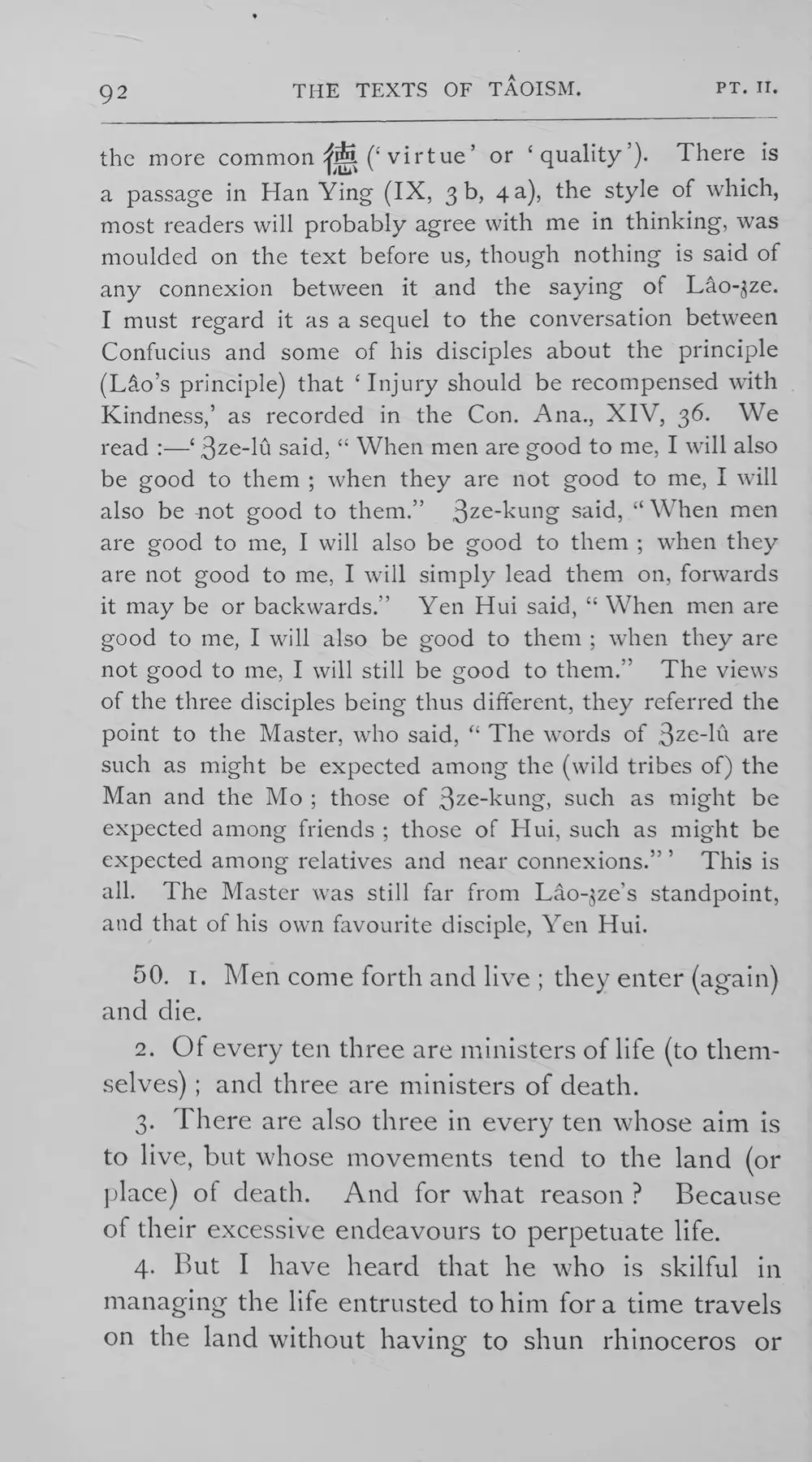
In par. 2 I adopt the reading 得 (‘to get’) instead of the more common 德 (‘virtue’ or ‘quality’). There is a passage in Han Ying (IX, 3b, 4a) whose style, most readers will probably agree with me, was moulded on the text before us, though nothing is said of any connection between it and the saying of Lâo-ȝze. I must regard it as a sequel to the conversation between Confucius and some of his disciples about the principle (Lâo’s principle) that ‘Injury should be recompensed with Kindness,’ as recorded in the Confucian Analects, XIV, 36.
We read:—‘Ȝze-lû said, “When men are good to me, I will also be good to them; when they are not good to me, I will also not be good to them.” Ȝze-kung said, “When men are good to me, I will also be good to them; when they are not good to me, I will simply lead them on, forwards it may be or backwards.” Yen Hui said, “When men are good to me, I will also be good to them; when they are not good to me, I will still be good to them.” As the views of the three disciples differed in this way, they referred the point to the Master, who said, “The words of Ȝze-lû are such as might be expected among the (wild tribes of) the Man and the Mo; those of Ȝze-kung, such as might be expected among friends; those of Hui, such as might be expected among relatives and near connections.”’
This is all. The Master was still far from Lâo-ȝze’s standpoint, and from that of his own favourite disciple, Yen Hui.
Legge identifies the commentator on par. 1 as ‘the last emperor but one’ of the earlier Sung, writing in the years 1111–1117. That is the emperor Hui-tsung, in whose reign those years fall; his son, the last emperor of that line, reigned only briefly. The identification is correct, and an emperor commenting on the King shows how fully it had entered the court’s reading.