Legge calls Kumaragiva’s comment ‘not very intelligible, and which I do not endorse’. It follows the text closely, though: ‘diminish and again diminish’ until even the good is put away and doing nothing leaves all things to do their own doing. On p. 76 Legge quoted the same commentator without demur. His resistance here is to a Buddhist reading of the King, not to an obscure one.
The Tâo Teh King — Sacred Books of China Part I, SBE Vol. 39 (trans. James Legge, 1891)
Open to all
page 90
No image is selected for this page; its own page image is shown.
page 90
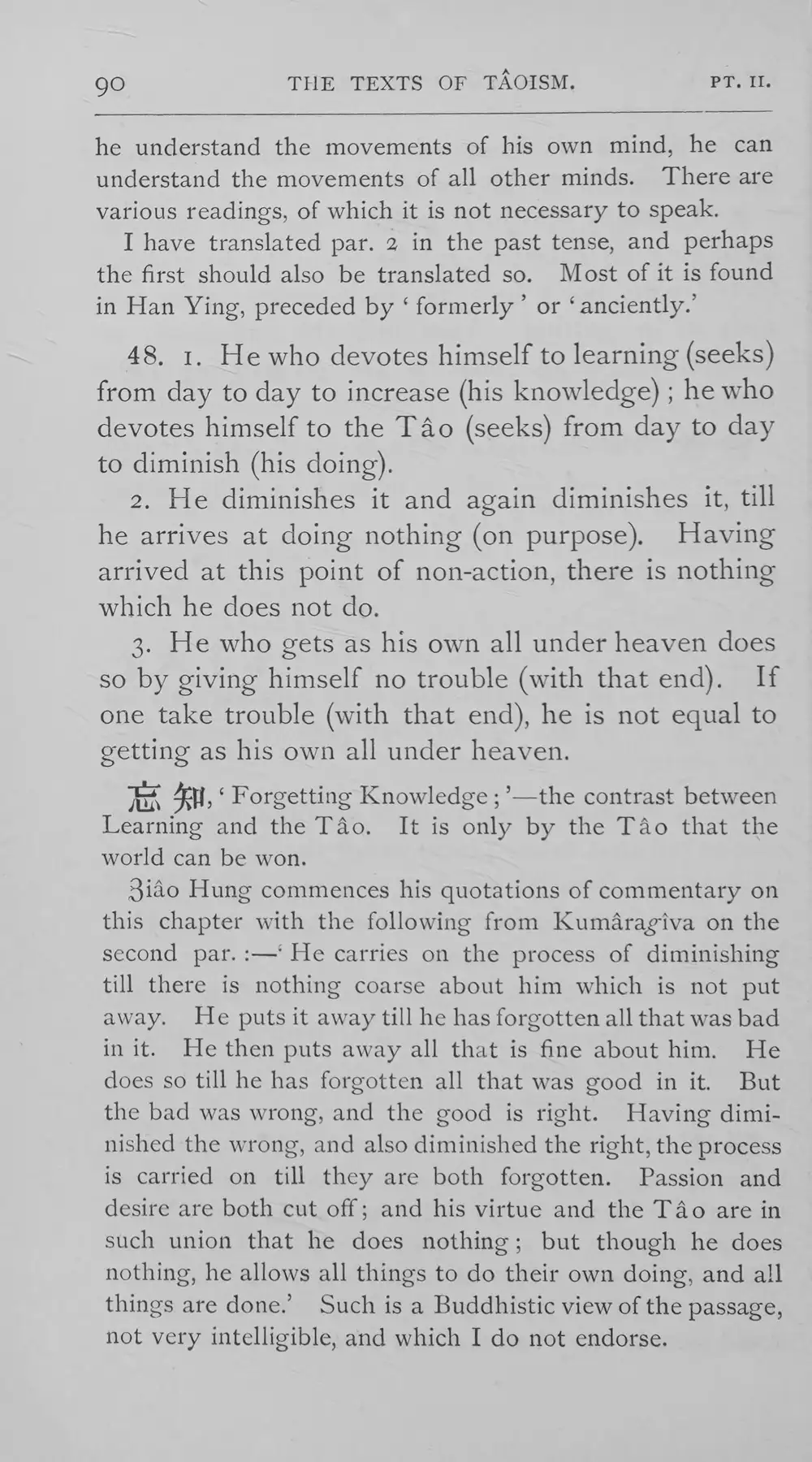
I have translated par. 2 in the past tense, and perhaps the first should also be translated so. Most of it is found in Han Ying, preceded by ‘formerly’ or ‘anciently.’
48. 1. He who devotes himself to learning (seeks) from day to day to increase (his knowledge); he who devotes himself to the Tâo (seeks) from day to day to diminish (his doing).
2. He diminishes it and diminishes it again, until he arrives at doing nothing (on purpose). Having arrived at this point of non-action, there is nothing which he does not do.
3. He who gets as his own all under heaven does so by giving himself no trouble (with that end). If one takes trouble (with that end), he is not equal to getting as his own all under heaven.
忘知, ‘Forgetting Knowledge;’—the contrast between Learning and the Tâo. It is only by the Tâo that the world can be won.
Ȝiâo Hung begins his quotations of commentary on this chapter with the following from Kumaragiva on the second par.:—‘He carries on the process of diminishing until there is nothing coarse about him that is not put away. He puts it away until he has forgotten all that was bad in it. He then puts away all that is fine about him. He does so until he has forgotten all that was good in it. But the bad was wrong, and the good is right. Having diminished the wrong, and also diminished the right, the process is carried on until they are both forgotten. Passion and desire are both cut off; and his virtue and the Tâo are in such union that he does nothing; but though he does nothing, he allows all things to do their own doing, and all things are done.’
Such is a Buddhist view of the passage, not very intelligible, and one which I do not endorse.