Reading ‘three in ten’ rather than ‘thirteen’, after Wang Pi, Legge accounts for nine in ten and concludes that ‘there remains only one in ten’ who uses the Tao rightly. The text never states that remainder; it is Legge’s arithmetic. It fits the shape of the chapter, which then turns to the one who is skilful, but the reader should know the ‘one in ten’ is inferred, not printed.
The Tâo Teh King — Sacred Books of China Part I, SBE Vol. 39 (trans. James Legge, 1891)
Open to all
page 93
No image is selected for this page; its own page image is shown.
page 93
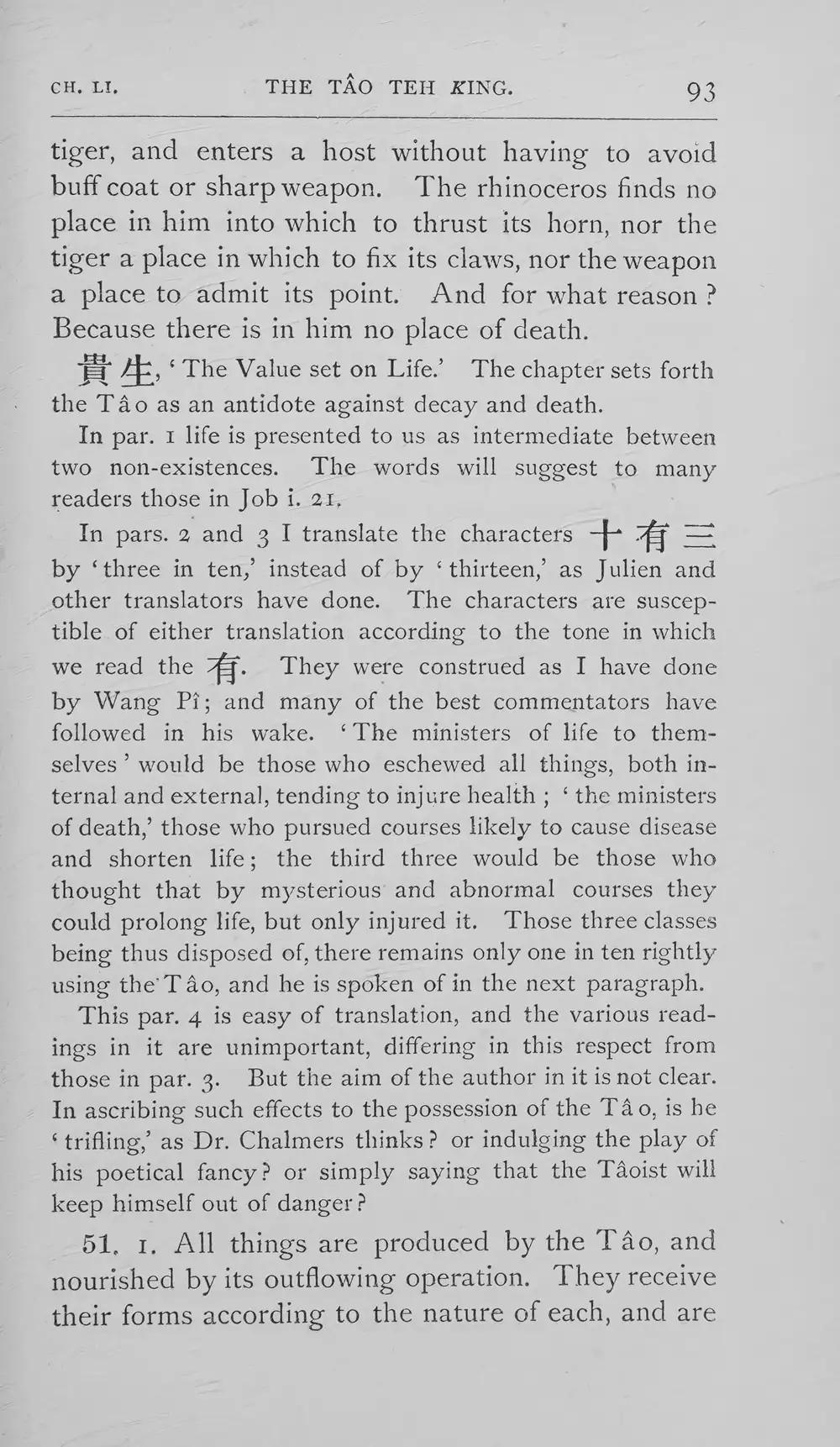
貴生, ‘The Value set on Life.’ The chapter sets forth the Tâo as an antidote to decay and death.
In par. 1 life is presented to us as lying between two non-existences. The words will suggest to many readers those in Job i. 21,
In pars. 2 and 3 I translate the characters 十有三 by ‘three in ten,’ instead of by ‘thirteen,’ as Julien and other translators have done. The characters bear either translation according to the tone in which we read the 有 [Press: to have; there is]. They were construed as I have done by Wang Pî, and many of the best commentators have followed in his wake.
‘The ministers of life to themselves’ would be those who shunned all things, both internal and external, tending to injure health; ‘the ministers of death,’ those who pursued courses likely to cause disease and shorten life; the third three would be those who thought that by mysterious and abnormal courses they could prolong life, but only injured it. Those three classes being thus disposed of, there remains only one in ten rightly using the Tâo, and he is spoken of in the next paragraph.
This par. 4 is easy to translate, and the various readings in it are unimportant, differing in this respect from those in par. 3. But the author’s aim in it is not clear. In ascribing such effects to the possession of the Tâo, is he ‘trifling,’ as Dr. Chalmers thinks? or indulging the play of his poetic fancy? or simply saying that the Tâoist will keep himself out of danger?
51. 1. All things are produced by the Tâo, and nourished by its outflowing operation. They receive their forms according to the nature of each, and are completed according to the circumstances of their condition. Therefore all things without exception honour the Tâo, and exalt its outflowing operation.