Legge has the Way of Heaven leave ‘no accumulation’ of its influence anywhere, and rejects the critics' gloss ‘rest’ as ‘not quite the idea’. The page favours him. The paragraph soon turns to still water as ‘a perfect Level’, so rest is a later subject, while the first sentence says Heaven's working never piles up in one place. His reading keeps apart two ideas that the gloss would merge.
The Tâo Teh King — Sacred Books of China Part I, SBE Vol. 39 (trans. James Legge, 1891)
Open to all
page 330
No image is selected for this page; its own page image is shown.
page 330
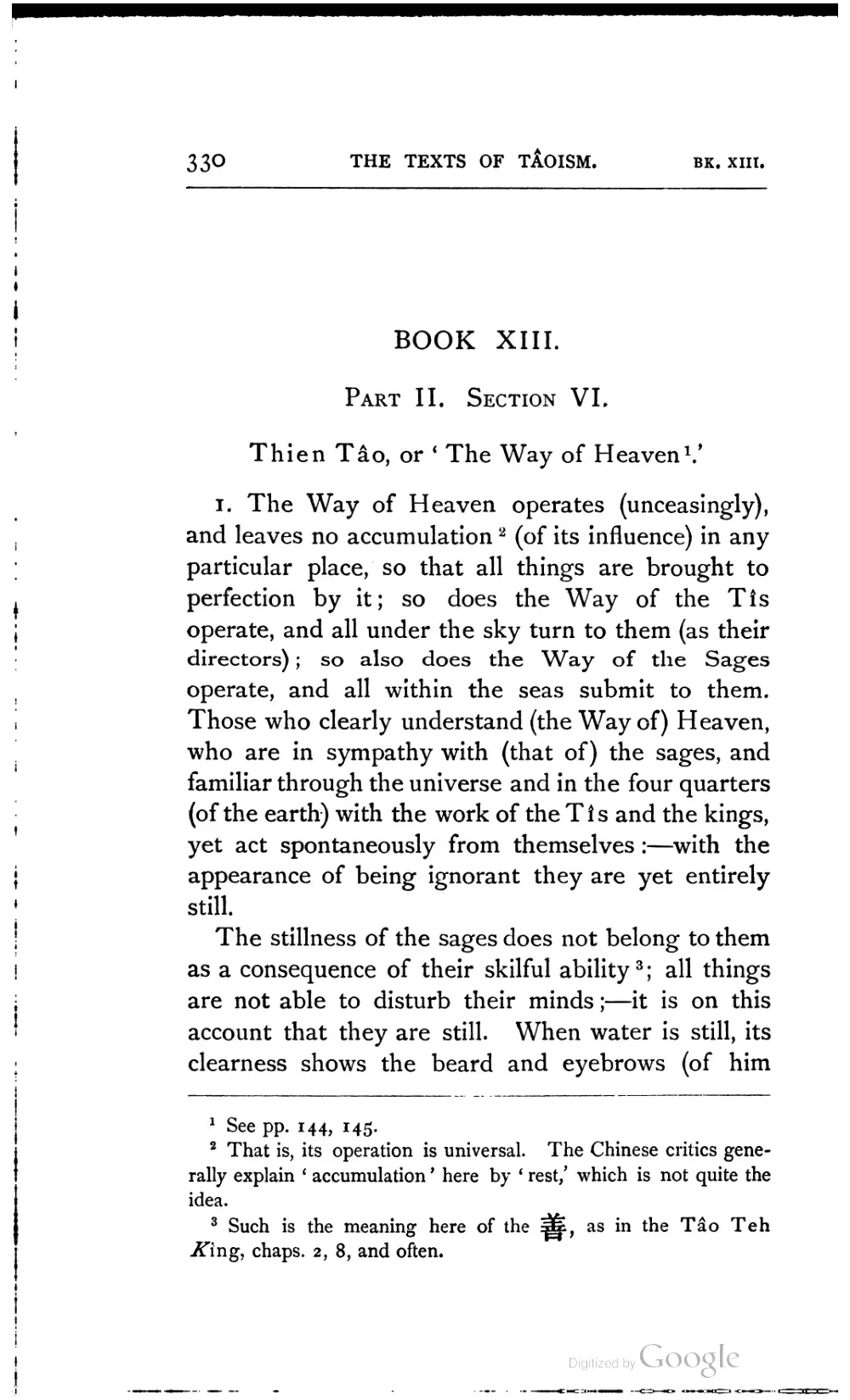
p. 330p. 330BOOK XIII.
Part II. Section VI.
Thien Tao, or ‘The Way of Heaven1.’
1. The Way of Heaven operates (unceasingly) and leaves no accumulation2 (of its influence) in any particular place, so that all things are brought to perfection by it; so too the Way of the Tis operates, and all under the sky turn to them (as their directors); so too the Way of the Sages operates, and all within the seas submit to them. Those who clearly understand (the Way of) Heaven, who are in sympathy with (that of) the sages, and who are familiar throughout the universe and in the four quarters (of the earth) with the work of the Tis and the kings, yet act spontaneously from themselves:—with the appearance of being ignorant, they are yet entirely still.
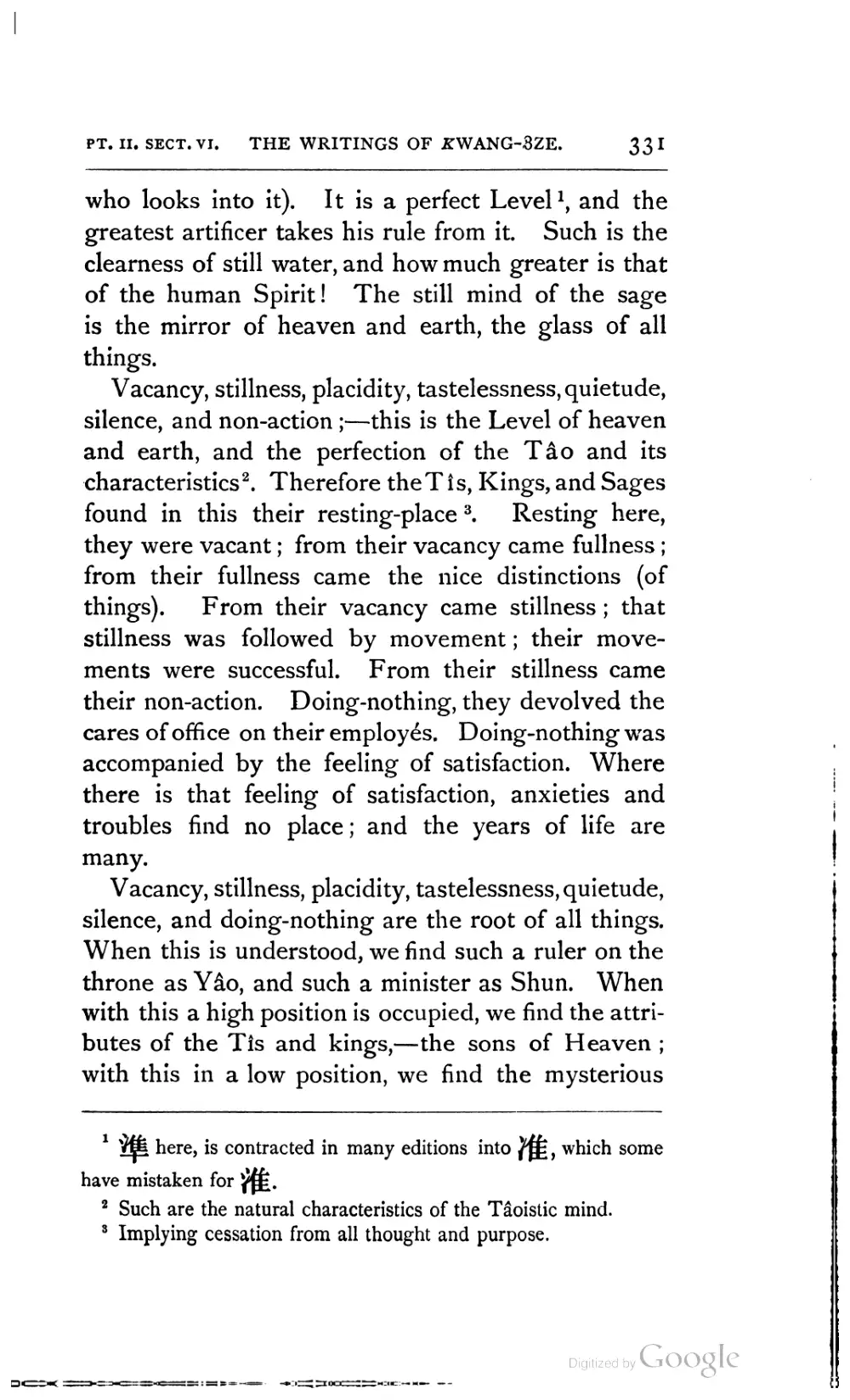
The stillness of the sages does not come to them as a consequence of their skilful ability3; nothing is able to disturb their minds;—it is on this account that they are still. When water is still, its clearness shows the beard and eyebrows (of him who looks into it). It is a perfect Level1, and the greatest artificer takes his rule from it. Such is the clearness of still water, and how much greater is that of the human Spirit! The still mind of the sage is the mirror of heaven and earth, the glass of all things.
* See pp. 144, 145.
* That is, its operation is universal. The Chinese critics generally explain ‘accumulation’ here as ‘rest,’ which is not quite the idea.
3 That is the meaning of 善 [Press: good; skilful] here, as in the Tâo Teh King, chapters 2, 8, and frequently.