The restraints named here are the insignia of office: ‘caps of leather’, the bonnet with kingfishers' plumes, the memorandum tablets and the long girdles. The attack is not on pleasure in general but on the dress of the scholar-official, and the comparison to ‘criminals whose arms are tied together’ answers the cangue and fetters of Book XI (p. 295). Book XII ends by putting the official and the condemned in one condition.
The Tâo Teh King — Sacred Books of China Part I, SBE Vol. 39 (trans. James Legge, 1891)
Open to all
page 329
No image is selected for this page; its own page image is shown.
page 329
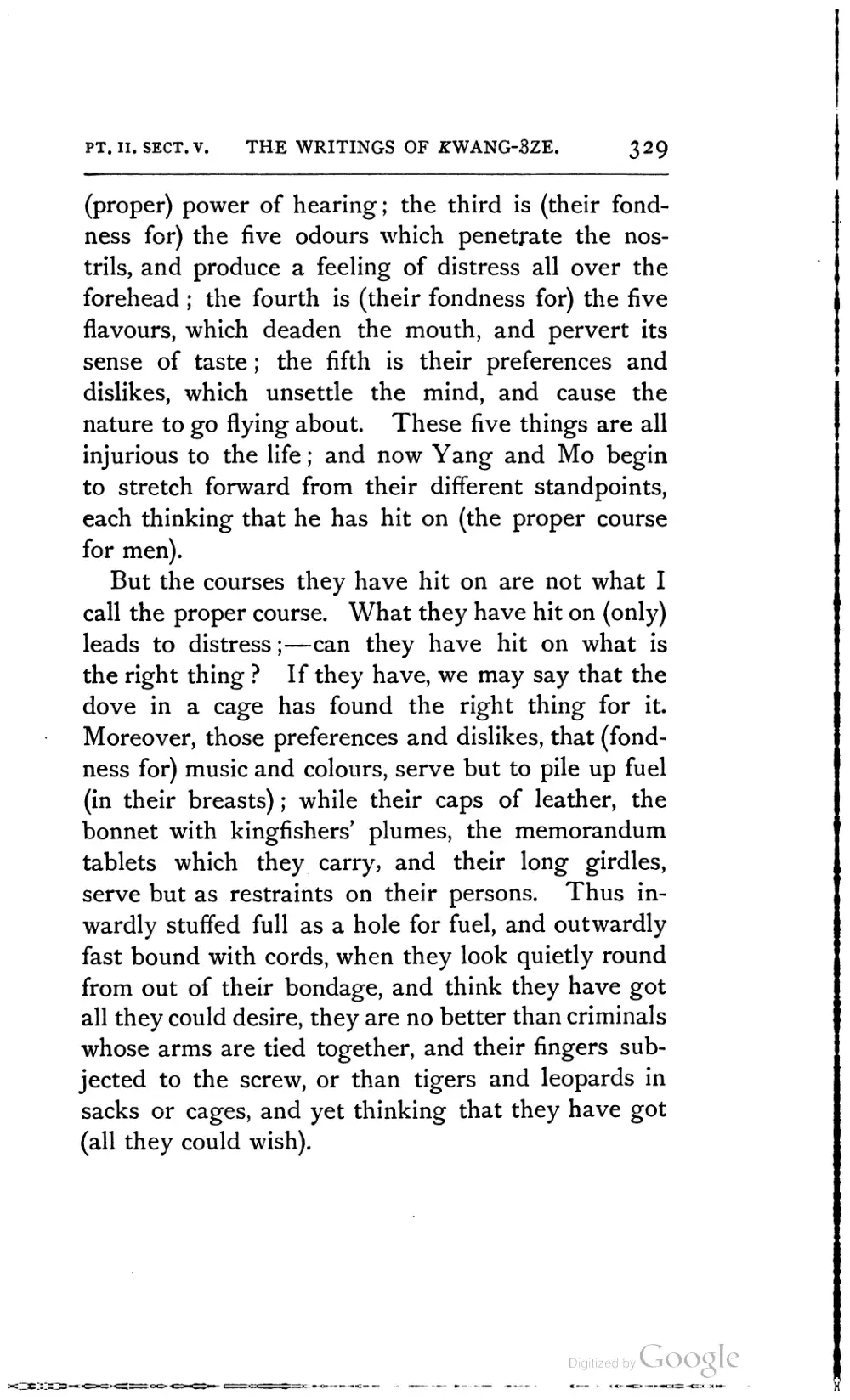
But the courses they have hit on are not what I call the proper course. What they have hit on (only) leads to distress;—can they have hit on the right thing? If they have, we may say that the dove in a cage has found the right thing for it.
Moreover, those preferences and dislikes, that (fondness for) music and colours, serve only to pile up fuel (in their breasts); while their leather caps, the bonnets with kingfishers’ plumes, the memorandum tablets they carry, and their long girdles serve only as restraints on their persons. Thus stuffed full inwardly like a pit for fuel, and bound fast outwardly with cords, when they look calmly round from inside their bondage and think they have got all they could desire, they are no better than criminals whose arms are tied together and whose fingers are put to the screw, or than tigers and leopards in sacks or cages, and yet they think that they have got (all they could wish).