Legge is right that Lâo-ȝze's figure is “a higher ideal than Burns’s honest man”, and the lines show why. Burns praises a poor man's worth in spite of poverty; the quoted sage gives the name of King to the one who “accepts his state’s reproach” and bears men's woes. The first is integrity that needs no rank; the second is rank earned by taking on others' burdens, the chapter's water-like weakness turned into rule.
The Tâo Teh King — Sacred Books of China Part I, SBE Vol. 39 (trans. James Legge, 1891)
Open to all
page 120
No image is selected for this page; its own page image is shown.
page 120
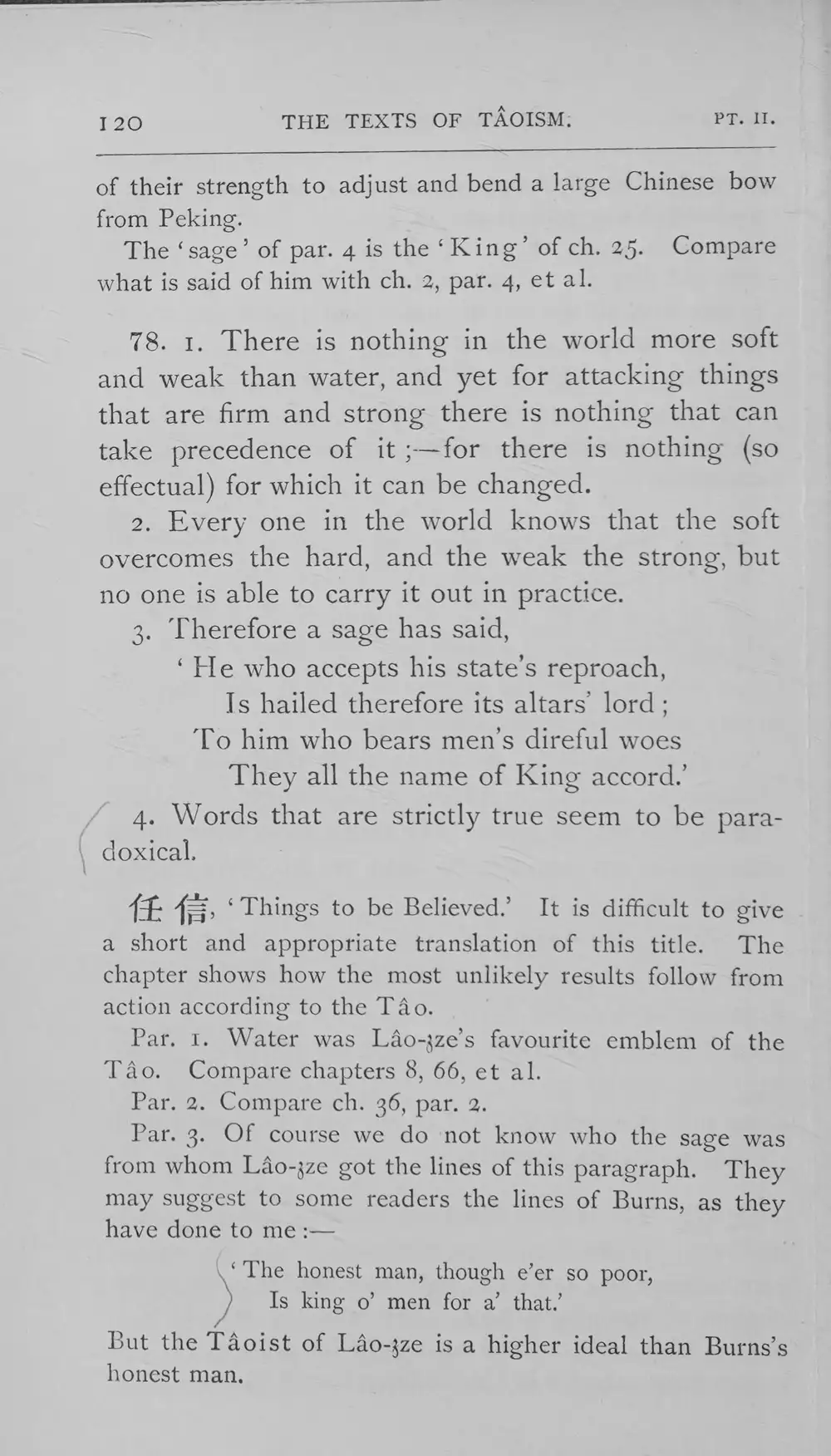
The ‘sage’ of par. 4 is the ‘King’ of ch. 25. Compare what is said of him with ch. 2, par. 4, and elsewhere.
78. 1. There is nothing in the world softer and weaker than water, and yet for attacking things that are firm and strong there is nothing that can take precedence of it;—for there is nothing (so effective) that could take its place.
2. Everyone in the world knows that the soft overcomes the hard, and the weak the strong, but no one is able to carry it out in practice.
3. Therefore a sage has said,
‘He who accepts his state’s reproach
Is hailed for that as lord of its altars;
To him who bears men’s direst woes
They all accord the name of King.’
4. Words that are strictly true seem to be paradoxical.
任信, ‘Things to be Believed.’ It is difficult to give a short and fitting translation of this title. The chapter shows how the most unlikely results follow from action according to the Tâo.
Par. 1. Water was Lâo-ȝze’s favourite emblem of the Tao. Compare chapters 8, 66, and elsewhere.
Par. 2. Compare ch. 36, par. 2.
Par. 3. Of course we do not know who the sage was from whom Lâo-ȝze took the lines of this paragraph. They may bring to some readers’ minds the lines of Burns, as they have to mine:— ‘The honest man, though e’er so poor, Is king o’ men for a’ that.’ But the Taoist of Lâo-ȝze is a higher ideal than Burns’s honest man.