The translation compares the Way of Heaven to “bending a bow”; the note speaks of “the method of stringing a bow”, and the note is the better guide. In stringing, the upper limb is drawn down and the lower raised against it, which is the levelling of paragraph 1, diminishing excess and supplying lack. Legge's report of strong men straining at a large bow shows he had watched it done, and the image works only as a picture of that operation.
The Tâo Teh King — Sacred Books of China Part I, SBE Vol. 39 (trans. James Legge, 1891)
Open to all
page 119
No image is selected for this page; its own page image is shown.
page 119
The ‘above’ and ‘below’ in par. 4 seem to be merely a play on the words, as they can mean ‘more and less honourable.’
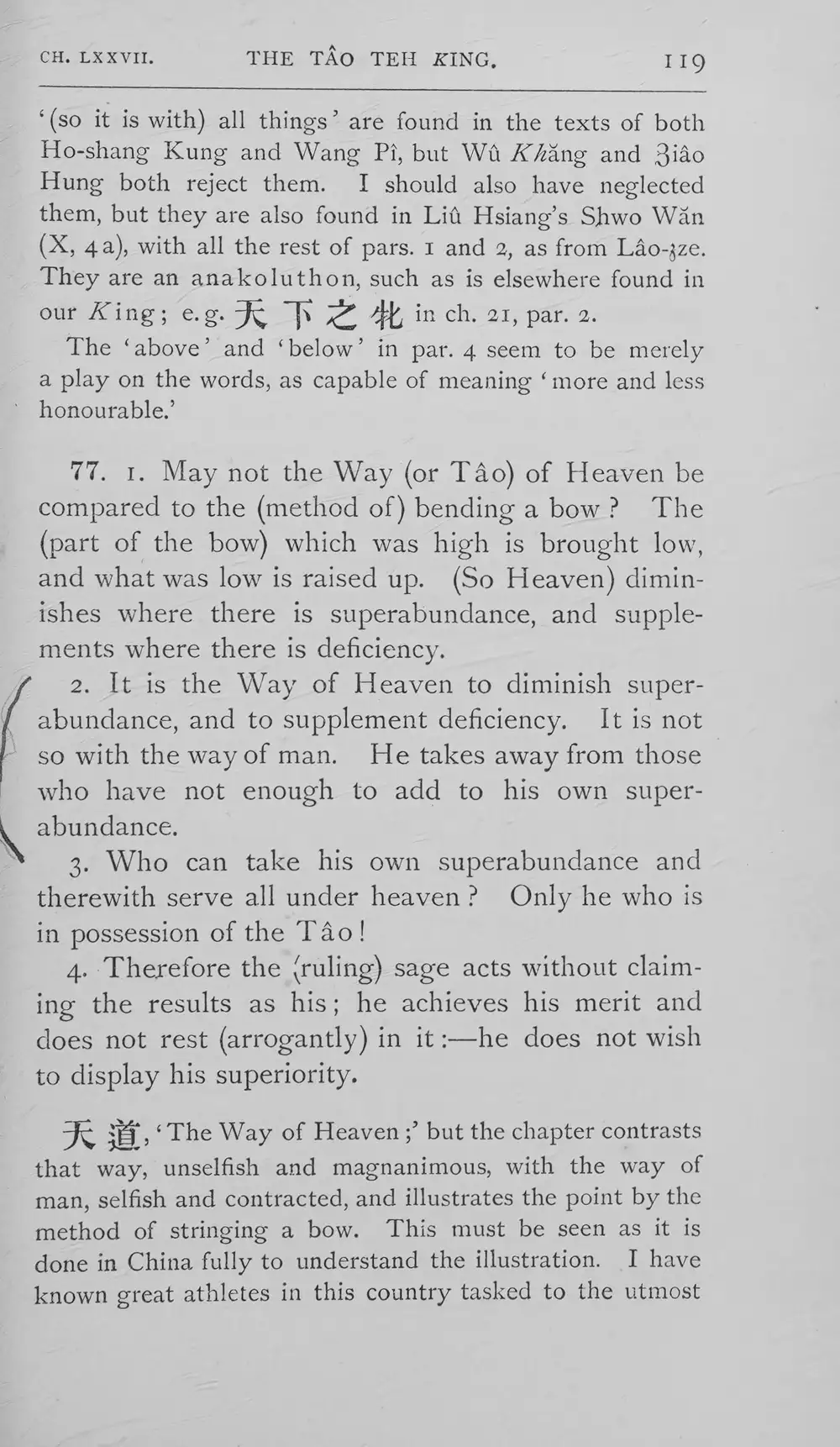
77. 1. May not the Way (or Tao) of Heaven be compared to the (method of) bending a bow? The (part of the bow) which was high is brought low, and what was low is raised up. (So Heaven) diminishes where there is excess, and supplements where there is deficiency.
2. It is the Way of Heaven to diminish excess and to supplement deficiency. It is not so with the way of man. He takes away from those who do not have enough, to add to his own excess.
3. Who can take his own excess and with it serve all under heaven? Only he who is in possession of the Tao!
4. Therefore the (ruling) sage acts without claiming the results as his own; he achieves his merit and does not rest (arrogantly) in it:—he does not wish to display his superiority.
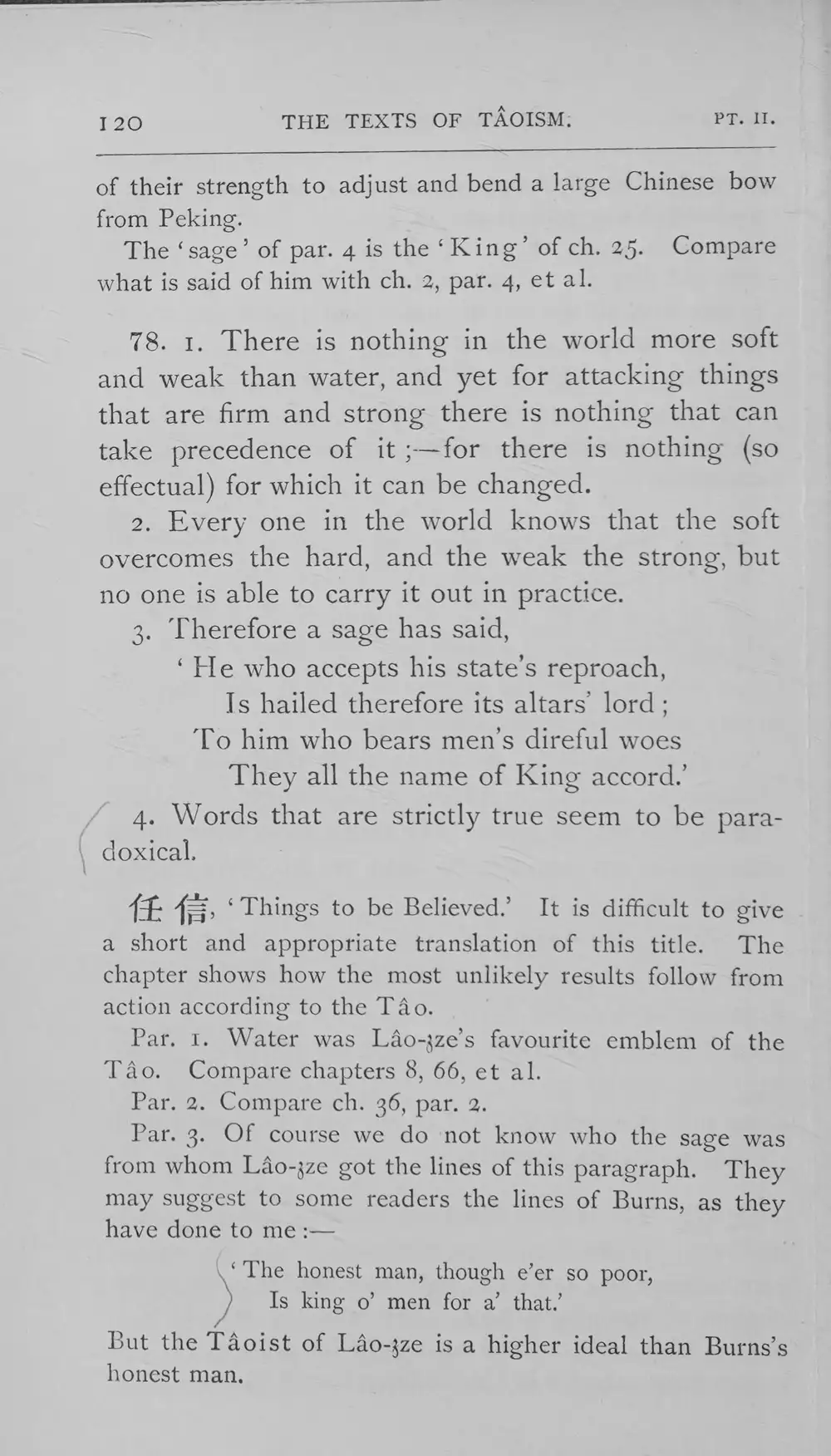
天道, ‘The Way of Heaven;’ but the chapter contrasts that way, unselfish and generous, with the way of man, selfish and narrow, and illustrates the point by the method of stringing a bow. One must see this done in China to understand the illustration fully. I have known great athletes in this country tasked to the utmost of their strength to adjust and bend a large Chinese bow from Peking.