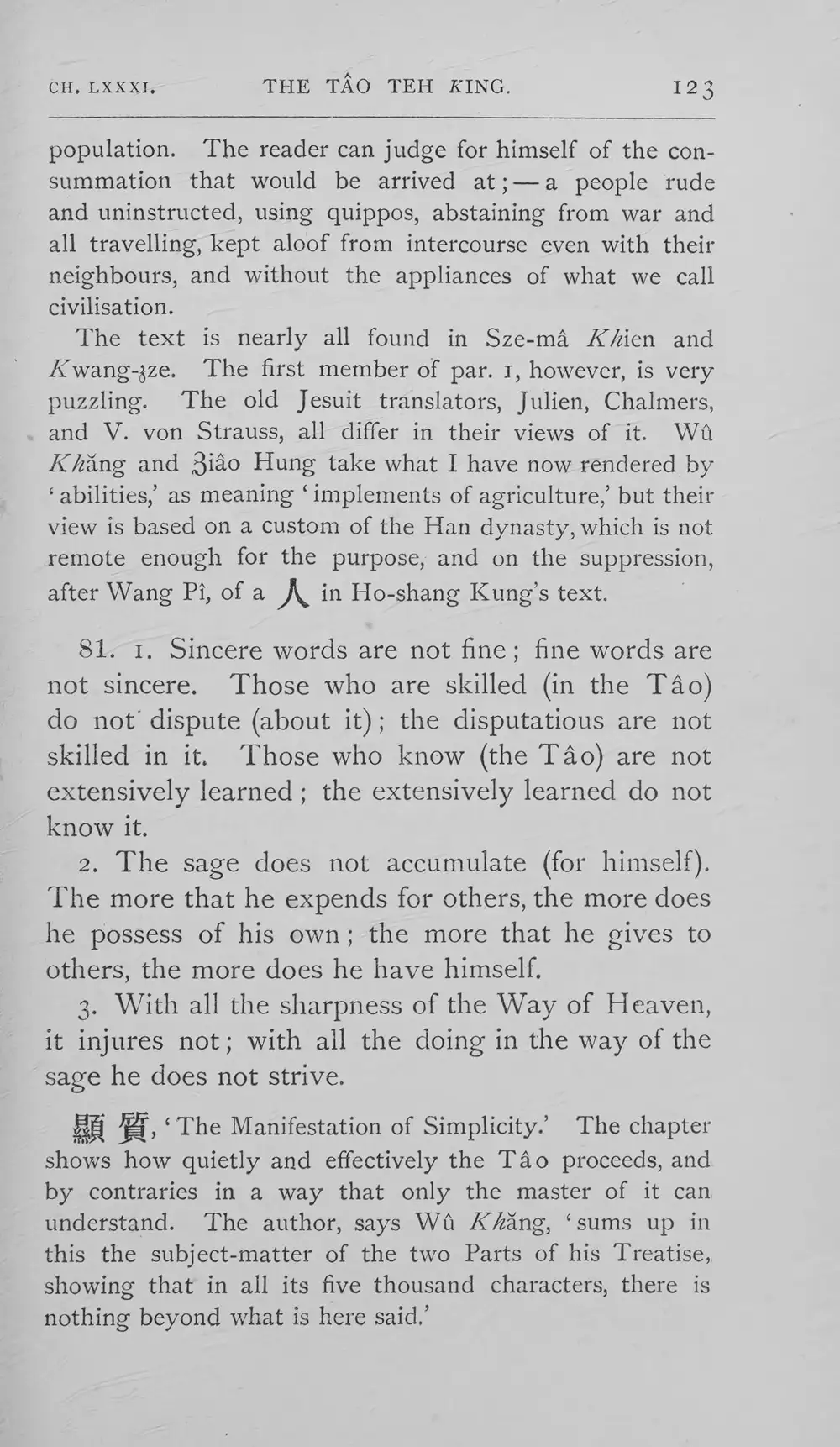
Legge invites the reader to judge “the consummation”: a people without travel or war, using knotted cords, “without the appliances of what we call civilisation”. That yardstick is his own age's. The chapter measures its little state by another, stated in paragraph 4: whether the people think their food sweet, their clothes beautiful and their dwellings places of rest. His verdict answers a question the chapter did not ask and leaves the one it did untouched.
The Tâo Teh King — Sacred Books of China Part I, SBE Vol. 39 (trans. James Legge, 1891)
Open to all
page 122
No image is selected for this page; its own page image is shown.
page 122
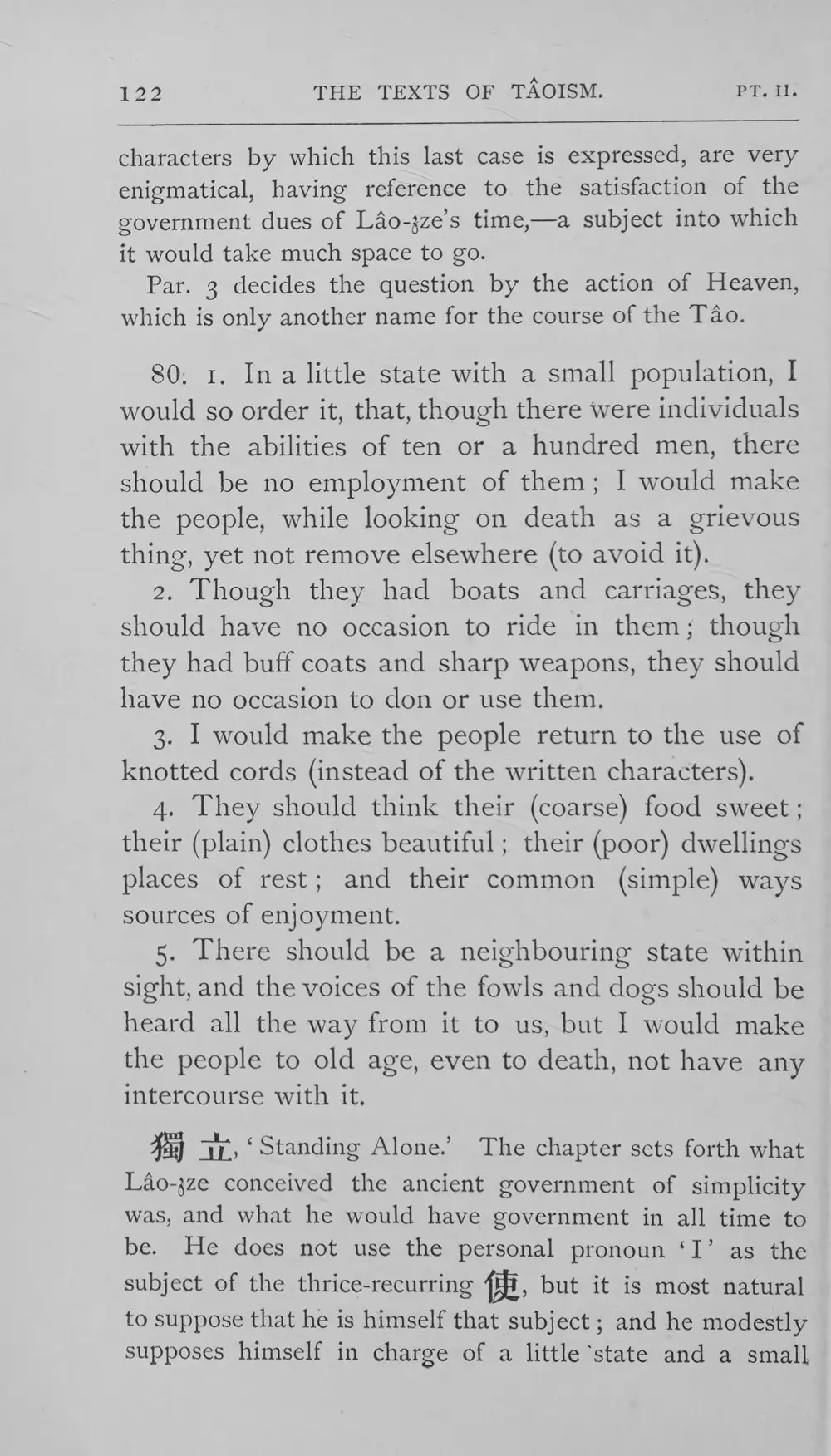
Par. 3 settles the question by the action of Heaven, which is only another name for the course of the Tao.
80. 1. In a little state with a small population, I would so order it that, though there were individuals with the abilities of ten or a hundred men, there should be no employment of them; I would make the people, while looking on death as a grievous thing, still not move elsewhere (to avoid it).
2. Though they had boats and carriages, they should have no occasion to ride in them; though they had buff coats and sharp weapons, they should have no occasion to put on or use them.
3. I would make the people return to the use of knotted cords (instead of written characters).
4. They should find their (coarse) food sweet; their (plain) clothes beautiful; their (poor) dwellings places of rest; and their common (simple) ways sources of enjoyment.
5. There should be a neighbouring state within sight, and the voices of its fowls and dogs should be heard all the way from it to us, but I would make the people, to old age, even to death, have no dealings with it.
獨立, ‘Standing Alone.’ The chapter sets out what Lâo-ȝze conceived the ancient government of simplicity to have been, and what he would have government be at all times. He does not use the personal pronoun ‘I’ as the subject of the thrice-recurring 使 [Press: to cause, to make (one do something)], but it is most natural to suppose that he himself is that subject, and he modestly supposes himself in charge of a little state and a small population. The reader can judge for himself what the result would be:—a people rough and uninstructed, using quipus, abstaining from war and all travel, kept apart from dealings even with their neighbours, and without the appliances of what we call civilisation.