Legge prints an unpublished Jesuit version beside his own, and it is a fair witness against him. Both of its explanations read the chapter as politics: the people's fear of the prince, taxes that drive them from their land, a sovereign who should spend himself for their happiness. His reading is a personal regimen. By printing it under “Quot homines, tot sententiae” rather than suppressing it, he lets the reader see that his predecessors took the chapter as a lesson to rulers.
The Tâo Teh King — Sacred Books of China Part I, SBE Vol. 39 (trans. James Legge, 1891)
Open to all
page 115
No image is selected for this page; its own page image is shown.
page 115
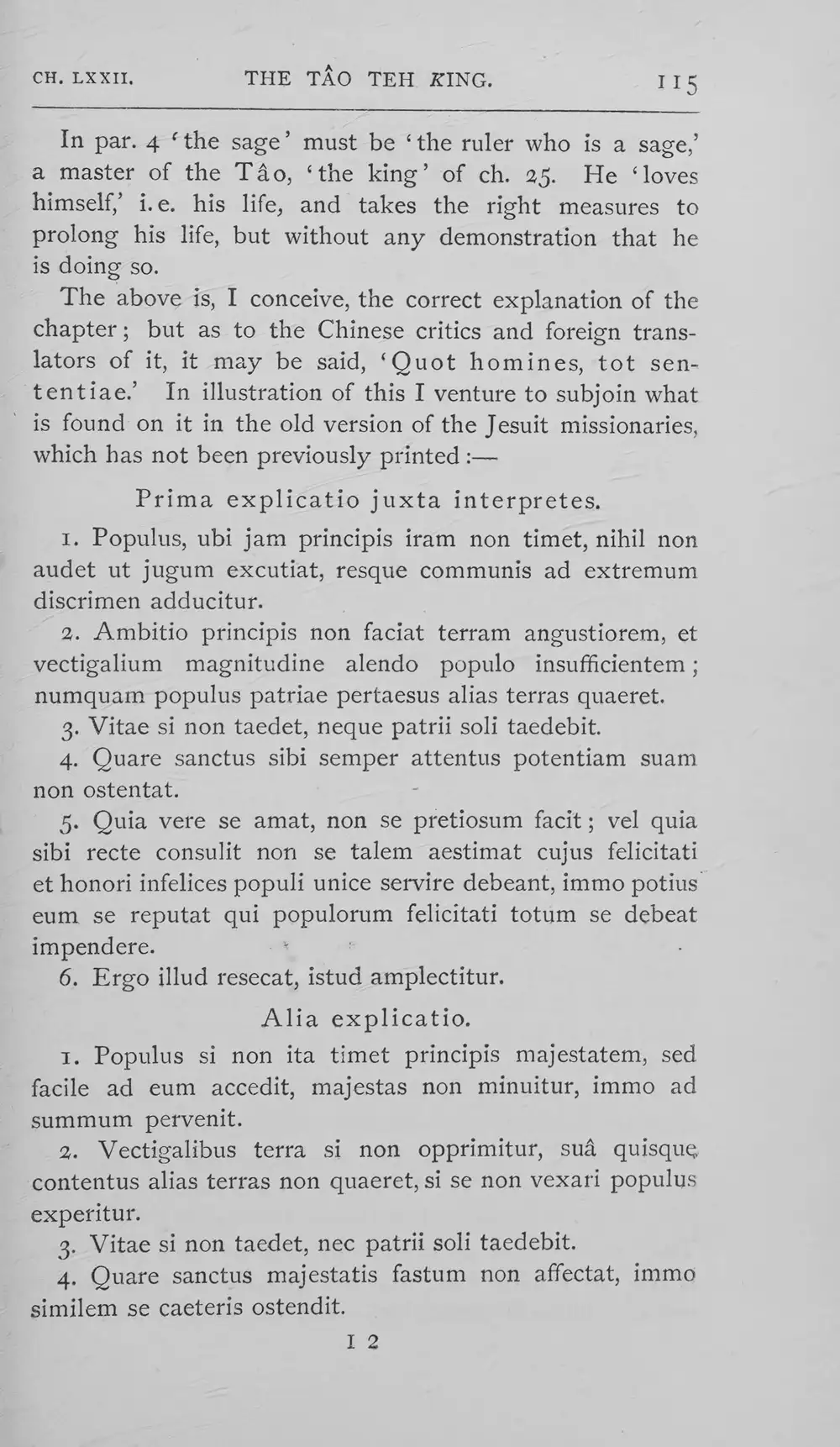
In par. 4 ‘the sage’ must be ‘the ruler who is a sage, a master of the Tâo’, ‘the king’ of ch. 25. He ‘loves himself’, i.e. his life, and takes the right measures to prolong it, but without any show of doing so.
The above is, I believe, the correct explanation of the chapter; but of the Chinese critics and foreign translators of it one may say, ‘As many men, so many opinions.’ To illustrate this I venture to add what is found on it in the old version of the Jesuit missionaries, which has not been printed before:—
First explanation, according to the interpreters.
1. The people, once they no longer fear the prince’s anger, will dare anything to throw off the yoke, and the commonwealth is brought to the utmost peril.
2. Let the prince’s ambition not make the land narrower, and, by the size of the taxes, insufficient to feed the people; then the people, never weary of their homeland, will not seek other lands.
3. If he is not weary of life, neither will he weary of his native soil.
4. Therefore the holy man, always attentive to himself, does not display his power.
5. Because he truly loves himself, he does not make himself precious; or, because he takes right thought for himself, he does not regard himself as one whose happiness and honour unhappy peoples ought to serve and nothing else, but rather counts himself one who ought to spend himself wholly on the happiness of the peoples.
6. Therefore he cuts away the one and embraces the other.
Alia explicatio.
1. If the people do not so fear the prince’s majesty, but approach him easily, his majesty is not lessened; rather, it reaches its height.
2. If the land is not oppressed with taxes, each man, content with his own, will not seek other lands, so long as the people find that they are not harassed.
3. If he is not weary of life, he will not weary of his native soil.
4. Therefore the holy man does not affect the pomp of majesty; rather, he shows himself like everyone else.