At the close of chapter 70 the sage wears hair cloth but carries “his (signet of) jade in his bosom”. Legge's supplied “signet” makes the jade a mark of office, an authority kept out of sight, and his note supports the turn: Lâo-ȝze's “principle and rule or ruler was the Tao”, and the complaint is of a ruler unrecognised. A plainer reading would keep the jade as hidden worth; the parenthesis commits the line to rank as well.
The Tâo Teh King — Sacred Books of China Part I, SBE Vol. 39 (trans. James Legge, 1891)
Open to all
page 113
No image is selected for this page; its own page image is shown.
page 113
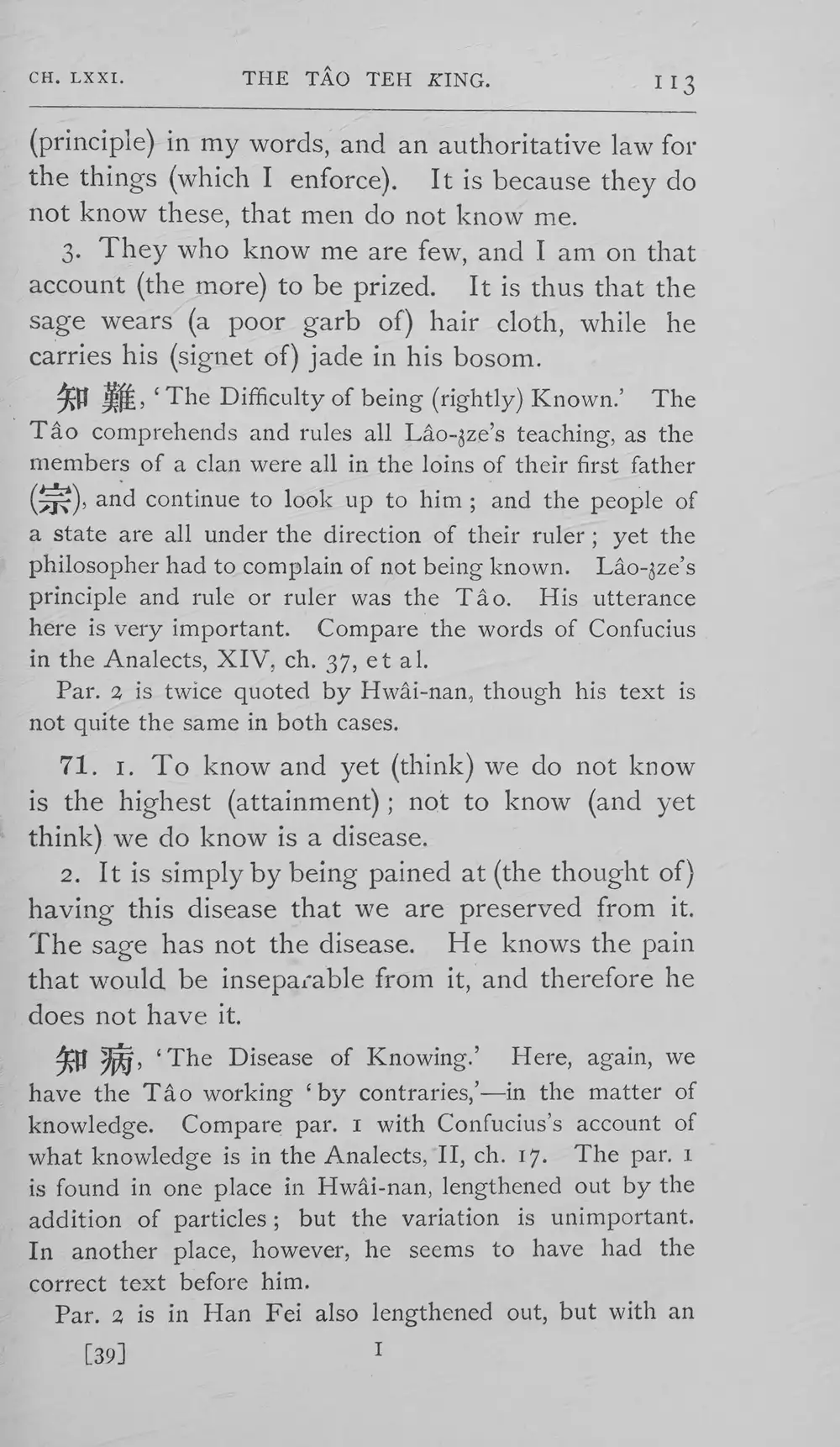
3. Those who know me are few, and on that account I am (all the more) to be prized. So it is that the sage wears (a poor garment of) haircloth, while he carries his (signet of) jade in his bosom.
知難, ‘The Difficulty of being (rightly) Known.’ The Tao comprehends and rules all of Lâo-ȝze’s teaching, as the members of a clan were all in the loins of their first father (宗), and continue to look up to him; and as the people of a state are all under the direction of their ruler; yet the philosopher had to complain of not being known. Lâo-ȝze’s principle, and rule or ruler, was the Tao. What he says here is very important. Compare the words of Confucius in the Analects, XIV, ch. 37, and elsewhere.
Par. 2 is quoted twice by Hwâi-nan, though his text is not quite the same in both cases.
71. 1. To know and yet (think) we do not know is the highest (attainment); not to know (and yet think) we do know is a disease.
2. It is simply by being pained at (the thought of) having this disease that we are kept from it. The sage does not have the disease. He knows the pain that would be inseparable from it, and therefore he does not have it.
知病, ‘The Disease of Knowing.’ Here again we have the Tao working ‘by contraries,’—in the matter of knowledge. Compare par. 1 with Confucius’s account of what knowledge is in the Analects, II, ch. 17. Par. 1 is found in one place in Hwâi-nan, lengthened by the addition of particles; but the variation is unimportant. In another place, however, he seems to have had the correct text before him.
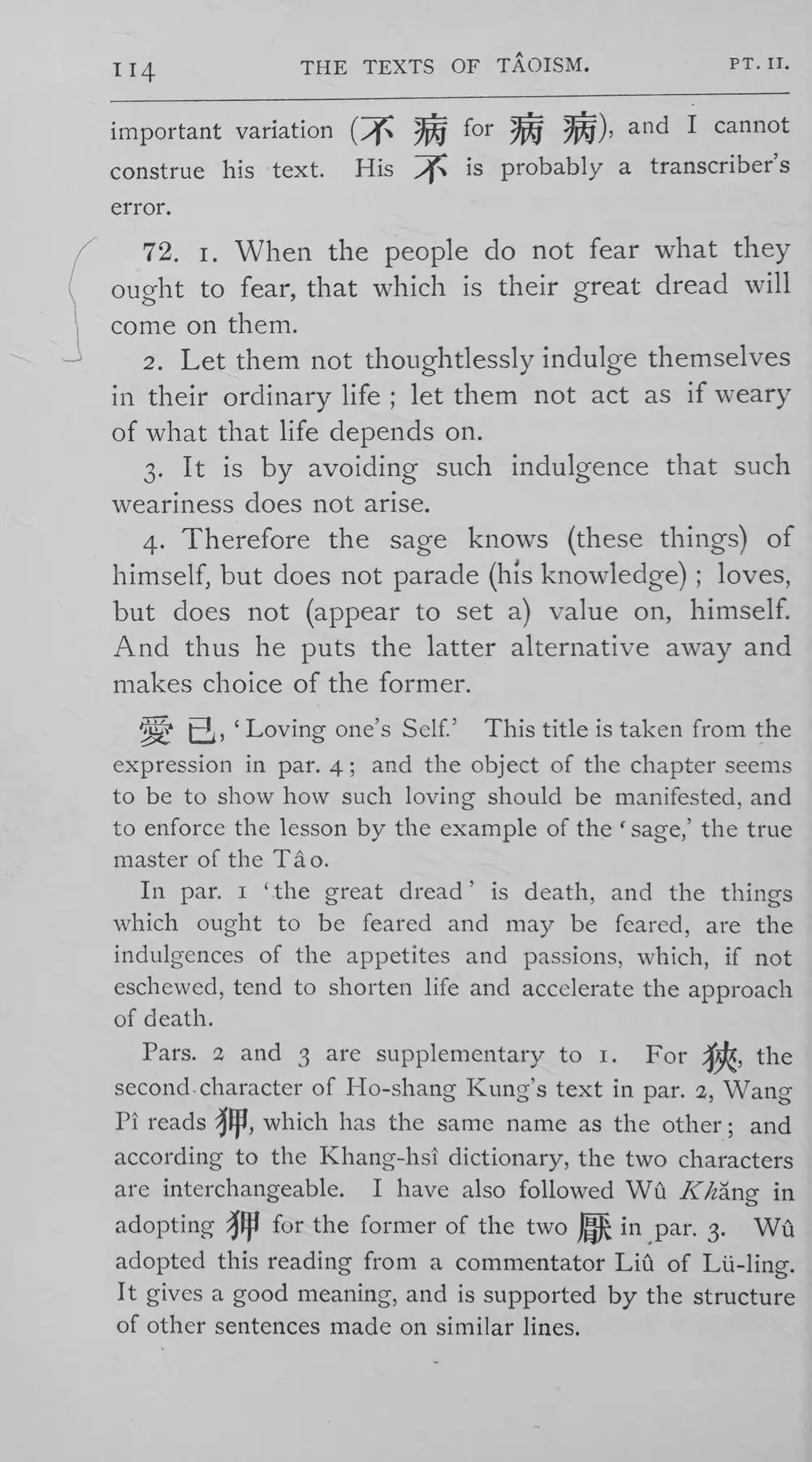
Par. 2 is in Han Fei also lengthened, with an important variation (不病 [Press: not ailing; free of the malady] for 病病 [Press: to feel the malady as a malady]), and I cannot construe his text. His 不 [Press: not] is probably a copyist’s error.