The variant Legge notes here, Ho-shang Kung's 狹 against Wang Pî's 狎, decides the chapter. He follows 狎 and reads paragraph 2 as a caution against self-indulgence. The Jesuit Latin he prints next asks that the prince not make the land “angustiorem”, narrower, by taxes, which looks like a reading of 狹 in its sense of narrow. The two interpretations rest on the two characters, and Legge's choice is what makes “their great dread” death rather than the ruin of the state.
The Tâo Teh King — Sacred Books of China Part I, SBE Vol. 39 (trans. James Legge, 1891)
Open to all
page 114
No image is selected for this page; its own page image is shown.
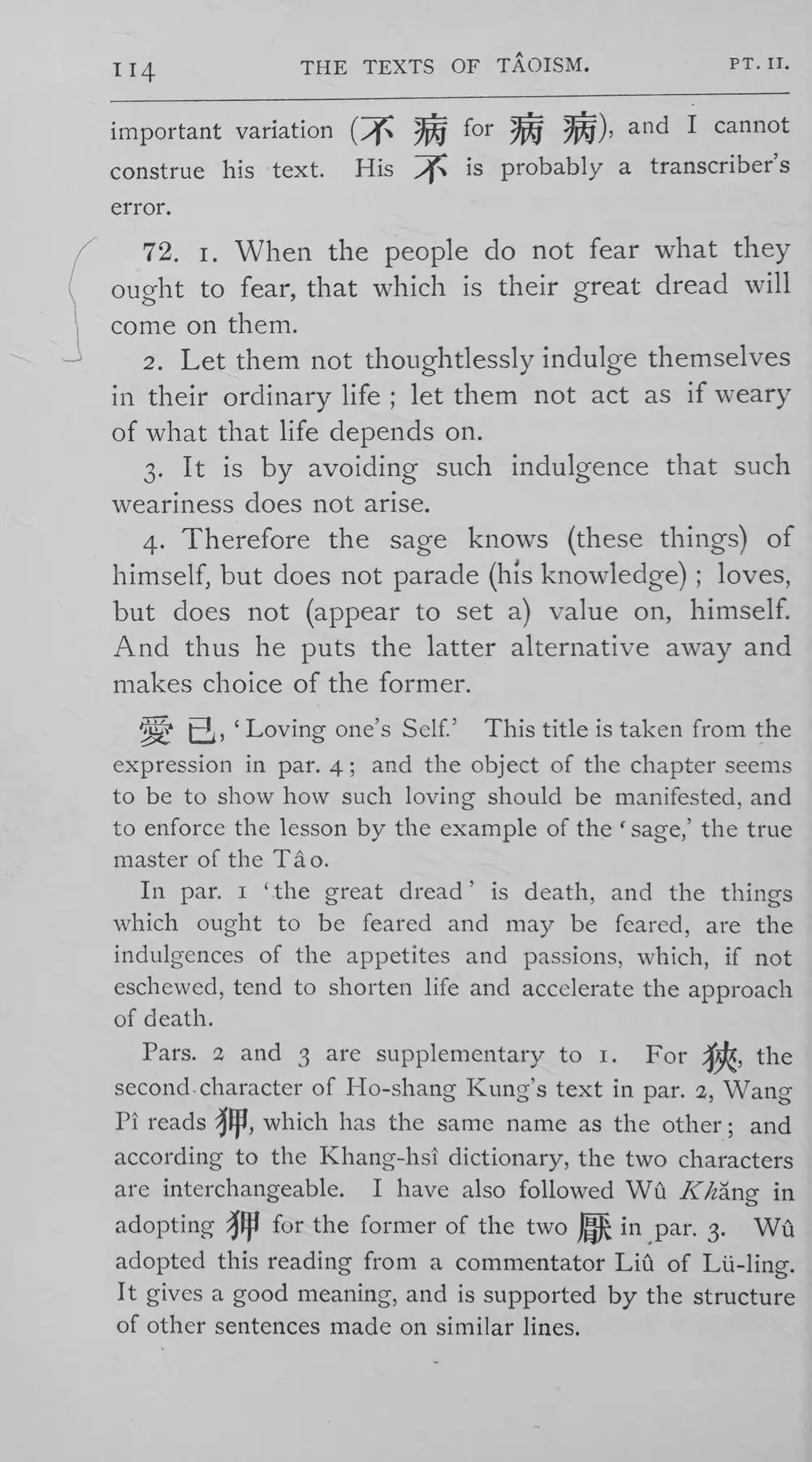
page 114
72. 1. When the people do not fear what they ought to fear, what is their great dread will come upon them.
2. Let them not thoughtlessly indulge themselves in their ordinary life; let them not act as if weary of what that life depends on.
3. It is by avoiding such indulgence that such weariness does not arise.
4. Therefore the sage knows (these things) of himself, but does not parade (his knowledge); he loves himself, but does not (appear to set a) value on himself. And so he puts the latter course away and chooses the former.
愛已, ‘Loving one’s Self.’ This title is taken from the expression in par. 4; and the aim of the chapter seems to be to show how such love should be shown, and to drive the lesson home by the example of the ‘sage,’ the true master of the Tao.
In par. 1 ‘the great dread’ is death, and the things which ought to be feared and may be feared are the indulgences of the appetites and passions, which, if not avoided, tend to shorten life and hasten the approach of death.
Pars. 2 and 3 are supplementary to 1. For 狹 [Press: narrow; to narrow, confine], the second character of Ho-shang Kung’s text in par. 2, Wang Pî reads 狎 [Press: to treat with familiarity; to slight], which has the same sound as the other; and according to the Khang-hsi dictionary the two characters are interchangeable. I have also followed Wû Khăng in adopting 狎 [Press: to treat with familiarity; to slight] for the first of the two 厭 [Press: to weary of, be satiated; to press down] in par. 3. Wû adopted this reading from a commentator, Lid of Lii-ling. It gives a good meaning, and is supported by the structure of other sentences built on similar lines.