Paragraph 1 of this chapter commands action: “Action should be taken before a thing has made its appearance”. Paragraph 3 says that he who acts does harm and the sage does not act. Legge reconciles them by supplying “(with an ulterior purpose)”, so that only purposeful action is condemned. The parenthesis is his, but it is the reading his note on chapter 63 had drawn, that Taoist non-action “had a method” in it; without some such qualification the chapter contradicts itself within a page.
The Tâo Teh King — Sacred Books of China Part I, SBE Vol. 39 (trans. James Legge, 1891)
Open to all
page 108
No image is selected for this page; its own page image is shown.
page 108
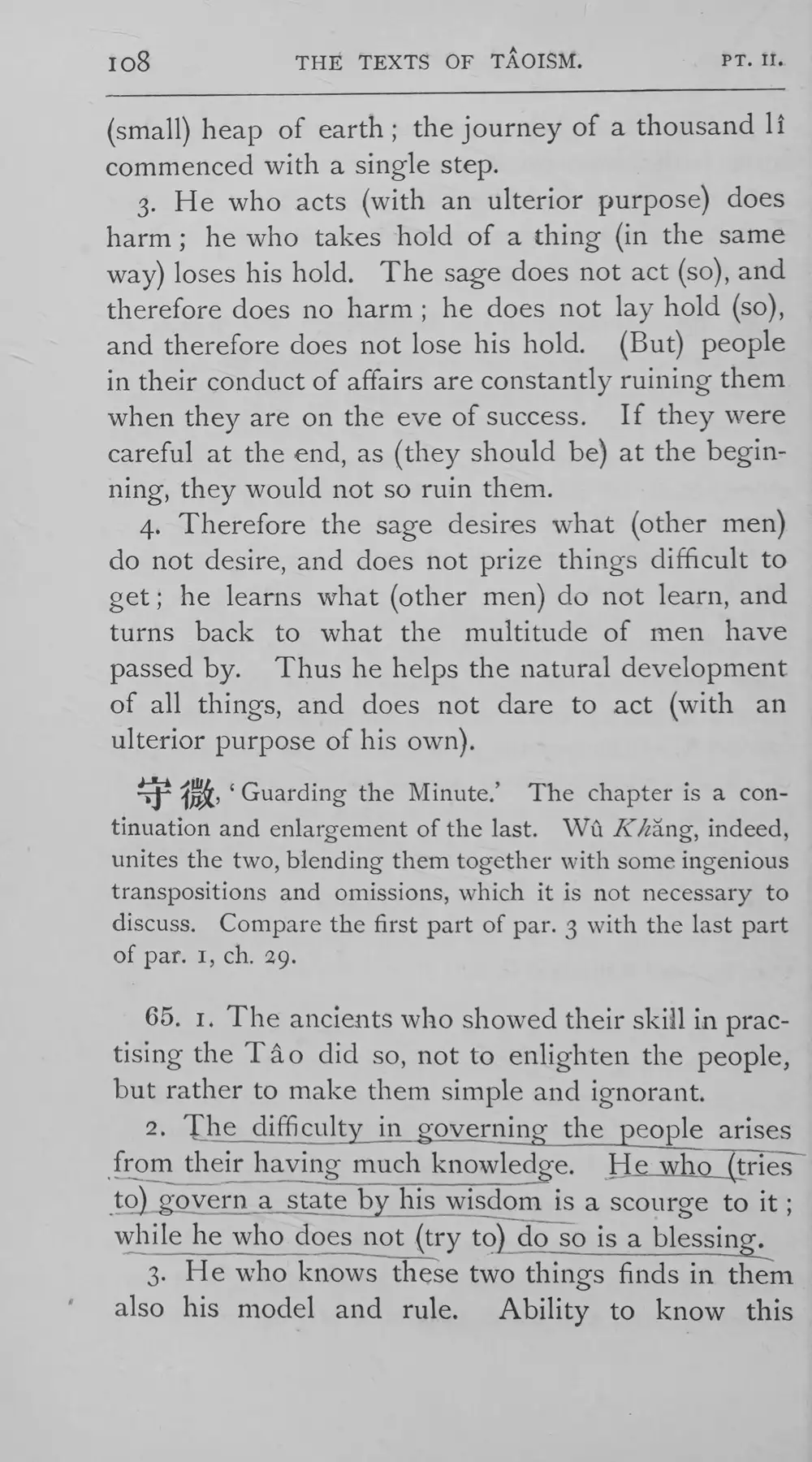
3. He who acts (with an ulterior purpose) does harm; he who takes hold of a thing (in the same way) loses his hold. The sage does not act (so), and therefore does no harm; he does not take hold (so), and therefore does not lose his hold. (But) people, in conducting their affairs, are constantly ruining them when they are on the verge of success. If they were as careful at the end as (they should be) at the beginning, they would not ruin them so.
4. Therefore the sage desires what (other men) do not desire, and does not prize things that are hard to get; he learns what (other men) do not learn, and turns back to what the mass of men have passed by. In this way he helps the natural development of all things, and does not dare to act (with an ulterior purpose of his own).
守微, ‘Guarding the Minute.’ The chapter is a continuation and enlargement of the last. Wû Khăng, indeed, unites the two, blending them together with some ingenious transpositions and omissions, which there is no need to discuss. Compare the first part of par. 3 with the last part of par. 1, ch. 29.
65. 1. The ancients who showed their skill in practising the Tao did so not to enlighten the people, but rather to make them simple and ignorant.
2. The difficulty in governing the people comes from their having much knowledge. He who (tries to) govern a state by his wisdom is a scourge to it; while he who does not (try to) do so is a blessing.
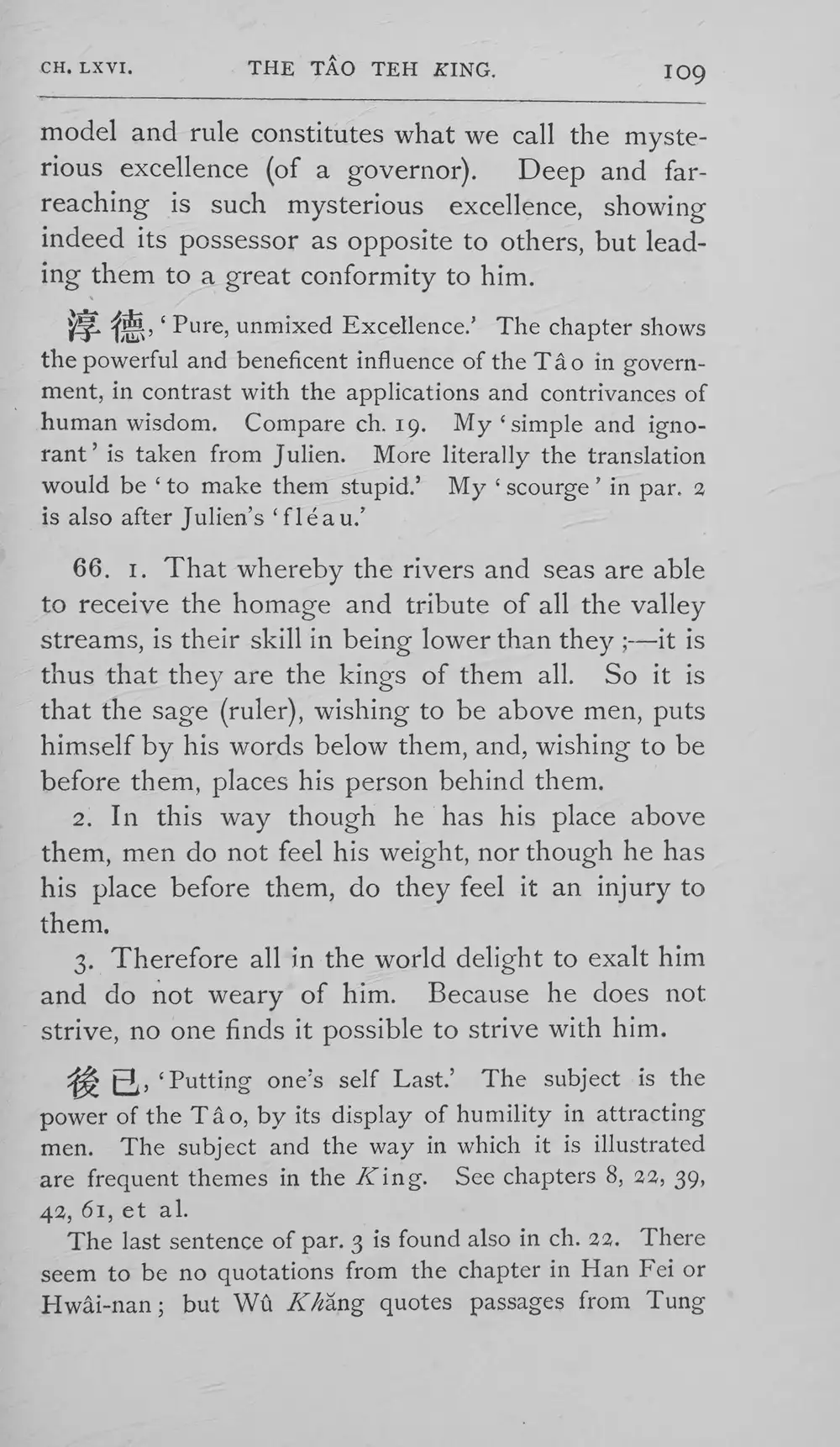
3. He who knows these two things finds in them also his model and rule. Ability to know this model and rule is what we call the mysterious excellence (of a ruler). Deep and far-reaching is such mysterious excellence, showing its possessor indeed as the opposite of others, but leading them to a great conformity with him.