The Tâo Teh King — Sacred Books of China Part I, SBE Vol. 39 (trans. James Legge, 1891)

Open to allEdited by F. Max Müller; translated by Müller, Legge, Bühler, West, Darmesteter, Palmer, Telang, Thibaut, Jolly, Rhys Davids, Oldenberg, Jacobi, Bloomfield and others1850 segments · 383 pp
page 106

No image is selected for this page; its own page image is shown.

The Tâo Teh King — Sacred Books of China Part I, SBE Vol. 39 (trans. James Legge, 1891), photo of the original · p. 106
Photo of the original · p. 106
page 106

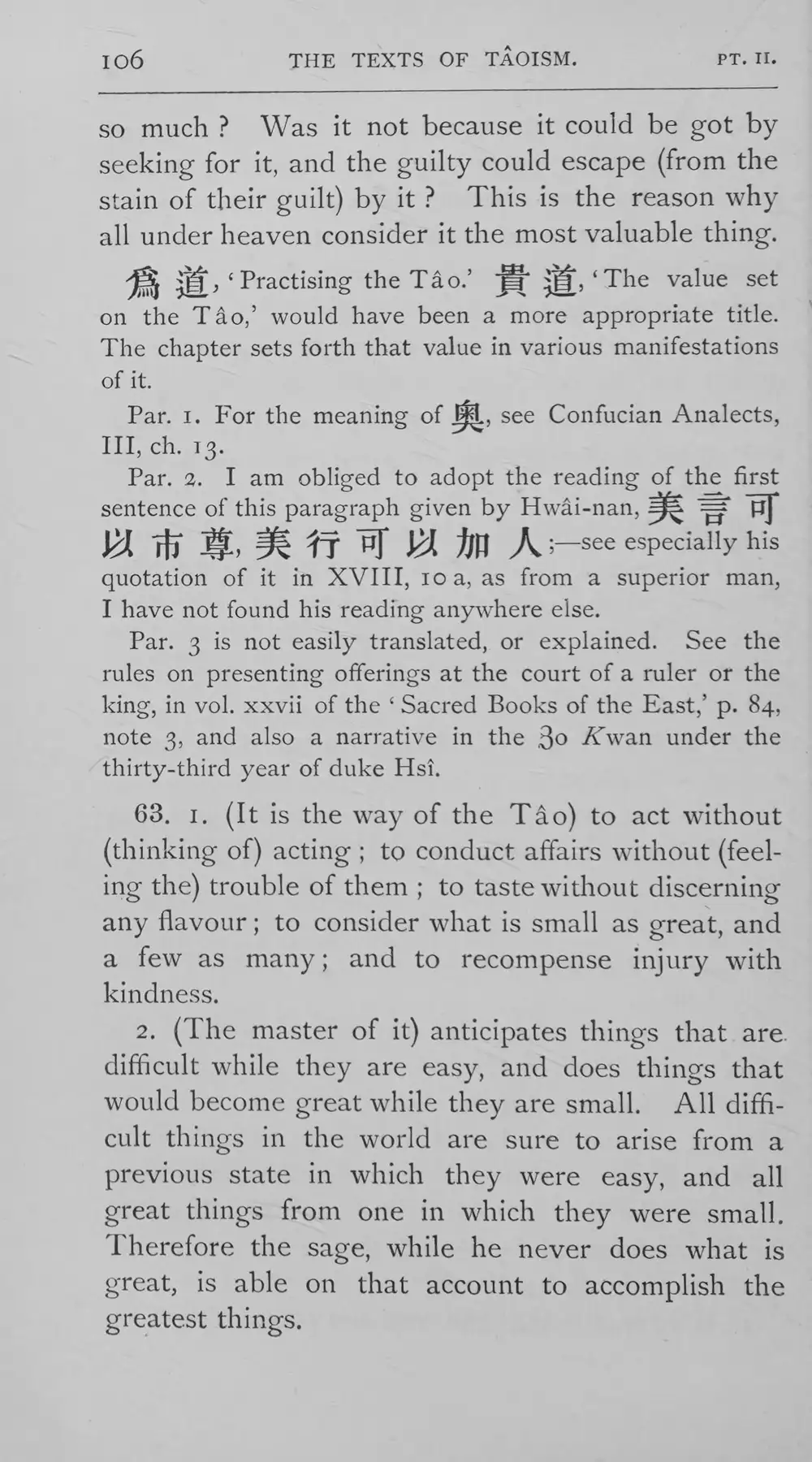
爲道, ‘Practising the Tâo.’ 貴道, ‘The value set on the Tâo,’ would have been a more fitting title. The chapter sets forth that value in various manifestations of it.

Par. 1. For the meaning of 奧 [Press: the secret, honoured corner of a house], see Confucian Analects, III, ch. 13.

Par. 2. I am obliged to adopt the reading of the first sentence of this paragraph given by Hwâi-nan, 美言可 [Press: fine words can] 以市尊 [Press: purchase honour],美行可以加人 [Press: fine deeds can raise a man above others];—see especially his quotation of it in XVIII, 10a, as from a superior man. I have not found his reading anywhere else.

Par. 3 is not easily translated or explained. See the rules on presenting offerings at the court of a ruler or the king, in vol. xxvii of the ‘Sacred Books of the East’, p. 84, note 3, and also a narrative in the 30 Awan under the thirty-third year of duke Hsi.

63, 1. (It is the way of the Tao) to act without (thinking of) acting; to manage affairs without (feeling) the trouble of them; to taste without perceiving any flavour; to regard what is small as great, and a few as many; and to repay injury with kindness.

2. (The master of it) deals with things that are difficult while they are still easy, and does things that would become great while they are still small. All difficult things in the world are sure to arise from an earlier state in which they were easy, and all great things from one in which they were small. Therefore the sage, while he never does what is great, is for that very reason able to accomplish the greatest things.

Commentary
page 106 ·
Cross-Estate§104

For the round symbol of rank and the team of horses in paragraph 3, Legge sends the reader to the Lî Kî, vol. xxvii, p. 84, note 3. That note concerns the horses only: whoever presents a carriage and horses carries the whip and mounting-strap up to the hall, and the team stays in the courtyard. It is the source of Legge's bracketed ‘(in the court-yard)’, and it belongs to rules for gifts from inferiors to superiors. Read with it, the line shows a presentation in full form, the jade in hand and the horses below, and Lâo-ȝze sets above it a lesson of the Tâo offered on one's knees.

cites The Lî Kî, Books I–X — Sacred Books of China Part III, SBE Vol. 27 (trans. James Legge, 1885)