Legge notices that “Three Precious Things” is also the Chinese name for the Buddhist Triratna, and declines to ask which borrowed from which. His distinction is the sound one: in Buddhism the three are objects of refuge, while here they are dispositions of conduct, gentleness, economy and not taking precedence. What the two share is a phrase, not a doctrine, and the chapter gives no ground for reading one into the other.
The Tâo Teh King — Sacred Books of China Part I, SBE Vol. 39 (trans. James Legge, 1891)
Open to all
page 110
No image is selected for this page; its own page image is shown.
page 110
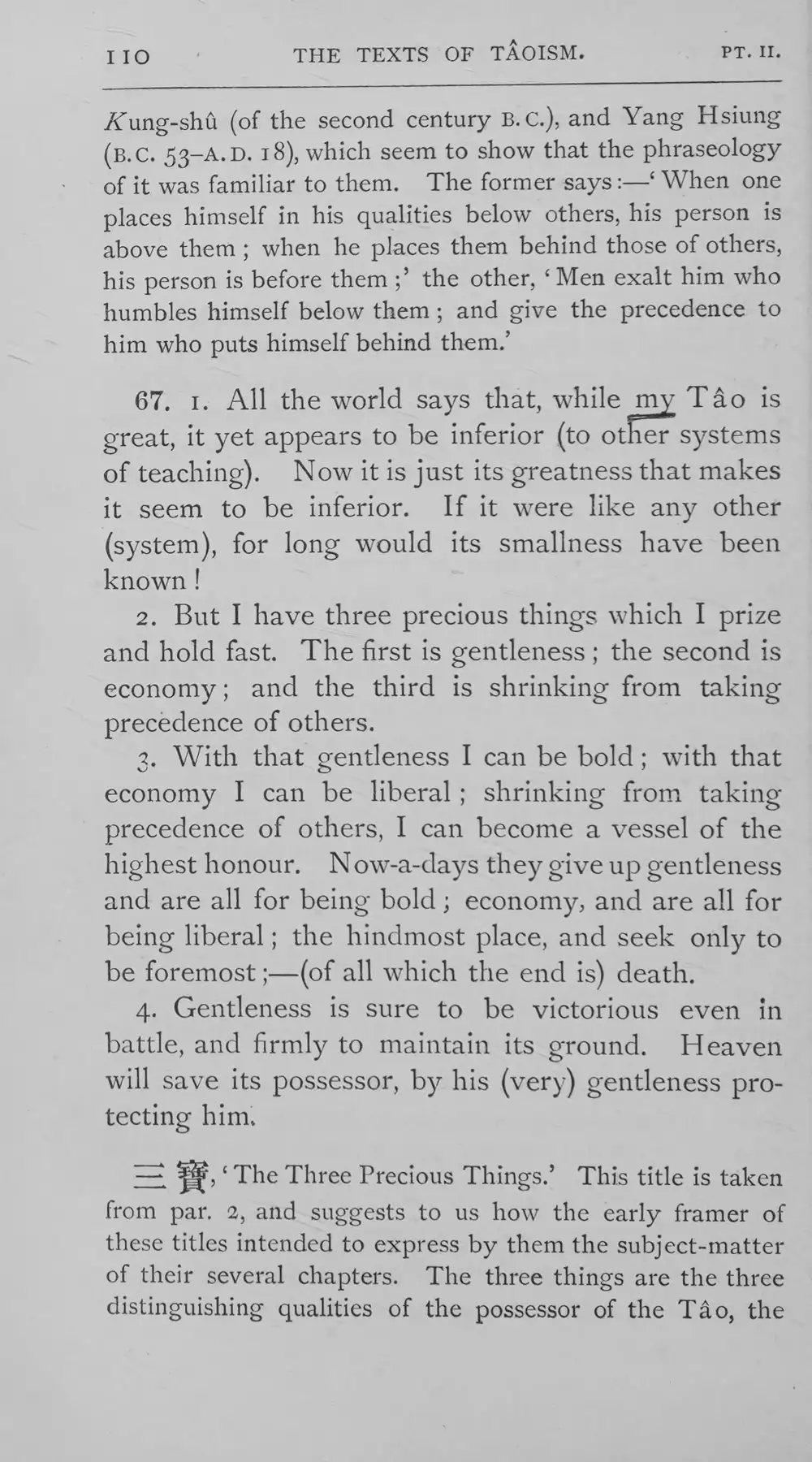
67. 1. All the world says that, while my Tâo is great, it still seems to be inferior (to other systems of teaching). Now it is precisely its greatness that makes it seem inferior. If it were like any other (system), its smallness would long ago have been known!
2. But I have three precious things which I prize and hold fast. The first is gentleness; the second is economy; and the third is shrinking from taking precedence of others.
3. With that gentleness I can be bold; with that economy I can be generous; shrinking from taking precedence of others, I can become a vessel of the highest honour. Nowadays people give up gentleness and are all for being bold; economy, and are all for being generous; the hindmost place, and seek only to be foremost;—(and the end of all this is) death.
4. Gentleness is sure to be victorious even in battle, and to hold its ground firmly. Heaven will save its possessor, protecting him by his (very) gentleness.
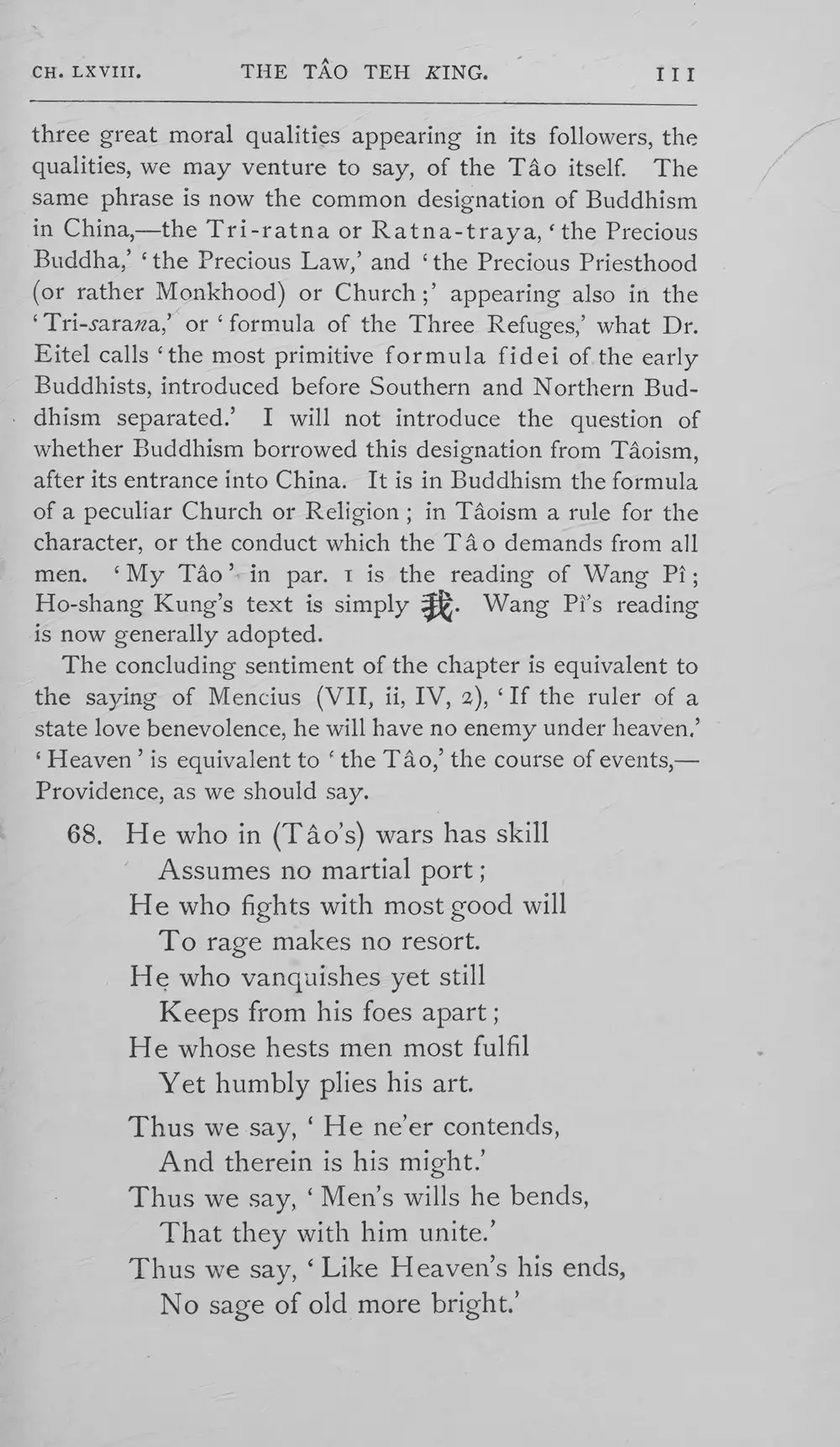
三寶, ‘The Three Precious Things.’ This title is taken from par. 2, and shows us how the early framer of these titles meant to express by them the subject-matter of their several chapters. The three things are the three distinguishing qualities of the possessor of the Tao, the three great moral qualities appearing in its followers—the qualities, we may venture to say, of the Tâo itself. The same phrase is now the common name for Buddhism in China,—the Tri-ratna or Ratna-traya, ‘the Precious Buddha,’ ‘the Precious Law,’ and ‘the Precious Priesthood (or rather Monkhood) or Church;’ appearing also in the Tri-sarana, or ‘formula of the Three Refuges,’ which Dr. Eitel calls ‘the most primitive formula of faith of the early Buddhists, introduced before Southern and Northern Buddhism separated.’
I will not raise the question whether Buddhism borrowed this name from Taoism after its entrance into China. In Buddhism it is the formula of a particular Church or Religion; in Taoism it is a rule for the character, or the conduct, which the Tao demands of all men.
‘My Tao’ in par. 1 is the reading of Wang Pî; Ho-shang Kung’s text is simply 我 [Press: I, me]. Wang Pî’s reading is now generally adopted. The closing sentiment of the chapter is equivalent to the saying of Mencius (VII, ii, IV, 2), ‘If the ruler of a state loves benevolence, he will have no enemy under heaven.’ ‘Heaven’ is equivalent to ‘the Tao,’ the course of events,—Providence, as we would say.