La Iniciación: Mensuario del Grupo Independiente de Estudios Esotéricos
The Initiation: Monthly of the Independent Group of Esoteric Studies
La Iniciación · Año V, Nº 48 · April 1946
Gate passedSeeker and aboveModern transcription — not a facsimileGIDEE / Orden Martinista de América del SurOperator ruling: no copyright implications asserted for this work. Uruguay life+50 (Leo d. 1970 → PD 2020); US URAA restoration assessed at ~2041 in the collection plan and overridden by the operator.350 of 350 segments translated · 25 ppsha 77adf4191659…
primary
derivedpage 9
19 KABBALISTIC THEORY OF MUSIC (Continuation and end) By Rouxel CHAPTER VII — Origin of the minor scale The proportions we have seen, and the chords that are their expression, are not the only ones that can be obtained.
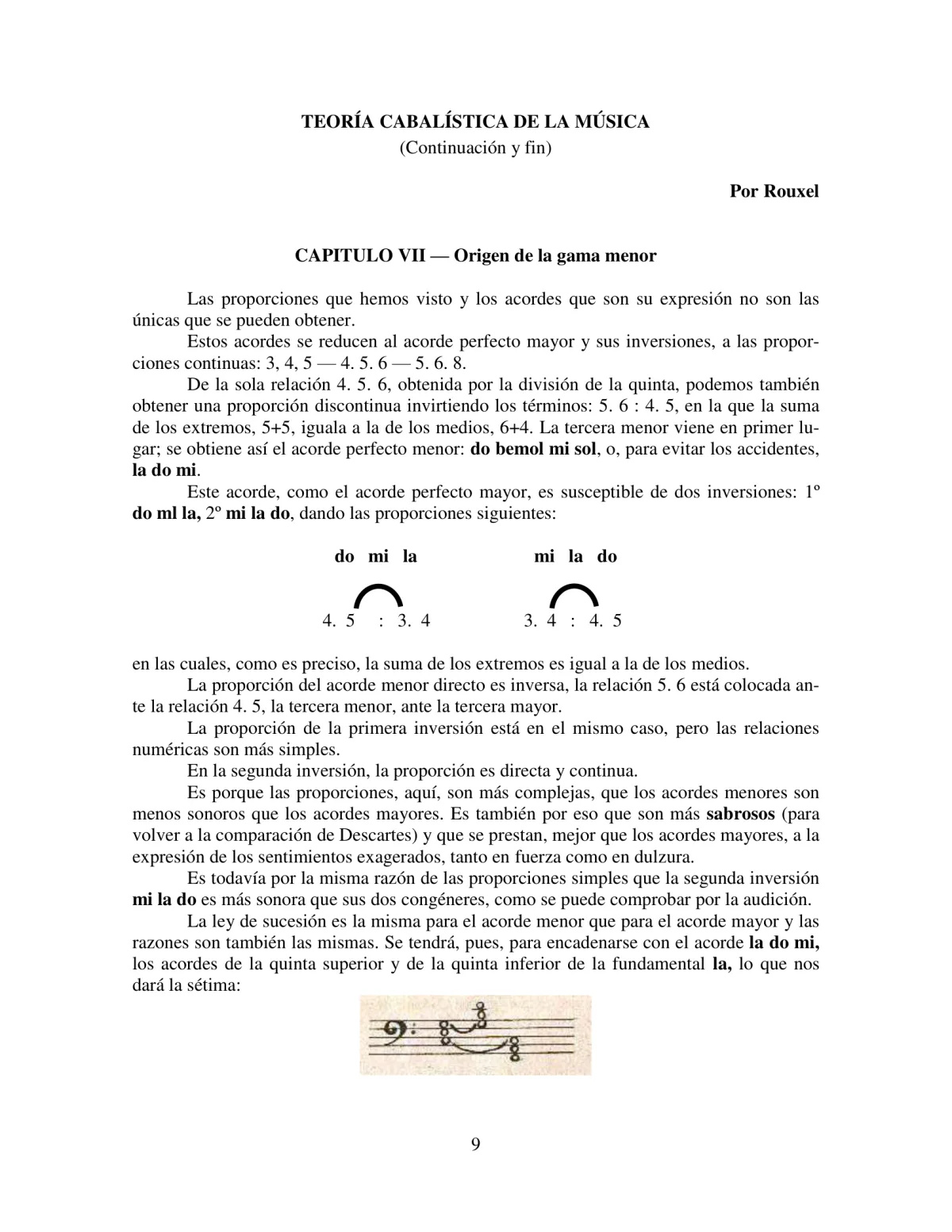
Musical example from Rouxel's 'Kabbalistic Theory of Music': a bass-clef stave carrying the derivation of the minor scale from the perfect minor chord.
La Iniciación 5.48 (GIDEE, Montevideo), page 9 of the scan
2These chords reduce to the perfect major chord and its inversions, to the continuous proportions: 3, 4, 5 — 4. 5. 6 — 5. 6. 8.
3From the single relation 4. 5. 6, obtained by the division of the fifth, we can also obtain a discontinuous proportion by inverting the terms: 5. 6 : 4. 5, in which the sum of the extremes, 5+5, equals that of the means, 6+4.
4The minor third comes in first place; thus is obtained the perfect minor chord: do flat-mi sol, or, to avoid accidentals, la do mi.
5This chord, like the perfect major chord, is susceptible of two inversions: 1st do mi la [Sic: the Spanish prints “do ml la”], 2nd mi la do, giving the following proportions: do mi la mi la do 4. 5 : 3. 4 3. 4 : 4. 5 in which, as is required, the sum of the extremes is equal to that of the means.
6The proportion of the direct minor chord is inverse: the relation 5. 6 is placed before the relation 4. 5, the minor third before the major third.
7The proportion of the first inversion is in the same case, but the numerical relations are simpler.
8In the second inversion, the proportion is direct and continuous.
9It is because the proportions here are more complex that the minor chords are less sonorous than the major chords.
10It is also for that reason that they are more savoury (to return to Descartes’ comparison) and that they lend themselves, better than the major chords, to the expression of exaggerated feelings, in force as in sweetness.
11It is again for the same reason of simple proportions that the second inversion mi la do is more sonorous than its two congeners, as can be verified by audition.
12The law of succession is the same for the minor chord as for the major chord, and the reasons are also the same.
13One will have, then, to link with the chord la do mi, the chords of the upper fifth and of the lower fifth of the fundamental la, which will give us the seventh:
Our translation, period-faithful. Citable as our translation, never as the source.
Commentarywhole issue ·
Historical[P-V]ini:5.48:1:003
Nº 48 is the review's most Eastern issue to date: a Ramakrishna memorial, the Suddha Dharma Gita commentary, and Guénon's Vedanta-saturated Demiurge instalment fill most of its pages, with only Rouxel's music theory and the astrology course holding the Western line.
Historical[P-V]ini:5.48:2:001
The reset masthead introduced in Nº 47 is retained unchanged: the collective 'Instructors and Brothers of Orders' formula, the currency notice, and the 1.80-dollar overseas price.
Historical[P-V]ini:5.48:3:001
The SUMARIO prints the Ramakrishna author as 'Arnapakaka' while the article itself signs 'Amapadaka' — a compositor's scramble of the same lodge-name. The contents also show the run's serial discipline: three continuations (Gita commentary, Demiurge, chromotherapy) and one series concluded (Rouxel).
Historical[P-V]ini:5.48:4:001
Read at session No. 270 of Papus Centre No. 5 on 15 February — Ramakrishna's birthday fell on 18 February 1836, and the text's 'l10 years since Chandramani gave birth' (the compositor set a letter ell before the digits) confirms the piece as a 110th-birthday commemoration, the Hindu counterpart of the Saint-Yves death-day lecture in Nº 47.
Comparative[P-V]ini:5.48:4:002
The frame is syncretic from the first line: the Lipikas and 'Lords of Karma' are Blavatsky's terms, the avatar-list runs Rama–Krishna–Buddha–Christ–Chaitanya, and Rama's torch-and-cup and Deva Nahusha come from Schuré's 'Great Initiates' — the lecturer is retelling Ramakrishna's life through the review's own composite canon rather than the Bengali sources.
Historical[P-V]ini:5.48:5:012
The Kali prayer given here is a close Spanish rendering of Ramakrishna's recorded prayers to the Divine Mother as transmitted in the Ramakrishna Mission literature ('I want no fame, no psychic powers — only pure love for Thee'). The Ramakrishna Ashrama appears among the masthead's fraternal orders, so the group had direct access to Mission publications.
Historical[P-V]ini:5.48:6:002
The eulogy breaks into free verse — 'Tenuous as a sigh, tender as a flower' — the same devotional-poem register the review's memorials reach for at their climax, as in the Saint-Yves invocation of Nº 47.
Comparative[P-V]ini:5.48:7:011
The three paths — Wisdom, Devotion, Action — are the classical jnana, bhakti and karma yogas; the lecturer's counsel that devotion is preferable 'while the feeling of personality endures' reproduces Ramakrishna's own teaching that bhakti is the path for this age.
Historical[P-V]ini:5.48:8:013
The succession scene is historical: Narendranath Datta — Swami Vivekananda — was designated by Ramakrishna before his death in August 1886 ('he is a roaring blaze' is from the recorded sayings), and the closing detail, the Master dying with Kali's name three times on his lips, is from the Mission's account of his last night. The article ends with the mantra OM MANI PADME HUM — Tibetan Buddhist, not Bengali — one more layer of the review's syncretism.
Historical[P-V]ini:5.48:9:001
Rouxel's 'Kabbalistic Theory of Music' here reaches its 'continuation and end'. Rouxel was a contributor to Papus's Paris 'L'Initiation' in the 1890s; the Montevideo review, which took its very name from that journal, is translating the French run's back catalogue for its own readers.
Comparative[P-V]ini:5.48:10:005
'Numbers govern the world' — the conclusion turns Pythagorean: music as the bridge (Kant is quoted for it) between physics and metaphysics, and the lost 'synthetic Science' founded on Number as the Kabbalah proper. This is the same doctrine of the One differentiating into the many that the review teaches through the Tarot's twenty-two keys and the Archeometer's correspondences.
Comparative[P-V]ini:5.48:11:009
The parallel columns — Music and Theology — map the fundamental, its octave and its fifth onto Father, Son and Holy Spirit, with the Latin Credo quoted clause by clause. The bracketed commentary is Rouxel's own; the review transmits the Latin as printed, slips included.
Historical[P-V]ini:5.48:12:003
Chateaubriand's line on the three ('a fraction that is not engendered and engenders all the others') is from 'Le Génie du christianisme'. The article closes the series by declaring music 'human and consequently metaphysical' — the aesthetic apologetics of 1802 pressed into kabbalistic service.
Historical[P-V]ini:5.48:13:001
Surya's judicial astrology course reaches Neptune, 'the planet of Divinity', ninth in his planet-by-planet march through the houses. The delineations are standard early-twentieth-century textbook astrology (Alan Leo's school), with the period's moralised vocabulary intact — 'effeminate', 'dissolute', mediumship as danger — transmitted as printed.
Cross-estate[P-V]parallelsini:5.48:13:001
House-by-house planetary delineation in exactly this format — planet, house, 'well aspected' versus 'afflicted' — is the practical method of The Light of Egypt's astrological chapters; Surya's course is the Montevideo group's equivalent of that Hermetic manual, and the shared Anglo-American astrological vocabulary shows both drawing on the same tradition.
→ thread:light_of_egypt_v1
Historical[P-V]ini:5.48:14:023
With Neptune's twelve houses completed, only Pluto — discovered 1930, still absent from the course's canon — remains untaught; the course's planetary roster (Saturn through Neptune) is the classical-plus-Uranus-and-Neptune set of pre-war manuals.
Historical[P-V]ini:5.48:15:001
The Suddha Dharma Mandalam was founded in Madras in 1915 by Sir Subramania Iyer ('Swami Subramanianda') with the theosophist T. M. Janardana; its edition of the Bhagavad Gita — attributed to the initiatic compiler 'Hamsa Yogi' — has 745 slokas in 26 chapters against the vulgate's 700 in 18, exactly the 745/620/57/67/1 distribution tabulated here. The review is serialising the Spanish version by 'G. Bruno' of the Mandalam's own commentary; the order also heads the masthead's list of fraternal bodies.
Comparative[P-V]ini:5.48:16:002
The anubandha-chatushtaya — subject, purpose, means and qualified aspirant — is the classical Sanskrit prologue-analysis applied by every Vedantic commentator; the Suddha synthesis compresses it to 'theme and aspirant', and the review's readers meet standard shastra method dressed in initiatic clothing.
Comparative[P-V]ini:5.48:17:010
The first verse of the Gita is read as pure allegory: Dharmakshetra and Kurukshetra as man's dense and subtle bodies, Kauravas and Pandavas as lower and higher nature, the whole question resolved into the Delphic KNOW THYSELF and 'as above, so below' — the Hermetic maxim welded directly onto the Sanskrit canon, which is the review's method in a single sentence.
Historical[P-V]ini:5.48:18:013
The translator's footnote names names: 'It is known that René Guénon is anti-reincarnationist and anti-theosophist…' — the Montevideo circle knew exactly who 'Palingenius' was, and prints a signed dissent (the footnote defends reincarnation against him) while continuing to serialise his text. A remarkable document of critical transmission: the group publishes its source and its disagreement side by side.
Historical[P-V]ini:5.48:19:002
The long quotations are from the Atmabodha ('Knowledge of the Spirit') attributed to Sankaracharya, which Guénon cites in the original French of 'Le Démiurge'; the rope-and-serpent illusion and the waking/dream/deep-sleep triad are Vedantic staples the review's readers would later meet again in its own courses.
Comparative[P-V]ini:5.48:20:010
Guénon's closing distinction between the higher and the lower Brahma — the latter 'nothing other than the Demiurge considered as the reflection of Being' — resolves the essay's whole argument: the creator-god of division is real only from inside the division. The review's own teaching on Maya and the two faces of the Absolute runs on the same rails.
Historical[P-V]ini:5.48:21:002
The chromotherapy history is built from real figures: Foveau de Courmelles (French radiologist who coined the term), the red-light smallpox treatments of folk and medieval practice, General Augustus Pleasanton's 1871 blue-glass craze in Philadelphia, and Edwin Babbitt, whose 'Principles of Light and Color' (1878) is the fountainhead of Western colour-healing. Goethe's Farbenlehre supplies the epigraph-grade quotation.
Historical[P-V]ini:5.48:22:007
The modern dossier continues with datable references: Regnault's colour experiments (1911–1924, Côte d'Azur médicale), the International College of Chromatics in England, Mangin's 1929 note to the Académie des Sciences, and the Lausanne radiesthesia congress of September 1934. The '1830' printed for Larvaron sits against the article's own chronology — likely 1930 — and is transmitted as printed with a Sic gloss.
Comparative[P-V]ini:5.48:23:005
The synthesis turns clinical colour-science into aura-reading: health as harmonic play of vibrations, illness as disharmony, and the clairvoyant diagnosis of mental, astral or physical origin. The three-body scheme is the same one the chromotherapy series established in Nº 47's twenty-point summary — the course is building a complete esoteric medicine.
Historical[P-V]ini:5.48:24:001
The G∴E∴I∴D∴E∴ plate stands unchanged from Nº 47, with Sister UPASIKA's Buddhism course still on the roster.
Historical[P-V]ini:5.48:25:001
The Buenos Aires book lists are likewise unchanged: four Martinist Library titles at Publicidad 'Ateneo' and the Kier list pairing Sevaka with Sédir and Hartmann.