May 1945; the war in Europe ends this month, and the number prints its usual serials without a word of it — the review's wartime reticence holds to the last.
→ ini:4.36
Fetching
One moment.
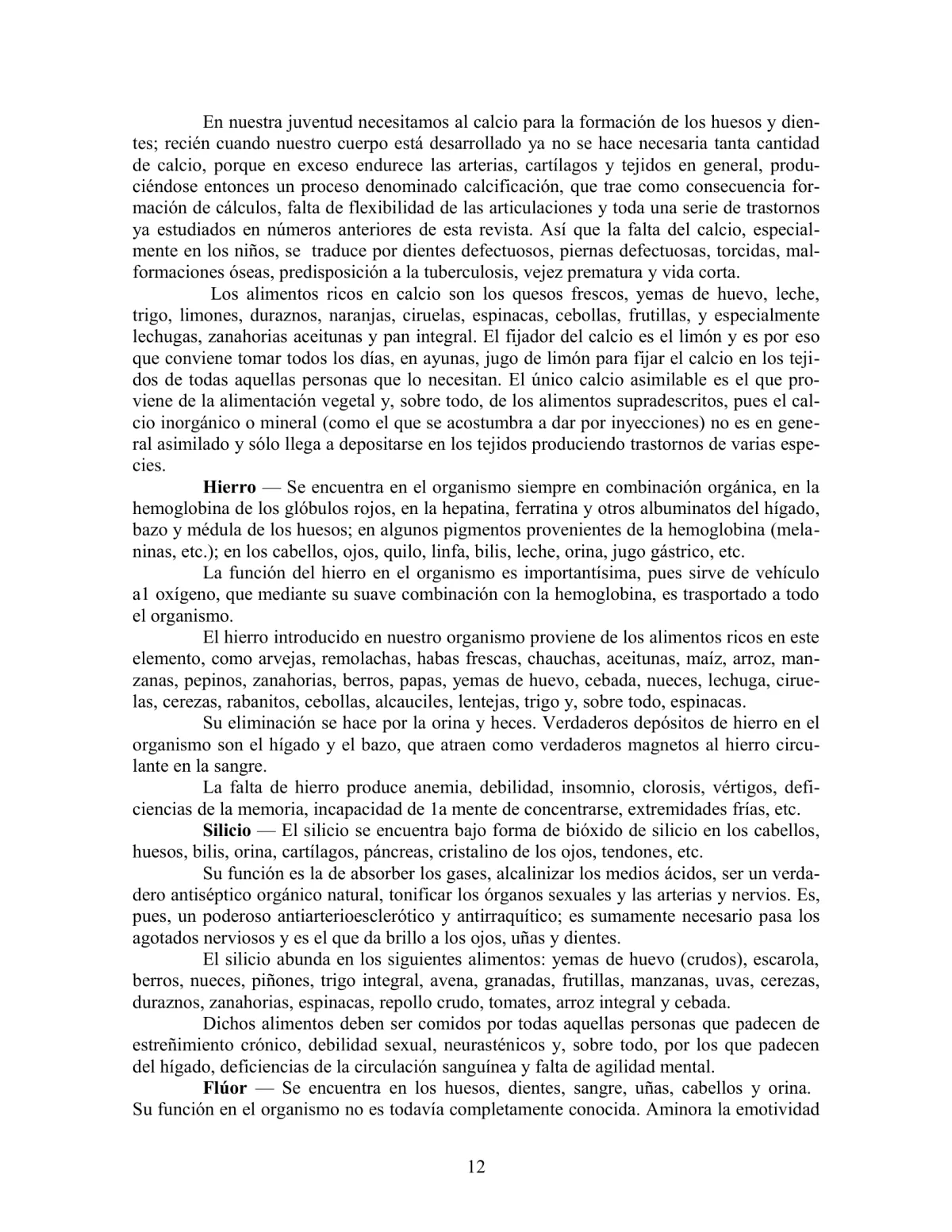
1In our youth we need calcium for the formation of the bones and teeth; only when our body is developed is so much calcium no longer necessary, because in excess it hardens the arteries, cartilages and tissues in general, there being produced then a process called calcification, which brings as consequence the formation of calculi, lack of flexibility of the joints and a whole series of disturbances already studied in previous numbers of this review.
2Thus the lack of calcium, especially in children, translates into defective teeth, defective, twisted legs, bone malformations, predisposition to tuberculosis, premature old age and a short life.
3The foods rich in calcium are fresh cheeses, egg yolks, milk, wheat, lemons, peaches, oranges, plums, spinach, onions, strawberries and especially lettuces, carrots, olives and wholemeal bread.
4The fixer of calcium is the lemon, and that is why it is advisable to take lemon juice every day, fasting, to fix the calcium in the tissues of all those persons who need it.
5The only assimilable calcium is that which comes from vegetable feeding and, above all, from the foods described above; for inorganic or mineral calcium (such as it is customary to give by injections) is in general not assimilated, and only comes to deposit itself in the tissues, producing disturbances of various kinds.
6Iron — It is found in the organism always in organic combination: in the haemoglobin of the red globules; in the hepatin, ferratin and other albuminates of the liver, spleen and bone marrow; in some pigments coming from haemoglobin (melanins, etc.); in the hair, eyes, chyle, lymph, bile, milk, urine, gastric juice, etc.
7The function of iron in the organism is most important, for it serves as vehicle to oxygen which, through its gentle combination with haemoglobin, is transported to the whole organism. [Sic: the Spanish prints a1, with a numeral.]
8The iron introduced into our organism comes from the foods rich in this element, such as peas, beetroots, fresh broad beans, green beans, olives, maize, rice, apples, cucumbers, carrots, watercress, potatoes, egg yolks, barley, walnuts, lettuce, plums, cherries, radishes, onions, artichokes, lentils, wheat and, above all, spinach.
9Its elimination takes place through the urine and faeces.
10True deposits of iron in the organism are the liver and the spleen, which attract the iron circulating in the blood like true magnets.
11The lack of iron produces anaemia, weakness, insomnia, chlorosis, vertigo, deficiencies of memory, incapacity of the mind to concentrate, cold extremities, etc. Silicon — Silicon is found, in the form of silicon dioxide, in the hair, bones, bile, urine, cartilages, pancreas, crystalline lens of the eyes, tendons, etc. [Sic: the Spanish prints 1a, with a numeral.]
12Its function is to absorb gases, alkalinise acid media, be a true natural organic antiseptic, tone the sexual organs and the arteries and nerves.
13It is, then, a powerful anti-arteriosclerotic and anti-rachitic; it is extremely necessary for the nervously exhausted, and it is what gives brightness to the eyes, nails and teeth.
14Silicon abounds in the following foods: egg yolks (raw), escarole, watercress, walnuts, pine-nuts, whole wheat, oats, pomegranates, strawberries, apples, grapes, cherries, peaches, carrots, spinach, raw cabbage, tomatoes, whole rice and barley.
15These foods should be eaten by all those persons who suffer from chronic constipation, sexual weakness, the neurasthenic and, above all, by those who suffer from the liver, deficiencies of the blood circulation and lack of mental agility.
16Fluorine — It is found in the bones, teeth, blood, nails, hair and urine.
17Its function in the organism is not yet completely known.
18It lessens emotivity · 12
Our translation, period-faithful. Citable as our translation, never as the source.
May 1945; the war in Europe ends this month, and the number prints its usual serials without a word of it — the review's wartime reticence holds to the last.
→ ini:4.36
Masthead stereotype unchanged.
Six articles; the S.D.M. section turns liturgical — Vaisakh observances with civil clock-times for four countries.
Joseph de Maistre enters the chronology: initiated 1776 in La Sincerité of Chambery, named beside his brother Xavier — the column's biggest literary name yet, with the Savoy lodge's aristocratic roll printed around him.
Willermoz's secret design told plainly: the Profession degrees (Knight and Grand Professed) as the vehicle for carrying Pasqually's Reintegration doctrine into templar masonry — "the continuation of the Order of the Elect Cohens within the Strict Observance". Saltzmann initiated as ally; the Congress of the Gauls convoked for 28 October 1778.
→ ini:4.36
PISCES closes the zodiac course begun in 1944: Ephraim and Manasseh as the two feet, "the end of Apollo's journey" — twelve signs complete, the course's longest finished arc.
→ thread:light_of_egypt_v1
The first face of Pisces "indicates diviners and prophets, according to the evolution that incarnates in it" — the only face-reading in the course that makes mediumship a birth-indication.
Markab and Scheat of Pegasus close the fixed-star layer: wounds by "fire, electricity or steam" and death by water — the maritime dooms of the old star-catalogues, unsoftened.
The 22-element table: 12 principal and 10 secondary elements of the body, each with functions, deficiency symptoms and food sources — the serial's most systematic instalment, an orthomolecular handbook avant la lettre.
The phosphorus food-list runs to thirty-nine items — the shelves of a Montevideo greengrocer readable behind the biochemistry: chauchas, zapallo, alcauciles.
Potassium's pharmacology is stated straight — small doses cardiotonic, "in larger doses powerful poisons for the protoplasm" — the serial's habit of keeping real toxicology beside its nature-cure creed.
"The fixer of calcium is the lemon" — the daily fasting lemon juice prescription; the warning against injected mineral calcium is period nature-cure doctrine kept intact.
The four conclusions cap the arc: every disturbance a deficiency, every emotion "a cry of alarm… asking for calcium, fluorine, magnesium", trust the "undegenerate instinct" — reviewed under the boundary and kept: dietetic doctrine, no claim about peoples.
The Maha Boddhi Sangha goes visible: "its visible activity in the present year" announced — Thursday Buddhism courses at the GIDEE seat join the Sunday cordillera broadcasts, and the right-speech abstentions (lying, gossip, harsh words, idle talk) are printed as practice.
The promised glossary begins: Pali terms first (the eightfold path entries, Bikku, Kamma, Nibbana), with the reader told to keep a notebook alphabetically — the review teaching its audience to build its own reference apparatus.
→ ini:4.34
The Guru's prediction circular, reproduced: Beach House, Mylapore, Madras, 10 January 1919 — Subramania Iyer announcing the Avatara's birth six days in advance, houses to be lit "as a demonstration of joy". The review's most direct documentary relic of the Madras founding generation.
The Vaisakh liturgy in full: Greenwich 1.48 converted to four national clock-times, the leaf and water-vessel altar, two red flowers whose meaning "the Members know", white flowers offered per verse, thirty minutes' adoration, written reports to the Officiant — the S.D.M.'s complete ritual mechanics, printed for scattered members to perform in synchrony.
The versicles pray to be "free from feelings of class hatreds" and for friendship "between governors and governed" — the order's social prayer, printed as the war ends.
A second glossary — Sanskrit liturgical terms this time, with the editorial note that OM "pronounced for egoistic ends… is to do harm": the apparatus pages now teach reverence alongside vocabulary.
A retype transposition documented: the temperature article opens mid-sentence with its own closing paragraph, breaks off mid-word ("de muy e—"), and the severed half surfaces at page 22 ("—scasa importancia"). Editorial glosses mark the splice at both ends; the text is preserved exactly as the retype transmits it.
The heat-tolerance ladder — 47° kills plant cells, algae at 63°, Ehrenberg's infusoria at 85°, anthrax spores past 100° — period thermobiology with its sources named; the human optimum "variable according to races and climates" is acclimatisation physiology, reviewed and kept.
Hiller's three forms of heat-stroke (asphyctic, paralytic, psychopathic) and the stokers working at 60° — occupational medicine of the steamship age, transmitted into the esoteric monthly's science pages.
GIDEE prospectus stereotype at page 23.
→ ini:3.30
Library back cover and imprint close the number.