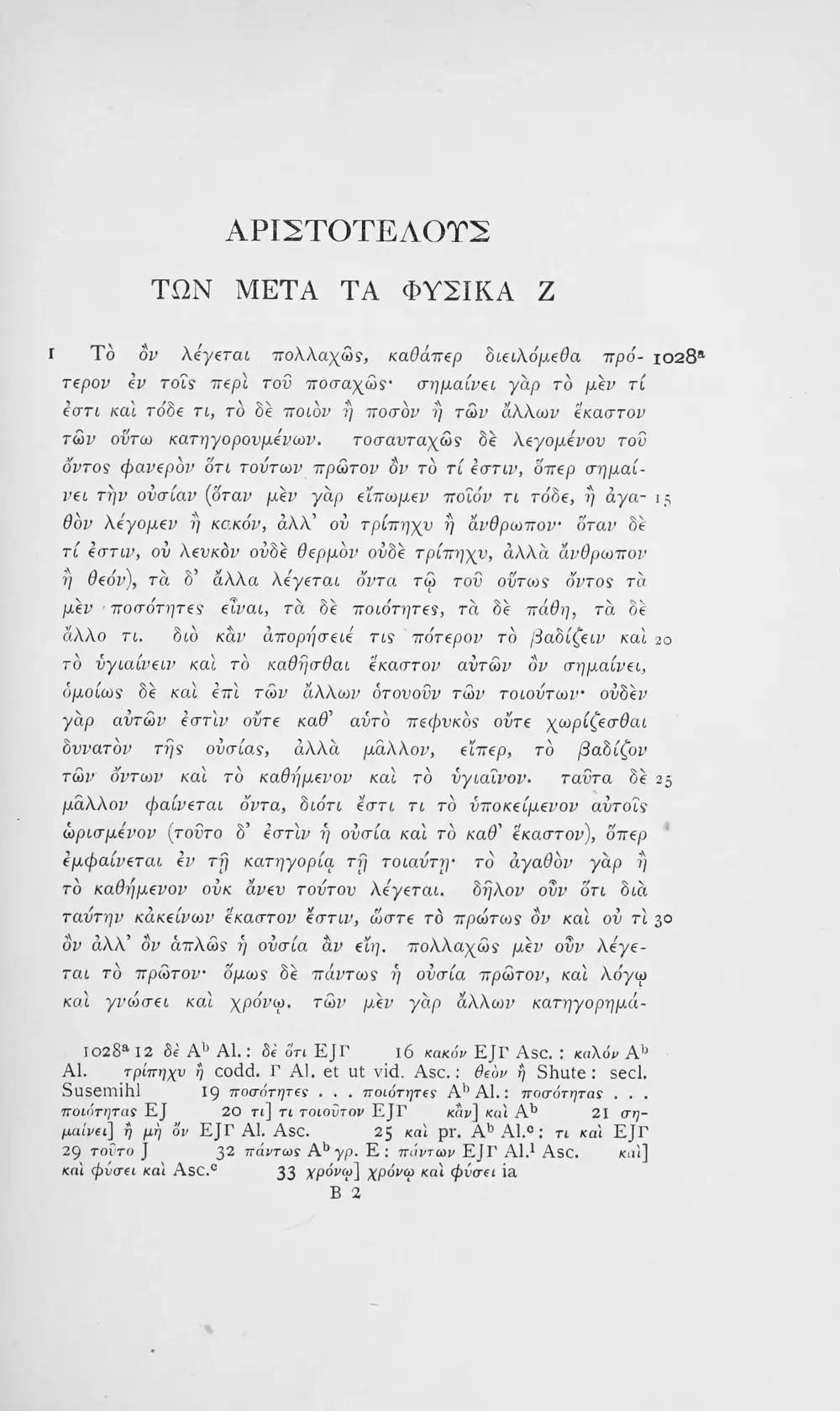
WHAT IS HELD HERE IS GREEK, AND THE SCAN HAS NOT SURVIVED IT. The pages carry the Metaphysics with a full critical apparatus — the manuscript sigla AP, EJT, Al., Asc., and the conjectures of Susemihl and Shute are all legible in the variant lines — but the polytonic Greek itself has been read by the OCR as Latin letters, so the text reads “TO ayabov yap” where it should read το ἀγαθόν. The apparatus survives and the text does not, which is the opposite of the usual failure. This issue is best treated as evidence that the edition exists in the collection rather than as a readable Aristotle.
The Metaphysics — Greek text with commentary, ed. W. D. Ross
Open to all
machine-assisted · checkedpage 1
For of the other categories
1028a 12 δὲ Ab Al.: δὲ ὅτι EJT 16 κακόν EJT Asc.: καλόν Ab Al. τρίπηχυ ἢ the manuscripts, Γ, Al. and apparently Asc.: θεὸν ἢ Shute: 566]. Susemihl [Sic: the scan garbles this reading] 19 ποσότητες . . . ποιότητες Ab Al.: moodrntas .. . ποιότητας EJ [Sic: «moodrntas» is the scan's reading of ποσότητας] 20 τι] τι τοιοῦτον EJT κἂν] καὶ Ab 21 σημαίνει] ἢ μὴ ὄν EJT Al. Asc. 25 καὶ first, Ab Al.l: τι καὶ EJT 29 τοῦτο J 32 πάντως Ab, γρ. E: πάντων EJT Al. Asc. καὶ] καὶ φύσει καὶ Asc.c 33 χρόνῳ] χρόνῳ καὶ φύσει ia
B2
none can exist apart, but this alone can. And in definition too it is first (for in the definition of each thing the definition of its substance must be present); and we think we know each thing most of all when we know what it is, what man or fire is, rather than its quality or its quantity or its place, since we know each of these too only [1028b] when we know what the quantity or the quality is. And indeed that which
was sought of old and is sought now and always, and is always a matter of perplexity,
namely what being is, is just this: what substance is (for it is this that some say is one and others more than one, and some limited in number and others unlimited); and so we too must consider chiefly and first and, one may say, solely what that is which is in this sense. [2] Substance is thought to belong most evidently to bodies
(and so we say that animals and plants and their parts
are substances, and natural bodies such as fire and water and earth and each thing of that kind, and all things that are parts of these or made of these, whether of parts or of the whole of them, such as the heaven and its parts, stars and moon and sun). But whether these alone are substances, or others too, or some of these and others as well, or none of these but certain others, must be examined. Some think that the limits of body, such as surface and line and point and unit, are substances, and more so than body and the solid. Further, some think there is nothing of this kind beside sensible things, others that there are more such things and that they are more truly, being eternal; so Plato holds the Forms and the objects of mathematics to be two substances, and the substance of sensible bodies a third; and Speusippus posits still more substances, beginning from the One, and principles for each substance, one for numbers, another for magnitudes, then one for soul; and in this way he extends the substances.
And some say that the Forms and the numbers have the same nature, and that the other things follow them, lines and planes, down to the substance of the heaven and to sensible things. Concerning these things, then, what
1028a 35 οὐσίας] οὐσίας λόγον EJT 36 δὲ εἰ [Sic: the reading is garbled in the scan] 37 τὸ first omitted by Ab b2 ἐστι AbΓ Asc.: ἐστιν ἢ EJ γνῶμεν Ab Al. Asc.: εἰδῶμεν EJT 8 ἡ ... μὲν] κυρίως ὂν εἶναι ἡ οὐσία, φανερώτατα μὲν ἐν αἱ νἱά. Al. [Sic: the end of this lemma is garbled in the scan]
11 ἢ EJT Asc.c: δὴ Ab 12 μορίων the manuscripts, Γ, Al.: τινῶν or ἐνίων conjectured by Bonitz 14 αὗται AbΓ Al. Asc.lc: αὐταὶ EJ RP [Sic: «RP» as printed] 15 ἄλλαι ἢ ... ἄλλων EJ Asc.: ἢ τούτων τινὲς καὶ ἄλλων Ab; omitted by Γ Al. 16 δέ] δή Bywater 21 καὶ EJΓ Asc.c; omitted by
Ab
is rightly said and what is not, and which things are substances, and whether
there are any beside the sensible ones or not, and how these are, and whether there is some separable substance, and if so why and how, or none beside the sensible ones, must be examined, once we have first sketched what substance is.
[3] Substance is spoken of, if not in more ways, at least in four above all; for the essence and the universal and the genus are thought to be the substance of each thing, and fourth of these the substratum. The substratum is that of which the other things are predicated,
while it itself is no longer predicated of anything else. So we must first determine about this; for substance is thought most of all to be the substratum [1029a]
that is first. In one way matter is said to be of this kind, in another the shape, and in a third the compound of these (by matter I mean, for instance, the bronze, by shape the pattern of its form, by the compound of these the statue, the concrete whole), so that if the form
is prior to the matter and more truly being, it will also be prior to the compound of both, by the same argument. Now, then, it has been said in outline what substance is: that which is not said of a substratum but of which the other things are said. But we must not say it only in this way, for that is not enough;
this very thing is unclear, and further matter becomes substance. For if this is not substance, what else is substance escapes us; for when the other things are stripped away, nothing evidently remains. For the other things are affections and products and powers of bodies, while length and breadth and depth are certain quantities and not substances (for quantity is not substance); rather, that to which these belong
first, that is substance.