The Tâo Teh King — Sacred Books of China Part I, SBE Vol. 39 (trans. James Legge, 1891)

Open to allEdited by F. Max Müller; translated by Müller, Legge, Bühler, West, Darmesteter, Palmer, Telang, Thibaut, Jolly, Rhys Davids, Oldenberg, Jacobi, Bloomfield and others1850 segments · 383 pp
page 308

No image is selected for this page; its own page image is shown.

The Tâo Teh King — Sacred Books of China Part I, SBE Vol. 39 (trans. James Legge, 1891), photo of the original · p. 308
Photo of the original · p. 308
The Tâo Teh King — Sacred Books of China Part I, SBE Vol. 39 (trans. James Legge, 1891), photo of the original · p. 309
Photo of the original · p. 309
page 308

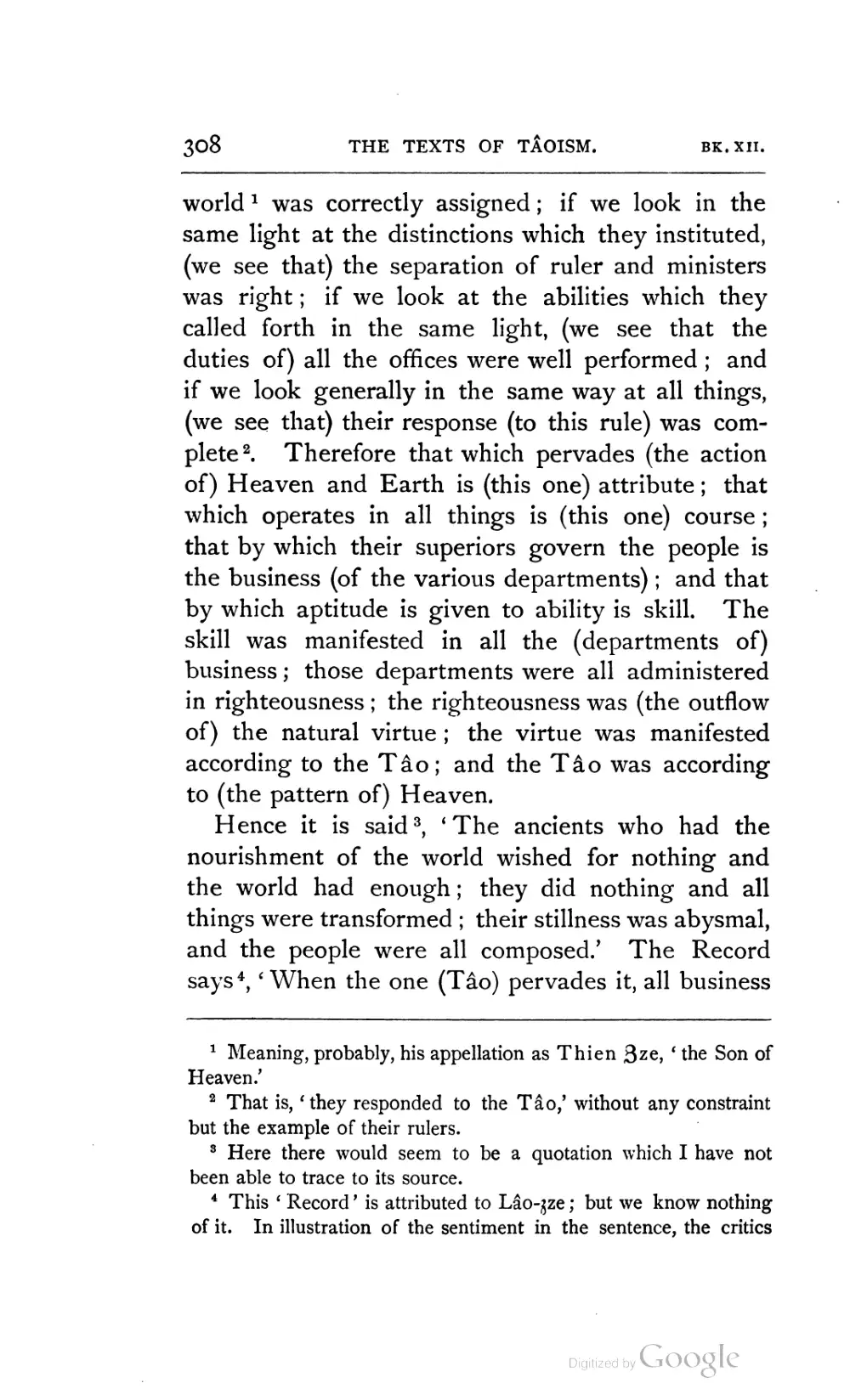
Hence it is said3, ‘The ancients who had the nourishing of the world wished for nothing, and the world had enough; they did nothing, and all things were transformed; their stillness was abysmal, and the people were all composed.’ The Record says4, ‘When the One (Tâo) pervades it, all business is completed. When the mind becomes free from all aim, even the Spirits submit.’

1 Meaning, probably, his appellation as Thien Ȝze, ‘the Son of Heaven.’

2 That is, ‘they responded to the Tâo, with no constraint but the example of their rulers.’

3 Here there seems to be a quotation which I have not been able to trace to its source.

4 This ‘Record’ is attributed to Lâo-ȝze; but we know nothing of it. To illustrate the sentiment of the sentence, the critics refer to par. 34 in the fourth Appendix to the Yi King; but it is not to the point.

Commentary
page 308 ·
Cross-Estate§105

Legge reports that the critics illustrate the sentence of the ‘Record’ from the fourth Appendix of the Yî King, then dismisses the parallel as ‘not to the point’ without saying why. The reader can test that against the Appendix in this shelf's Yî King. What the page does show is Legge refusing to let a commentator's parallel stand in for a source he cannot find; of the Record itself he says plainly, ‘we know nothing of it’.

parallels The Yî King — Sacred Books of China Part II, SBE Vol. 16 (trans. James Legge, 1882)