Thien Ti, ‘Heaven and Earth’, is taken from the book's first words, ‘Notwithstanding the greatness of heaven and earth’, as Book XIII's ‘The Way of Heaven’ comes from its first line (p. 330). Such a title names where a book starts, not what it argues. Legge's own footnote, that the ruler's course ‘gives the thesis, or subject-matter of the whole Book’, is the better guide, and readers should not take these titles as summaries.
The Tâo Teh King — Sacred Books of China Part I, SBE Vol. 39 (trans. James Legge, 1891)
Open to all
page 307
No image is selected for this page; its own page image is shown.
page 307
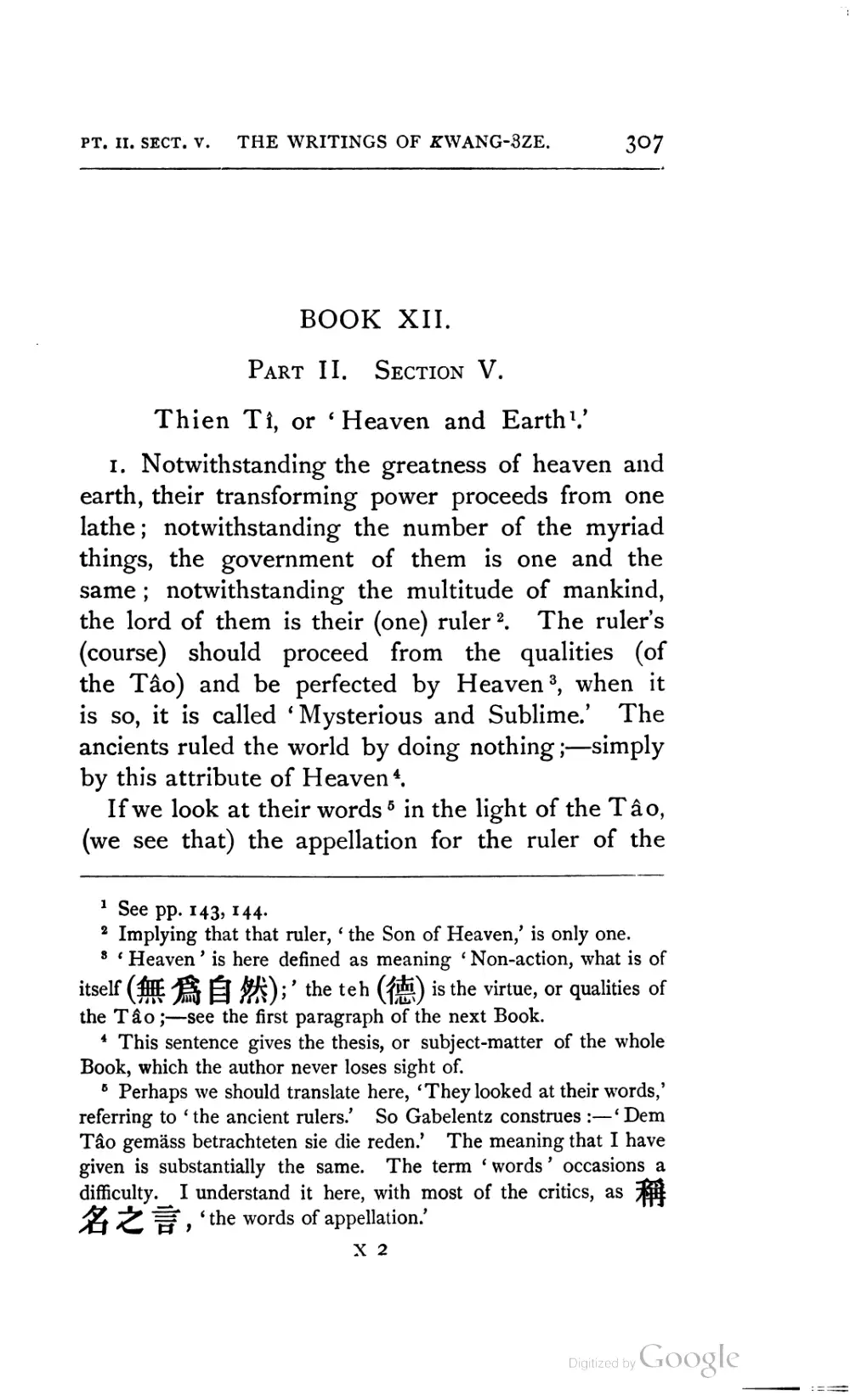
p. 307BOOK XII.
Part II. Section V.
Thien Ti, or ‘Heaven and Earth’
1. Notwithstanding the greatness of heaven and earth, their transforming power proceeds from one lathe; notwithstanding the number of the myriad things, the government of them is one and the same; notwithstanding the multitude of mankind, their lord is their (one) ruler2. The ruler’s (course) should proceed from the qualities (of the Tao) and be perfected by Heaven3; when it is so, it is called ‘Mysterious and Sublime.’ The ancients ruled the world by doing nothing;—simply by this attribute of Heaven4.
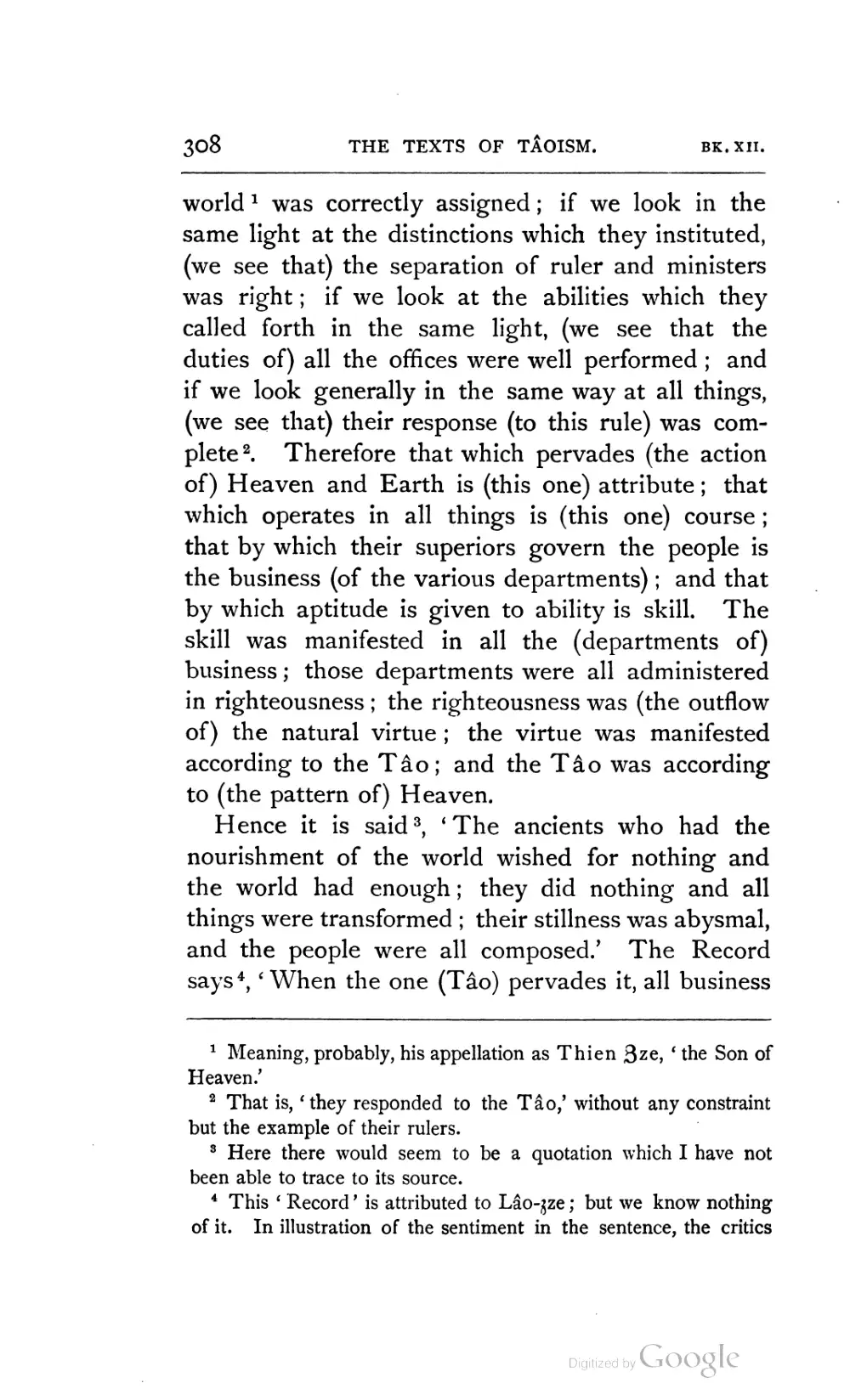
If we look at their words5 in the light of the Tâo, (we see that) the appellation … world1 was correctly assigned; if we look in the same light at the distinctions they instituted, (we see that) the separation of ruler and ministers was right; if we look in the same light at the abilities they called forth, (we see that the duties of) all the offices were well performed; and if we look in the same way at all things generally, (we see that) their response (to this rule) was complete2.
Therefore what pervades (the action of) Heaven and Earth is (this one) attribute; what operates in all things is (this one) course; what their superiors govern the people by is the business (of the various departments); and what gives aptitude to ability is skill. The skill was shown in all the (departments of) business; those departments were all administered in righteousness; the righteousness was (the outflow of) the natural virtue; the virtue was shown according to the Tao; and the Tâo was according to (the pattern of) Heaven.
* See pp. 143, 144.
2 Implying that that ruler, ‘the Son of Heaven,’ is only one.
3 ‘Heaven’ is defined here as meaning ‘Non-action, what is of itself (無爲自然);’ the teh (德) is the virtue, or qualities, of the Tao;—see the first paragraph of the next Book.
4 This sentence gives the thesis, or subject-matter, of the whole Book, which the author never loses sight of.
6 Perhaps we should translate here, ‘They looked at their words,’ referring to ‘the ancient rulers.’ So Gabelentz construes:—‘In accordance with the Tao they considered the words.’ The meaning I have given is substantially the same. The term ‘words’ causes a difficulty. I understand it here, with most of the critics, as 稱 名之言, ‘the words of appellation.’
Legge passes on the critics' definition of Heaven as ‘Non-action, what is of itself’. It governs the paragraph: a course ‘perfected by Heaven’ is perfected by spontaneity, and the ancients ruled ‘by doing nothing ;—simply by this attribute of Heaven’. Taken seriously, the definition rules out reading Heaven on these pages as a personal power, which matters when Legge later writes of ‘the place of God’ (p. 313).