Legge cannot account for the ‘twelve generations’ of the usurping house and suggests an interpolation ‘made in the time of Khin, or subsequently.’ The count matters for dating: a writer living while the house still ruled could not know how many generations it would hold the state. Either the number is a later addition, as Legge proposes, or the Book was written late, and on either view this passage is not all of one early date.
The Tâo Teh King — Sacred Books of China Part I, SBE Vol. 39 (trans. James Legge, 1891)
Open to all
page 282
No image is selected for this page; its own page image is shown.
page 282
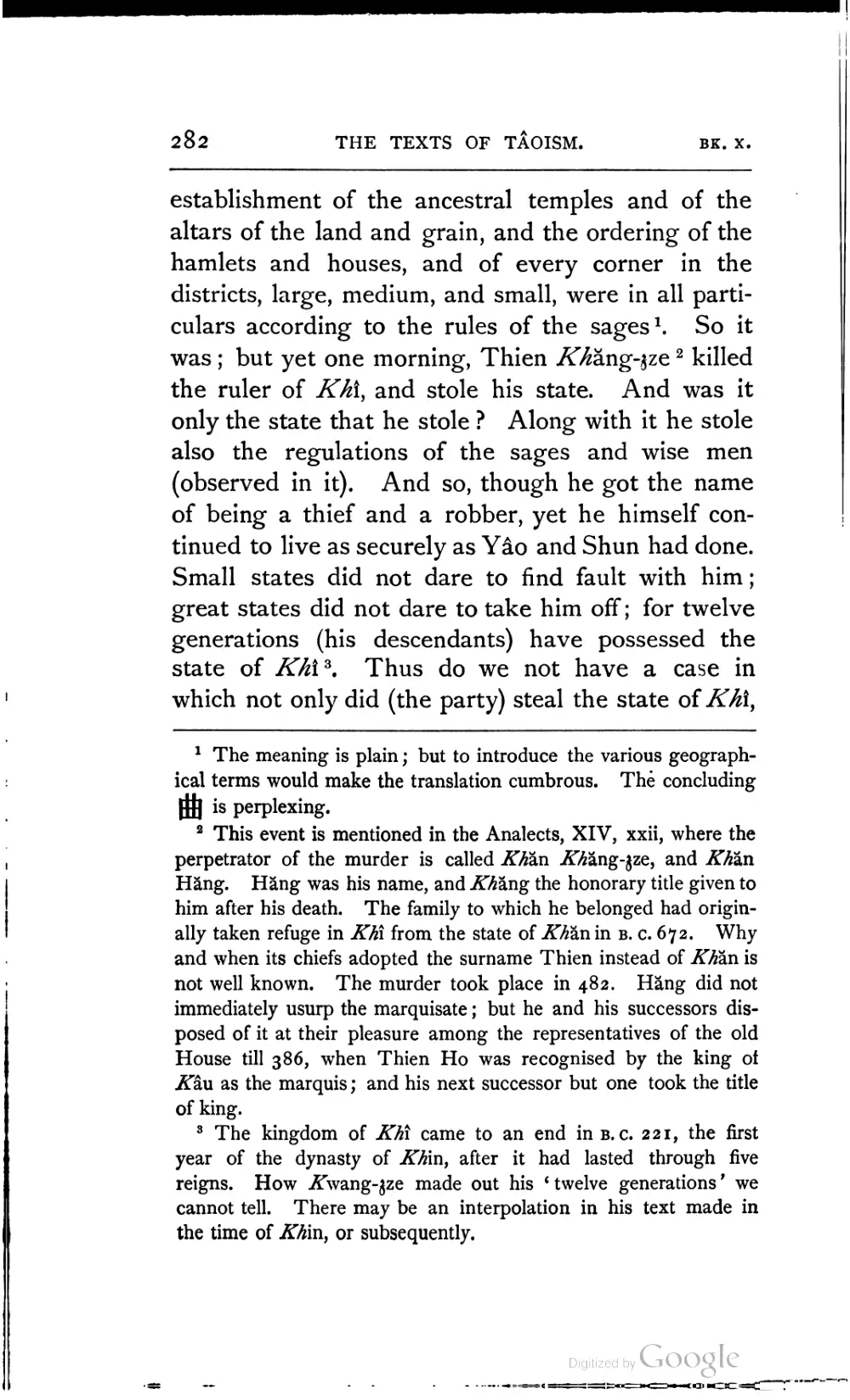
1 The meaning is plain; but to bring in the various geographical terms would make the translation cumbersome. The concluding 曲 [Press: bent, crooked] is perplexing.
2 This event is mentioned in the Analects, XIV, xxii, where the perpetrator of the murder is called Khăn Khăng-ȝze, and Khăn Hang. Hang was his name, and Khăng the honorary title given to him after his death. The family to which he belonged had originally taken refuge in Khî from the state of Khăn in B.C. 672. Why and when its chiefs adopted the surname Thien instead of Khăn is not well known. The murder took place in 482. Hang did not immediately usurp the marquisate; but he and his successors disposed of it as they pleased among the representatives of the old House until 386, when Thien Ho was recognised by the king of Kâu as the marquis; and his next successor but one took the title of king.
3 The kingdom of Khî came to an end in B.C. 221, the first year of the dynasty of Khin, after it had lasted through five reigns. How Kwang-ȝze made out his ‘twelve generations’ we cannot tell. There may be an interpolation in his text, made in the time of Khin or later.