The English keeps a gradation the author draws with care: cutting the raw materials is ‘the crime of the skilful workman,’ while the injury to the Tâo is ‘the error of the sagely men’ (罪 against 過). The pairing returns below, the ‘crime of Po-lâo’ beside ‘the error of those sagely men.’ The craftsman acts on things and is guilty; the sage acts through teaching and is mistaken, a distinction that tempers the attack on the sages even as it repeats it.
The Tâo Teh King — Sacred Books of China Part I, SBE Vol. 39 (trans. James Legge, 1891)
Open to all
page 279
No image is selected for this page; its own page image is shown.
page 279
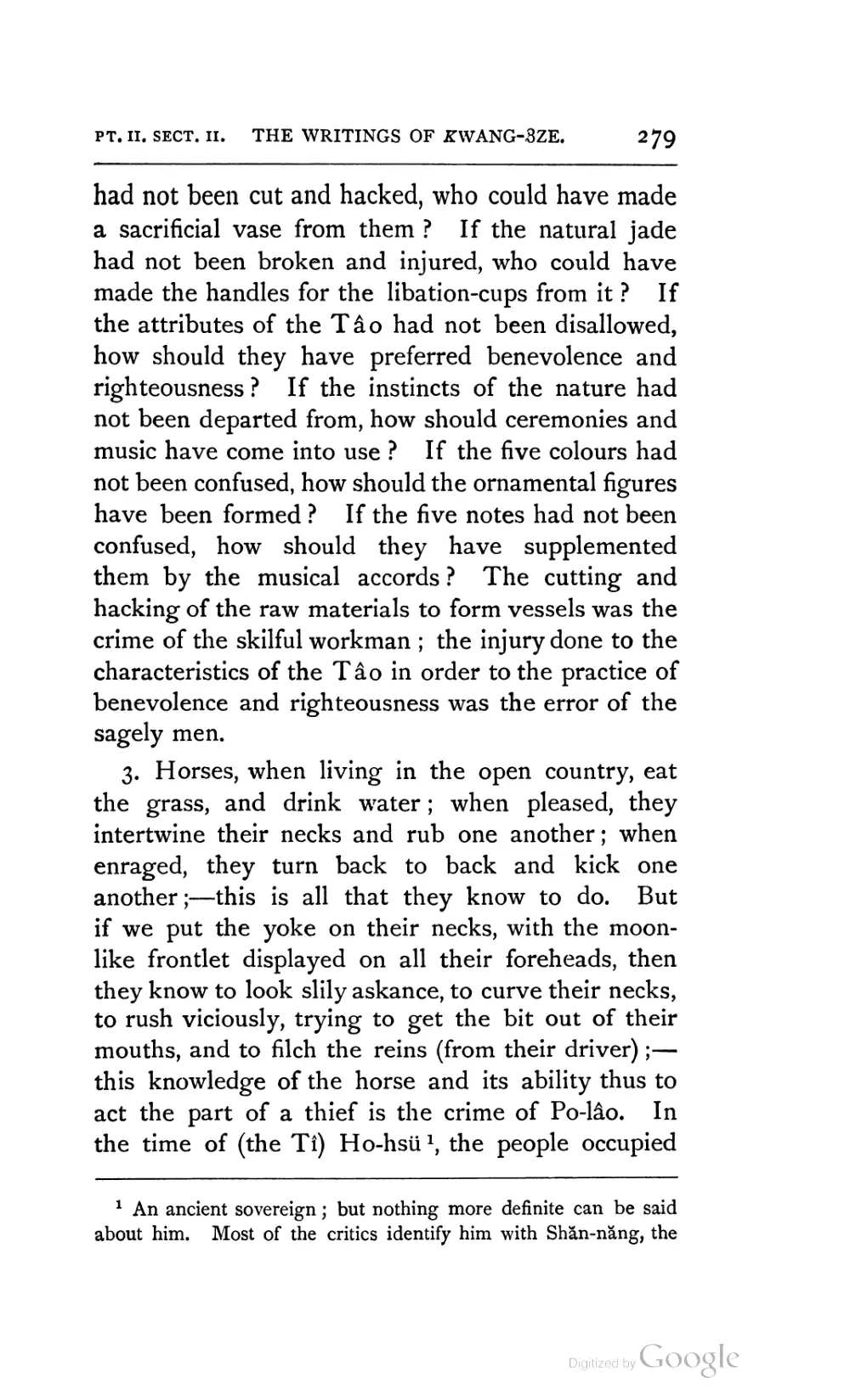
… had not been cut and hacked, who could have made a sacrificial vase from them? If the natural jade had not been broken and injured, who could have made the handles of the libation-cups from it? If the attributes of the Tâo had not been set aside, how should they have preferred benevolence and righteousness? If the instincts of the nature had not been departed from, how should ceremonies and music have come into use? If the five colours had not been confused, how should the ornamental figures have been formed? If the five notes had not been confused, how should they have supplemented them by the musical accords? The cutting and hacking of the raw materials to form vessels was the crime of the skilful workman; the injury done to the characteristics of the Tao for the practice of benevolence and righteousness was the error of the sagely men.
3. Horses, when living in the open country, eat grass and drink water; when pleased, they intertwine their necks and rub against one another; when enraged, they turn back to back and kick one another;—this is all they know how to do. But if we put the yoke on their necks, with the moon-like frontlet displayed on all their foreheads, then they learn to look slyly askance, to curve their necks, to rush viciously, trying to get the bit out of their mouths, and to filch the reins (from their driver);—this knowledge of the horse and its ability thus to act the part of a thief is the crime of Po-lâo.
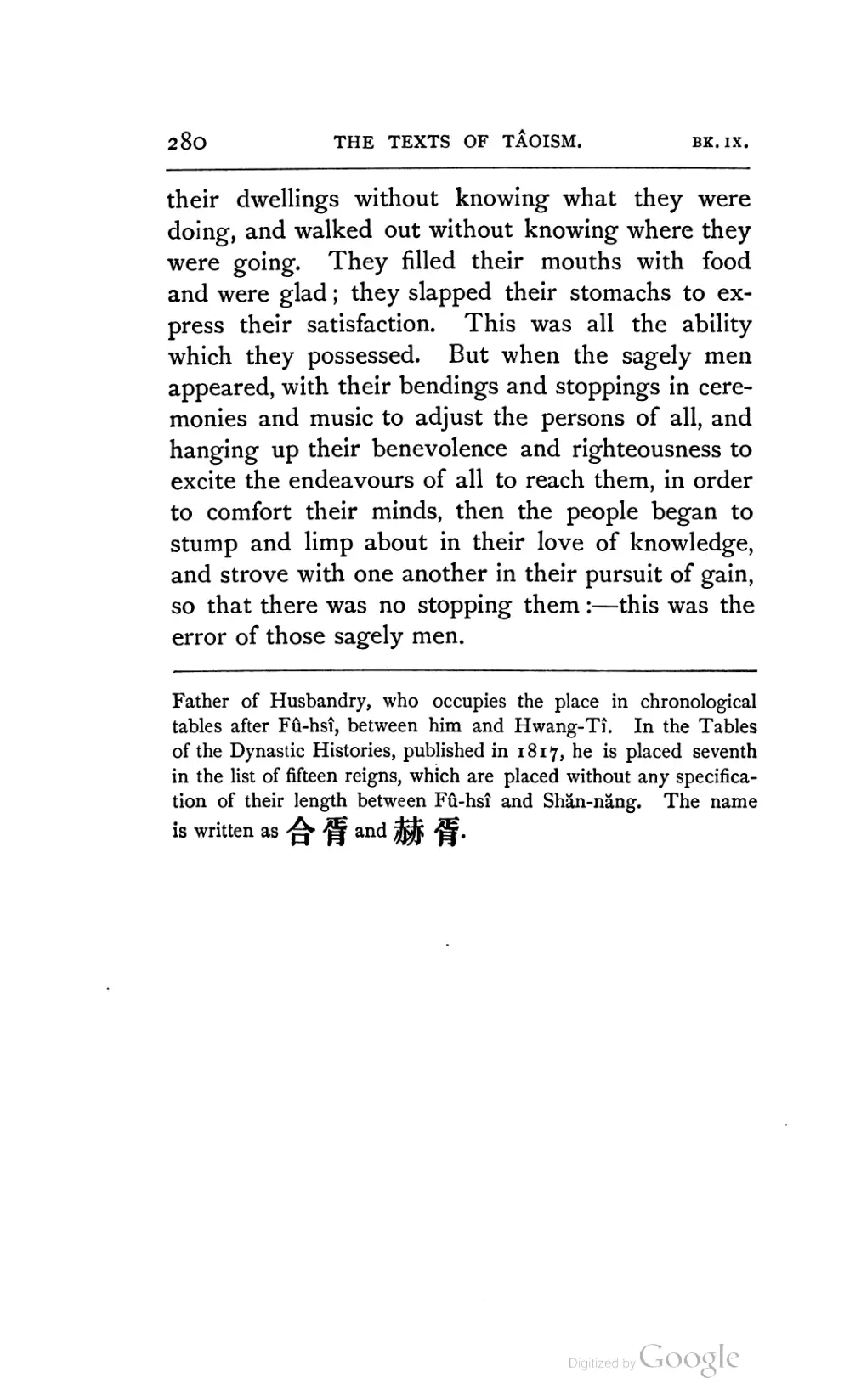
In the time of (the Ti) Ho-hsü1, the people stayed in their dwellings without knowing what they were doing, and walked out without knowing where they were going. They filled their mouths with food and were glad; they slapped their stomachs to show their satisfaction. This was all the ability they possessed. But when the sagely men appeared, with their bendings and stoppings in ceremonies and music to adjust the persons of all, and hanging up their benevolence and righteousness to stir the endeavours of all to reach them, in order to comfort their minds, then the people began to stump and limp about in their love of knowledge, and to strive with one another in their pursuit of gain, so that there was no stopping them:—this was the error of those sagely men.
1 An ancient sovereign; but nothing more definite can be said about him. Most of the critics identify him with Shan-nang, the Father of Husbandry, who occupies the place in the chronological tables after Fû-hsi, between him and Hwang-Ti. In the Tables of the Dynastic Histories, published in 1817, he is placed seventh in the list of fifteen reigns which are placed, without any specification of their length, between Fû-hsi and Shan-nang. The name is written as 合胥 [Press: Hexu, a variant writing of the name] and 赫胥 [Press: Hexu, the name of an ancient sovereign].