The Tâo Teh King — Sacred Books of China Part I, SBE Vol. 39 (trans. James Legge, 1891)

Open to allEdited by F. Max Müller; translated by Müller, Legge, Bühler, West, Darmesteter, Palmer, Telang, Thibaut, Jolly, Rhys Davids, Oldenberg, Jacobi, Bloomfield and others1850 segments · 383 pp
page 273

No image is selected for this page; its own page image is shown.

The Tâo Teh King — Sacred Books of China Part I, SBE Vol. 39 (trans. James Legge, 1891), photo of the original · p. 273
Photo of the original · p. 273
page 273

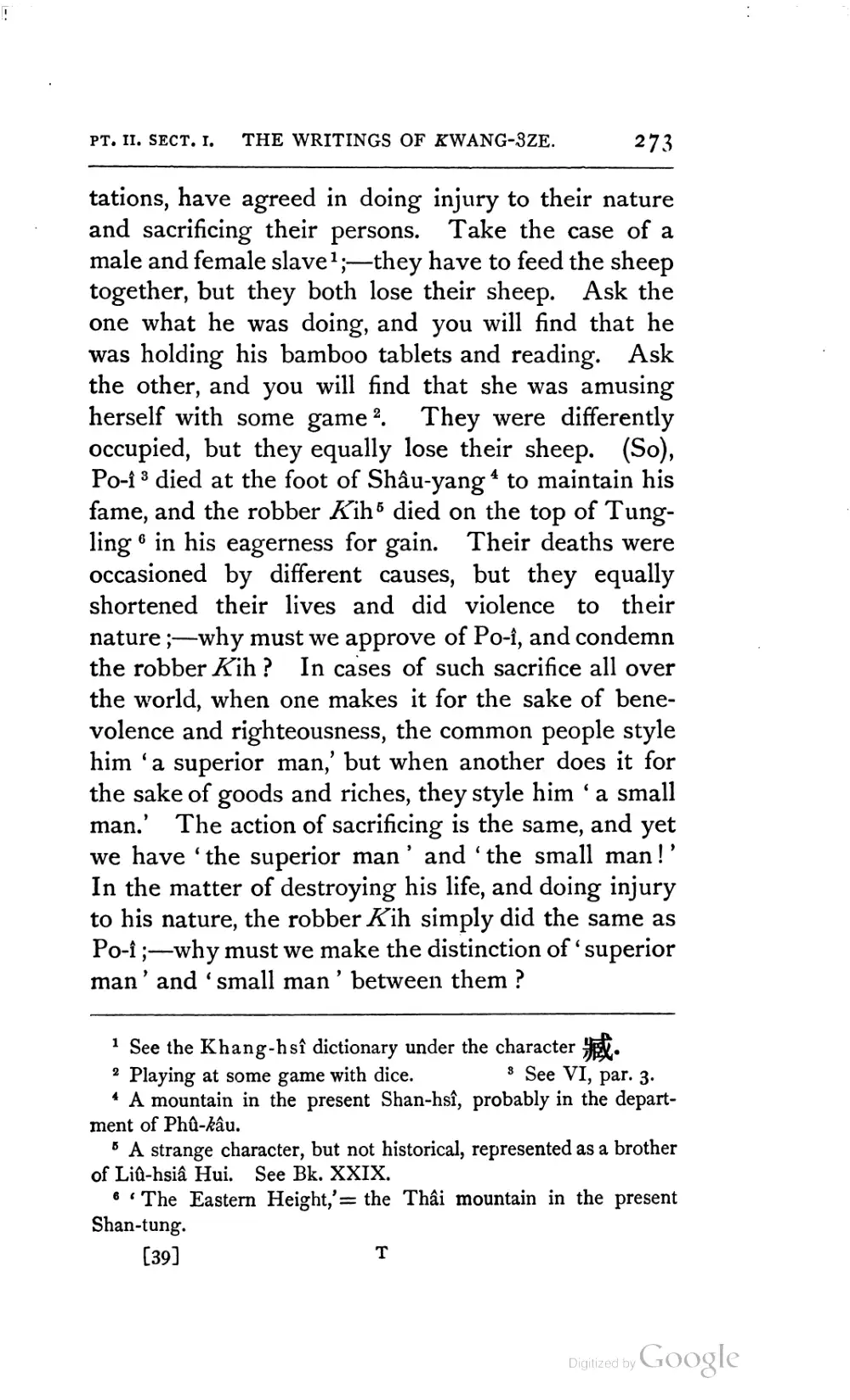
1 See the Khang-hsî dictionary, under the character 臧 [Press: good; also a servant].

2 Playing at some game with dice. 3 See VI, paragraph 3.

4 A mountain in the present Shan-hsi, probably in the department of Phû-kâu.

6 A strange character, but not a historical one, represented as a brother of Liû-hsia Hui. See Bk. XXIX.

6 ‘The Eastern Height,’ that is, the Thai mountain in the present Shan-tung.

Commentary
page 273 ·
Cross-Estate§104

Legge calls the robber Kih ‘a strange character, but not historical,’ and points to Book XXIX, which is given over to him. The argument here does not need him to be historical: set beside Po-i, he is a counterweight chosen to make the comparison as extreme as possible. Making him the brother of Liû-hsia Hui, a worthy, sharpens the same point inside one family.

continued in The Writings of Kwang-tze — Sacred Books of China Part II, SBE Vol. 40 (trans. James Legge, 1891)