Legge’s English gives the passage a Biblical cadence: the constitution of things ‘should not be made of none effect,’ the King James phrase for setting aside the word of God by tradition. The register suits the argument’s seriousness but adds an undertone of divine law the Chinese does not need. The author’s claim is plainer: things are bent, round or joined by their own regular principles, and adding the hook, compass and glue of benevolence is ‘a deception practised upon the world.’
The Tâo Teh King — Sacred Books of China Part I, SBE Vol. 39 (trans. James Legge, 1891)
Open to all
page 271
No image is selected for this page; its own page image is shown.
page 271
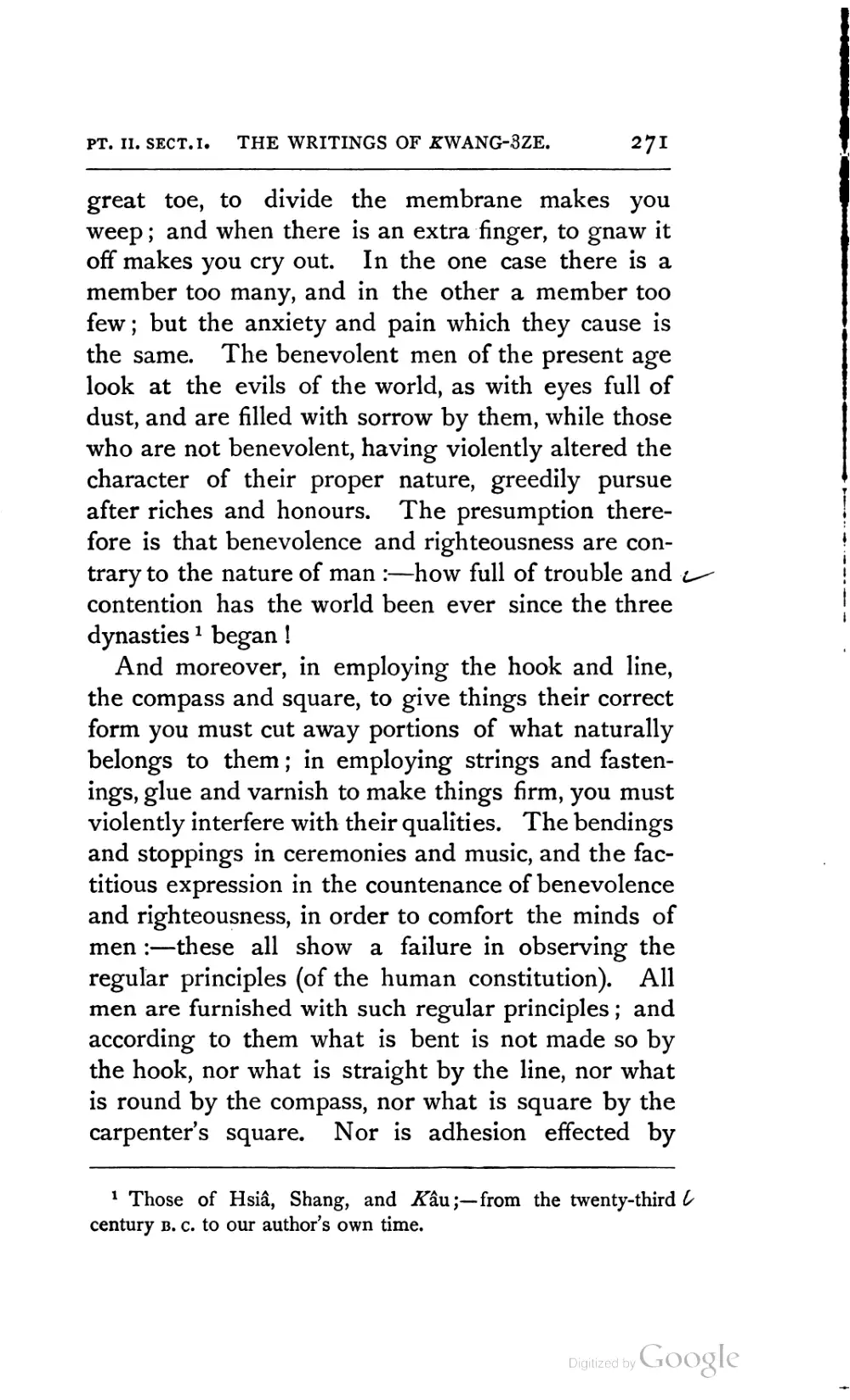
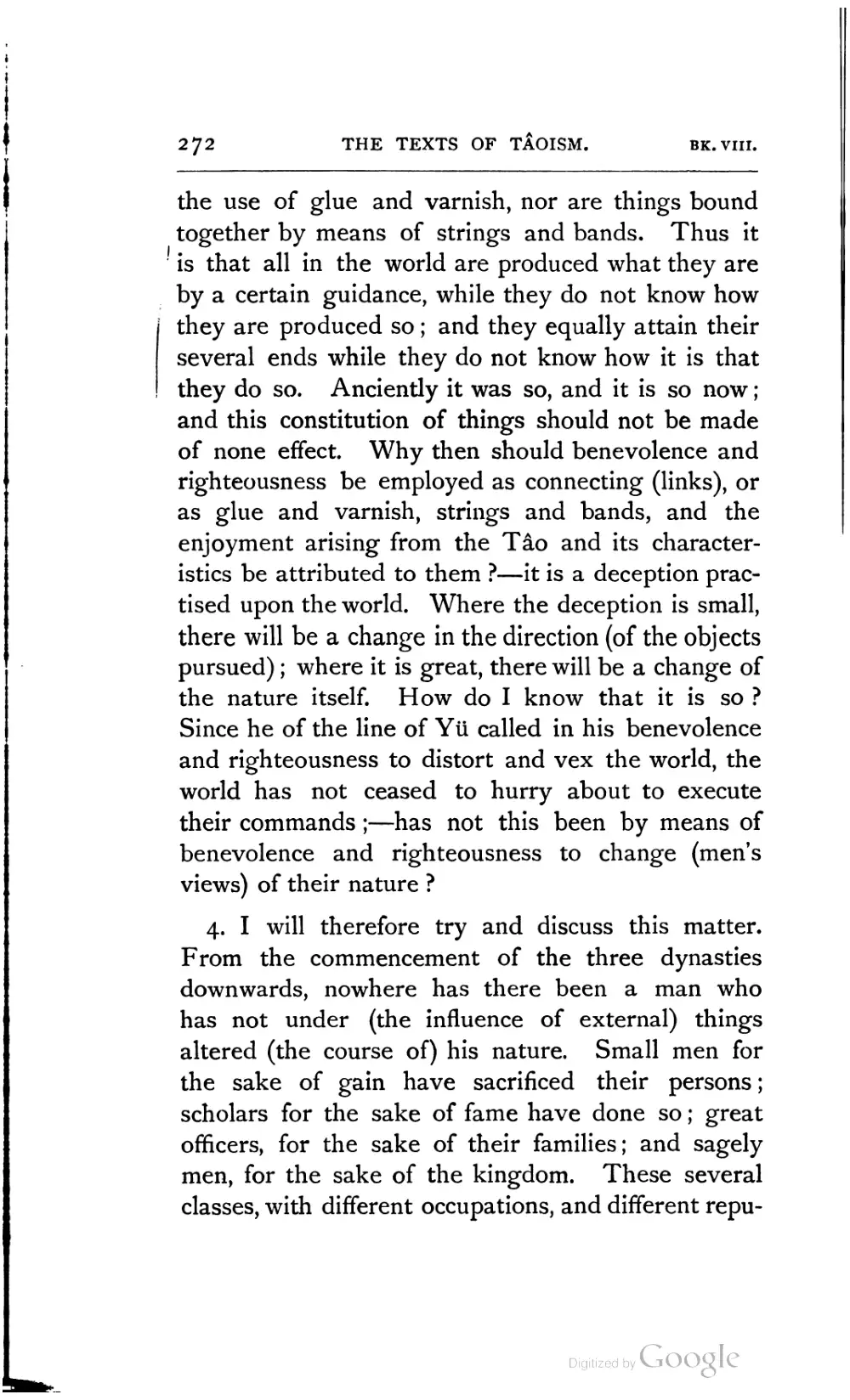
And moreover, in using the hook and line, the compass and square, to give things their correct form, you must cut away portions of what naturally belongs to them; in using strings and fastenings, glue and varnish, to make things firm, you must violently interfere with their qualities. The bendings and stoppings in ceremonies and music, and the artificial expression of benevolence and righteousness in the countenance, in order to comfort the minds of men: these all show a failure to observe the regular principles (of the human constitution). All men are furnished with such regular principles; and according to them what is bent is not made so by the hook, nor … nor what is round by the compass, nor what is square by the carpenter’s square. Nor is adhesion effected by the use of glue and varnish, nor are things bound together by means of strings and bands.
So it is that all in the world are produced what they are by a certain guidance, while they do not know how they are produced so; and they equally attain their several ends while they do not know how it is that they do so. So it was of old, and so it is now; and this constitution of things should not be made of no effect. Why then should benevolence and righteousness be employed as connecting (links), or as glue and varnish, strings and bands, and the enjoyment arising from the Tao and its characteristics be attributed to them? It is a deception practised upon the world.
Where the deception is small, there will be a change in the direction (of the objects pursued); where it is great, there will be a change of the nature itself. How do I know that it is so? Since he of the line of Yii called in his benevolence and righteousness to distort and vex the world, the world has not ceased to hurry about to carry out their commands; has not this been changing (men’s views) of their nature by means of benevolence and righteousness?
1 Those of Hsia, Shang, and Kâu;—from the twenty-third century B.C. down to our author’s own time.