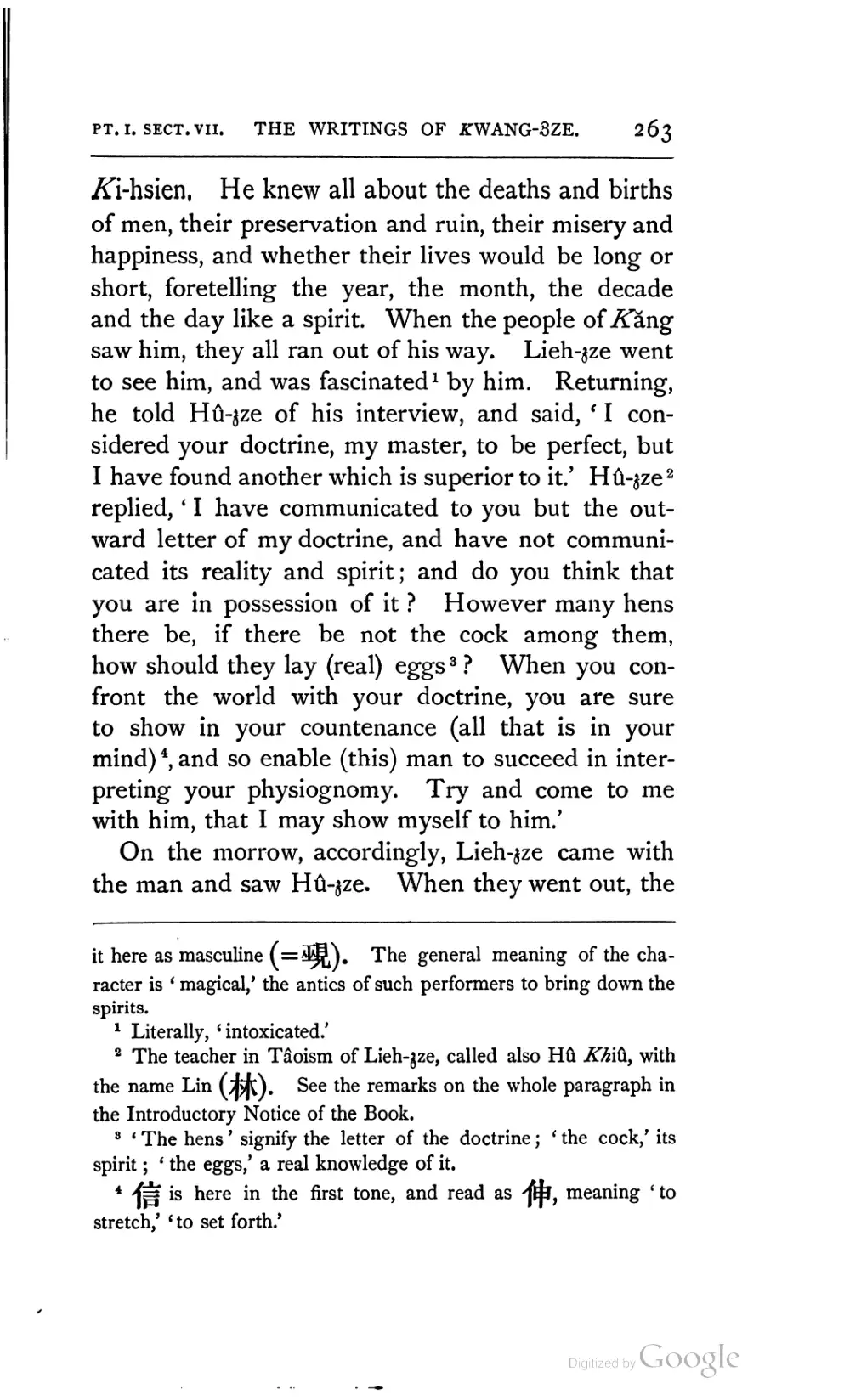
Legge decodes the hens as ‘the letter of the doctrine,’ the cock as ‘its spirit,’ and the eggs as real knowledge. The image condemns Lieh-ȝze before the test begins: his fascination with the wizard shows that he holds only the letter, and the letter, shown in his face, is what the physiognomist reads. Hû-ȝze answers not with argument but with demonstration, which is the only way the spirit of a doctrine could be shown.
The Tâo Teh King — Sacred Books of China Part I, SBE Vol. 39 (trans. James Legge, 1891)
Open to all
page 263
No image is selected for this page; its own page image is shown.
page 263
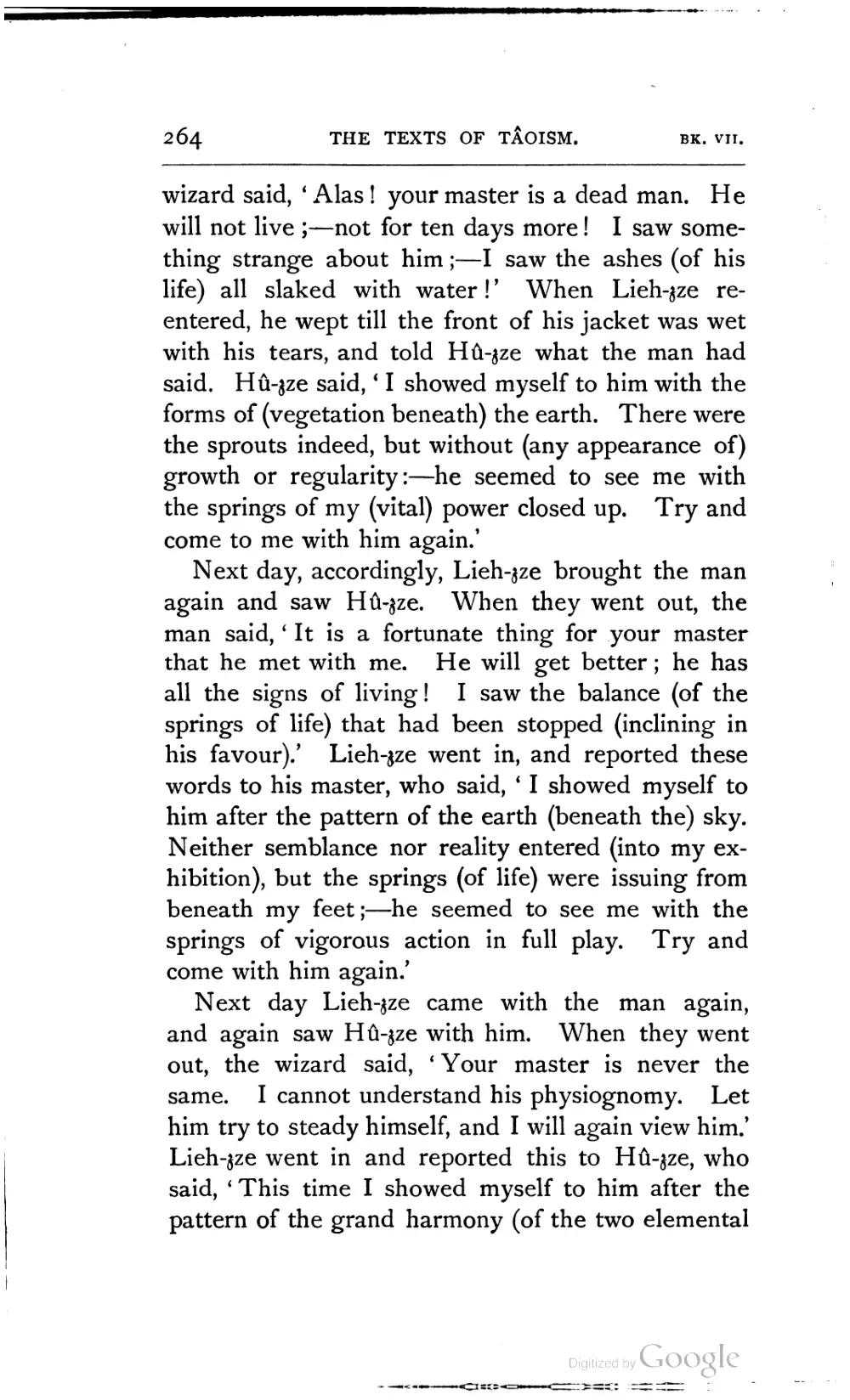
The next day, accordingly, Lieh-ȝze came with the man and saw Hû-ȝze. When they went out, the wizard said, ‘Alas! your master is a dead man. He will not live;—not for ten days more! I saw something strange about him;—I saw the ashes (of his life) all slaked with water!’ When Lieh-ȝze went back in, he wept till the front of his jacket was wet with his tears, and told Hû-ȝze what the man had said. Hû-ȝze said, ‘I showed myself to him with the forms of (vegetation beneath) the earth. There were the sprouts indeed, but without (any appearance of) growth or regularity:—he seemed to see me with the springs of my (vital) power closed up. Try and come to me with him again.’
1 Literally ‘intoxicated.’
2 Lieh-ȝze’s teacher in Taoism, also called Hû Khiû, with the name Lin (林 [Press: Lin, ‘forest’ (a name)]). See the remarks on the whole paragraph in the Introductory Notice of the Book.
8 ‘The hens’ signify the letter of the doctrine; ‘the cock,’ its spirit; ‘the eggs,’ a real knowledge of it.
4 信 is here in the first tone, and is read as 伸, meaning ‘to stretch,’ ‘to set forth.’