Legge identifies Yang Ȝze-kü with the Yang Kû ‘whom Mencius attacked so fiercely’ and suggests he was ‘perhaps a contemporary and disciple of Lâo-ȝze.’ The second suggestion lets the scene set the chronology. Mencius attacked Yang’s teaching as a living rival, and the author’s habit of staging meetings with Lao Tan is no evidence that they took place. The interview is better read as a known name used to test the ideal of the clever, diligent ruler.
The Tâo Teh King — Sacred Books of China Part I, SBE Vol. 39 (trans. James Legge, 1891)
Open to all
page 261
No image is selected for this page; its own page image is shown.
page 261
Happening to meet there the man whose name is not known, he put a question to him, saying, ‘I beg to ask what should be done in order to (carry on) the government of the world.’ The nameless man said, ‘Go away; you are a rude borderer. Why do you put to me a question for which you are unprepared? I would simply play the part of the Maker of (all) things*. When wearied, I would mount on the bird of the light and empty air, go beyond the six cardinal points, and wander in the region of nonentity, to dwell in the wilderness of desert space. What method have you, moreover, for the government of the world, that you (thus) agitate my mind?’ (Thien Kan), however, asked the question again, and the nameless man said, ‘Let your mind find its enjoyment in pure simplicity; blend yourself with (the primal) ether in idle indifference; allow all things to take their natural course; and admit no personal or selfish consideration: do this, and the world will be governed.’
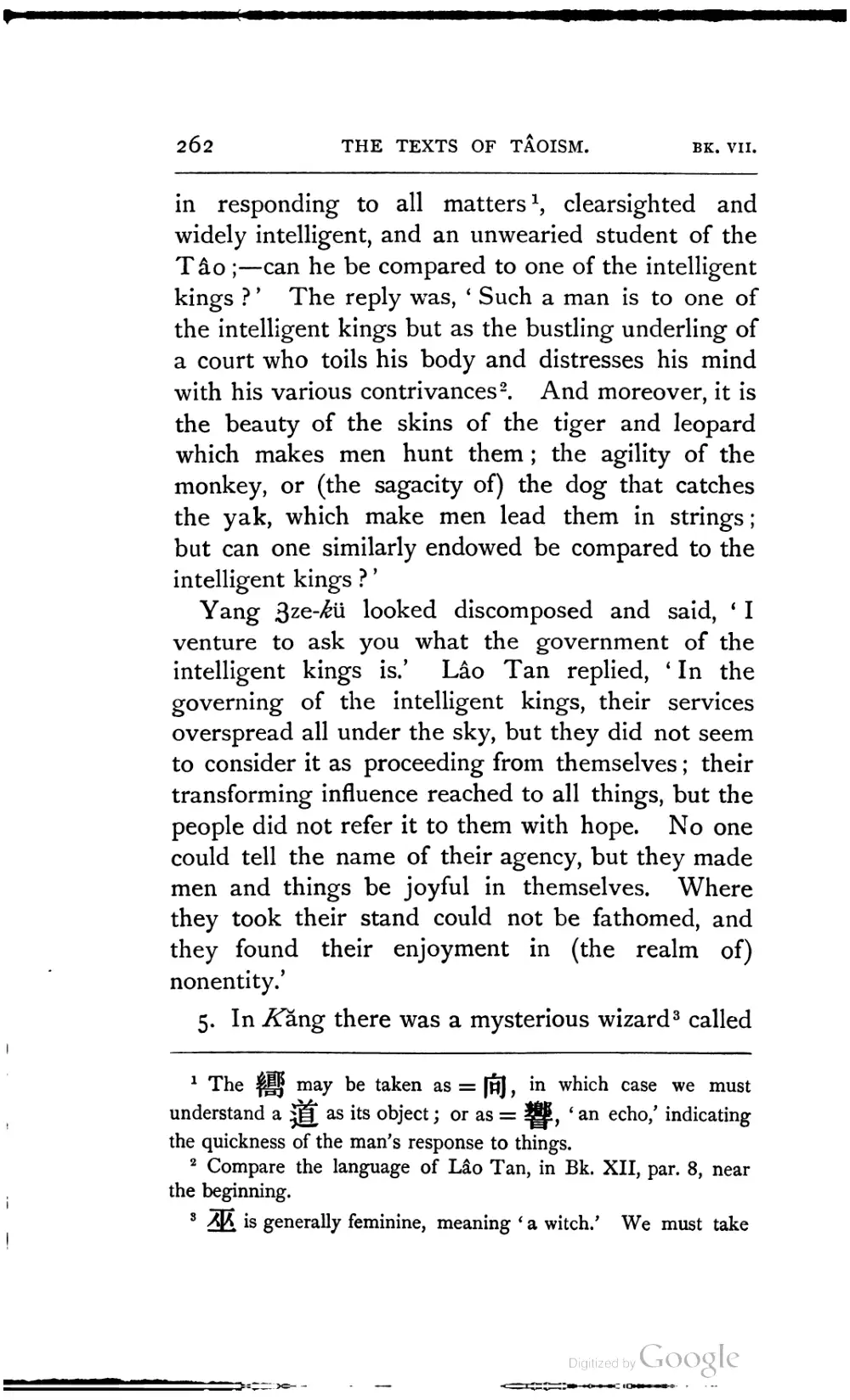
4. Yang Ȝze-kü⁵, having an interview with Lao Tan, said to him, ‘Here is a man, in responding to all matters1, clear-sighted and widely intelligent, and an unwearied student of the Tâo;—can he be compared to one of the intelligent kings?’ The reply was, ‘Such a man is to one of the intelligent kings only as the bustling underling of a court who toils his body and distresses his mind with his various contrivances2. And moreover, it is the beauty of the skins of the tiger and leopard that makes men hunt them; the agility of the monkey, or (the sagacity of) the dog that catches the yak, that makes men lead them on strings; but can one similarly endowed be compared to the intelligent kings?’
1 Or, ‘a nameless man.’ We cannot tell whether Kwang-ȝze had in view any particular Being so named or not.
2 The objectionable point in the question is the assumption that ‘doing’ was necessary in the case.
3 Or, ‘I am unprepared.’ But as Thien Kan repeats the question, it seems better to supply the second pronoun. He had thought about the subject.
4 See the same phraseology in VI, par. 11. What follows is simply our author’s way of describing the non-action of the Tao.
5 The Yang Kû whom Mencius attacked so fiercely. He was, perhaps, a contemporary and disciple of Lâo-ȝze.